

Existing law authorizes the governing board of any school district to levy a fee, charge, dedication, or other requirement against any construction within the boundaries of the district, as provided. Existing law, the Planning and Zoning Law, limits the amount of fees, charges, dedications, and other requirements levied or imposed by state and local agencies on the planning, use, or development of real property for the construction or reconstruction of school facilities based upon assessable space, as defined. Existing law exempts certain facilities from these charges, including any facility owned and occupied by a federal, state, or local entity. This bill would prohibit a school district from levying a fee, charge, dedication, or other requirement against the construction or operation of a college or university student housing facility, as defined. The bill would require the owner of the facility to pay the school impact mitigation fee for a unit of the facility if a child residing in that unit attends a school of the district. The bill would require the owner of a facility to record a covenant in favor of the school district requiring the owner to pay the school impact mitigation fee as provided, and submit a report to the school district each year disclosing each unit that houses a child attending a school of the district and the assessable area of each of those units. This bill would require a developer of a college or university student housing facility to notify the appropriate school districts of their intent to construct and operate a college or university student housing facility, as specified. The bill would require a developer that proposes to convert a college or university student housing facility to any other use to obtain the approval of the city or county that issued the original building permit after all school impact mitigation fees have been paid, as provided. By imposing additional duties on local agencies, this bill would impose a state-mandated local program. The California Constitution requires the state to reimburse local agencies and school districts for certain costs mandated by the state. Statutory provisions establish procedures for making that reimbursement. This bill would provide that no reimbursement is required by this act for a specified reason.
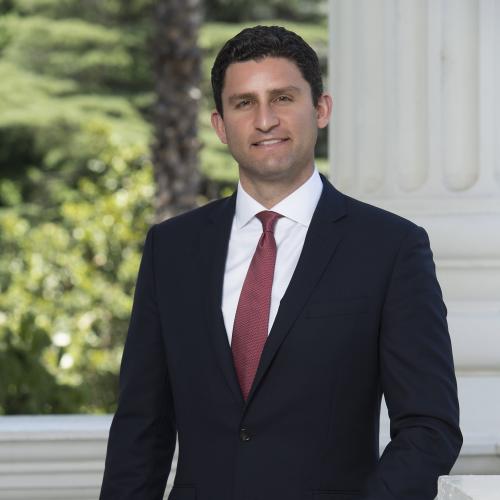
Asm. Jesse Gabriel
Sponsored bills
This measure would name the public street, circle, and plaza at 914 and 915 Capitol Mall in the City of Sacramento as the Willie L. Brown, Jr. Circle and Plaza. The measure would request the Department of General Services to determine the cost of erecting the appropriate signage commemorating this special designation and, upon receiving donations from nonstate sources, to cover that cost to erect that signage.
Existing law requires the Attorney General to establish and maintain an online database known as the Prohibited Armed Persons File, sometimes referred to as the Armed Prohibited Persons System, to cross-reference persons who have ownership or possession of a firearm on or after January 1, 1996, and who, subsequent to the date of that ownership or possession of a firearm, fall within a class of persons who are prohibited from owning or possessing a firearm. The Budget Act of 2019 appropriated $3,000,000 to the Counties of Alameda, San Diego, Santa Cruz, and Ventura to support local law enforcement activities related to seizing weapons and ammunition from persons who are prohibited from possessing them through a Gun Violence Reduction Pilot Program. This bill would require the Counties of Alameda, San Diego, Santa Cruz, and Ventura on or before 15 months after receiving these funds appropriated in the Budget Act of 2019, to submit a report to the Department of Justice and to the Legislature containing specified information relating to the efficacy of their programs.
Existing law establishes the Medi-Cal program, which is administered by the State Department of Health Care Services and under which qualified low-income individuals receive health care services. The Medi-Cal program is, in part, governed and funded by federal Medicaid program provisions. Existing law establishes a schedule of benefits under the Medi-Cal program, including various mental health services. Existing federal law authorizes, at the option of the state, preventive services, as defined, that are recommended by a physician or other licensed practitioner of the healing arts. This bill would require the department to establish, no later than January 1, 2021, a violence intervention pilot program at a minimum of 9 sites, including at least one site in 9 specified counties, and would require the department to consult with identified stakeholders, such as professionals in the community violence intervention field, for purposes of establishing the pilot program. The bill would require the department to provide violence preventive services that are rendered by a qualified violence prevention professional to a Medi-Cal beneficiary who meets identified criteria, including that the beneficiary has received medical treatment for a violent injury. The bill would require the department to approve one or more training and certification programs for violence prevention professionals, and would require an entity that employs or contracts with a qualified violence prevention professional to maintain specified documentation on, and to ensure compliance by, that professional. The bill would require the department to seek any federal approvals necessary to implement these requirements, and would condition the department's implementation of these provisions to the extent that federal financial participation is available and not otherwise jeopardized, and any necessary federal approvals have been obtained. The bill would make its provisions inoperative 5 calendar years following the date upon which violence preventive services are able to be provided and billed pursuant to the bill, as specified. The bill would require the department to issue, at least one calendar year prior to the inoperative date, a report to the Legislature on the implementation of the violence intervention pilot program, and the demonstrated impact of violence preventive services.
Existing law requires public and private postsecondary educational institutions and private vocational educational institutions to each adopt, and implement at each of their respective campuses or other facilities, a written procedure or protocols to ensure, to the fullest extent possible, that students, faculty, and staff who are victims of sexual assault receive treatment and information, as provided. Existing law requires the governing board of each community college district, the Trustees of the California State University, the Regents of the University of California, and the governing boards of independent postsecondary institutions, in order to receive state funds for student financial assistance, to adopt a policy concerning sexual assault, domestic violence, dating violence, and stalking involving a student both on and off campus. Existing law requires a public school, including a charter school, or a private school, that serves pupils in any of grades 7 to 12, inclusive, and that issues pupil identification cards to have printed on either side of the pupil identification cards the telephone number for the National Suicide Prevention Lifeline, and authorizes those schools to have printed on either side of the pupil identification cards the Crisis Text Line and a local suicide prevention hotline telephone number. Existing law requires a public or private institution of higher education that issues student identification cards to have printed on either side of the student identification cards the telephone number for the National Suicide Prevention Lifeline, and authorizes the institution to have printed on either side of the student identification cards the Crisis Text Line, the campus police or security telephone number, or the local nonemergency telephone number, as provided, and a local suicide prevention hotline telephone number. This bill would require public schools, including charter schools, if they issue pupil identification cards, to have printed on either side of those identification cards the telephone numbers for the National Sexual Assault Hotline and a local resource that provides sexual and reproductive health care information that meets certain requirements. The bill would require a private school, if it issues pupil identification cards, to have printed on either side of those identification cards the telephone number for the National Sexual Assault Hotline. The bill would require public and private institutions of higher education, if they issue student identification cards, to have printed on either side of those identification cards the telephone number for a local sexual assault hotline or the National Sexual Assault Hotline. The bill would additionally require public and nonsectarian private institutions of higher education, if they issue student identification cards, to have printed on those identification cards the telephone number for a local resource that provides sexual and reproductive health care information that is medically accurate. The bill would make these provisions operative on July 1, 2020. The bill would authorize schools and institutions subject to these requirements that have a supply of unissued, noncompliant identification cards as of January 1, 2020, to issue the noncompliant identification cards until that supply is depleted.
The California Constitution generally limits ad valorem taxes on real property to 1% of the full cash value of that property. For purposes of this limitation, "full cash value" is defined as the assessor's valuation of real property as shown on the 1975–76 tax bill under "full cash value" or, thereafter, the appraised value of that real property when purchased, newly constructed, or a change in ownership has occurred. Existing law defines "newly constructed" and "new construction" to mean any addition to real property since the last lien date and any alteration of land or of any improvement since the last lien date that constitutes a major rehabilitation thereof or that converts the property to a different use. Existing law, where real property has been damaged or destroyed by misfortune or calamity, excludes from the definition of "newly constructed" and "new construction" any timely reconstruction of the real property, or portion thereof, where the property after reconstruction is substantially equivalent to the property prior to damage or destruction. This bill would define the term "substantially equivalent" for purposes of the provisions described above to mean the size of the improvement after reconstruction does not exceed 120% of the size of the improvement prior to damage or destruction or the full cash value of the improvement after reconstruction does not exceed 120% of the full cash value of the improvement prior to damage or destruction. The bill would apply this definition to real property damaged or destroyed by misfortune or calamity on or after January 1, 2017. By imposing new duties upon local government officials, this bill would impose a state-mandated local program. This bill would make legislative findings and declarations regarding the public purpose served by the bill. The California Constitution requires the state to reimburse local agencies and school districts for certain costs mandated by the state. Statutory provisions establish procedures for making that reimbursement. This bill would provide that, if the Commission on State Mandates determines that the bill contains costs mandated by the state, reimbursement for those costs shall be made pursuant to the statutory provisions noted above. Existing law requires the state to reimburse local agencies annually for certain property tax revenues lost as a result of any exemption or classification of property for purposes of ad valorem property taxation. This bill would provide that, notwithstanding those provisions, no appropriation is made and the state shall not reimburse local agencies for property tax revenues lost by them pursuant to the bill.
Existing law generally requires firearms transactions to be processed through a licensed firearms dealer. Existing law generally requires firearms transactions that are exempt from the dealer requirement to be reported to the Department of Justice, either by mail or in person, or in a format prescribed by the department. This bill would, for various firearm transactions, as specified, instead allow the report to be made only by mail or via the California Firearms Application Reporting System (CFARS) , and would, for reports submitted by mail, allow the Department of Justice to charge the person making the report a surcharge, not to exceed $20, for the reasonable cost of receiving and processing the report. Existing law allows the Department of Justice to charge a specific fee sufficient to reimburse it for the actual processing costs associated with the submission of a Dealers' Record of Sale to the department. This bill would delete that authority. This bill would incorporate additional changes to Section 27920 of the Penal Code proposed by AB 1292 to be operative only if this bill and AB 1292 are enacted and this bill is enacted last. This bill would incorporate additional changes to Section 27966 of the Penal Code proposed by SB 376 to be operative only if this bill and SB 376 are enacted and this bill is enacted last. This bill would incorporate additional changes to Section 28230 of the Penal Code proposed by SB 376 to be operative only if this bill and SB 376 are enacted and this bill is enacted last.
This measure would recognize September 2020 as Sickle Cell Disease Awareness Month and encourage the Legislature to appropriate funds for research, treatment, and monitoring of sickle cell disease, and for related education and outreach.