

Existing law authorizes a peace officer to use reasonable force to effect the arrest, to prevent escape, or to overcome resistance. Existing law requires law enforcement agencies to maintain a policy on the use of force, as specified. Existing law requires the Commission on Peace Officer Standards and Training to implement courses of instruction for the regular and periodic training of law enforcement officers in the use of force. This bill would prohibit the use of kinetic energy projectiles or chemical agents, as defined, by any law enforcement agency to disperse any assembly, protest, demonstration, or other gathering of persons, except in compliance with specified standards set by the bill, and would prohibit their use solely due to a violation of an imposed curfew, verbal threat, or noncompliance with a law enforcement directive. The bill would prohibit the use of chloroacetophenone tear gas or 2-chlorobenzalmalononitrile gas by law enforcement agencies to disperse any assembly, protest, demonstration, or other gathering of persons. The bill would include in the standards for the use of kinetic energy projectiles and chemical agents to disperse gatherings the requirement that, among other things, those weapons only be fired at a specific target who presents a clear and imminent threat to themselves, the officers, or other persons. The bill would make these provisions inapplicable within a state prison facility. Existing law requires specified law enforcement agencies, by no later than January 1, 2021, to maintain a policy on the use of force that meets specified requirements. This bill would require those agencies, by no later than January 1, 2022, to include in those policies specified guidelines relating to deployment at assemblies, protests, demonstrations, and similar gatherings of people. Existing law requires each law enforcement agency to annually report specified use of force incidents to the Department of Justice and requires the Department of Justice to annually publish a summary of those incidents, as specified. The bill would also require each law enforcement agency, beginning on January 1, 2023, to report any incident in which a kinetic energy projectile or chemical agent is used against a person resulting in a reported injury. The bill would require those agencies, commencing on March 31, 2024, to annually publish a report on their use of kinetic energy projectiles and chemical agents. The bill would require a city in which federal law enforcement is operating to request that the federal law enforcement agency refrain from the use of kinetic energy projectiles or chemical agents to disperse any assembly, protest, demonstration, or other gathering, except as specified in the standards. By imposing new duties on law enforcement agencies and cities, this bill would create a state-mandated local program. The California Constitution requires the state to reimburse local agencies and school districts for certain costs mandated by the state. Statutory provisions establish procedures for making that reimbursement. This bill would provide that, if the Commission on State Mandates determines that the bill contains costs mandated by the state, reimbursement for those costs shall be made pursuant to the statutory provisions noted above.
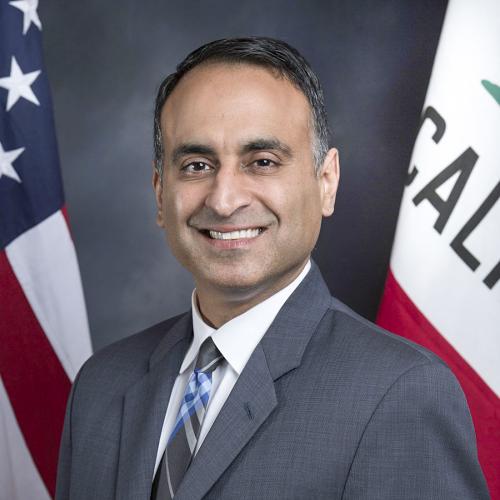
Asm. Ash Kalra
Sponsored bills
Existing provisions of the California Constitution establish the University of California as a public trust under the administration of the Regents of the University of California. The California Constitution grants to the regents all the powers necessary or convenient for the effective administration of this public trust. Pursuant to the California Constitution, there are 7 ex officio members of the regents and 18 appointive members appointed by the Governor and approved by the Senate, a majority of the membership concurring. This measure would enact the University of California Equal Employment Opportunity Standards Act, which would, effective January 1, 2021, except as specified, require the regents to ensure that all contract workers, as defined, who are paid to perform support services for students, faculty, patients, or the general public at any campus, dining hall, medical center, clinic, research facility, laboratory, or other university location, are at all times subject to and afforded the same equal employment opportunity standards, as defined, as university employees performing similar services. The measure would authorize the regents, or any campus or other entity of the University of California, to contract for, or otherwise arrange to use, contract labor, as defined, to perform support services only under specified conditions, only if authorized to do so by statute, and only to the extent necessary to address one or more of prescribed needs. The measure would authorize the Legislature to enact statutes to further the purposes of, and to aid the enforcement of, this measure.
This measure would urge each bank with which the State of California has a business relationship to evaluate its commercial relationship with gun manufacturers and to consider the repercussions of that relationship, and urge all banks to discuss their lending practices with their shareholders and to adopt lending practices that mirror the people of California's values of protecting citizens before profit.
(1) The California Integrated Waste Management Act of 1989, administered by the Department of Resources Recycling and Recovery, generally regulates the disposal, management, and recycling of solid waste, including, among other solid waste, single-use plastic straws. The Sustainable Packaging for the State of California Act of 2018 prohibits a food service facility located in a state-owned facility, operating on or acting as a concessionaire on state property, or under contract to provide food service to a state agency from dispensing prepared food using a type of food service packaging unless the type of food service packaging is on a list that the department publishes and maintains on its internet website that contains types of approved food service packaging that are reusable, recyclable, or compostable. Existing law makes a legislative declaration that it is the policy goal of the state that not less than 75% of solid waste generated be source reduced, recycled, or composted by 2020. This bill would enact the California Circular Economy and Plastic Pollution Reduction Act, which would impose a comprehensive regulatory scheme on producers, retailers, and wholesalers of single-use packaging, as defined, and priority single-use products, as defined, made partially or entirely of plastic, to be administered by the department. As part of that regulatory scheme, the bill would require producers, as defined, (A) to source reduce, to the maximum extent feasible, single-use packaging and priority single-use products, and (B) to ensure that all single-use packaging and priority single-use products that are manufactured on or after January 1, 2032, and that are offered for sale, sold, distributed, or imported in or into the state are recyclable or compostable. The bill would require the department to achieve and maintain, by January 1, 2032, a statewide 75% reduction of the waste generated from single-use packaging and priority single-use products offered for sale, sold, distributed, or imported in or into the state through source reduction, recycling, or composting. The bill would require the department, by January 1, 2025, to adopt regulations to implement the act and, before adopting the regulations, to conduct extensive outreach, as prescribed, and to identify and evaluate specified provisions for potential inclusion in the regulations. The bill would require the department to establish a Circular Economy and Waste Pollution Reduction Panel for the purpose of identifying barriers and solutions to creating a circular economy consistent with the act. The regulatory scheme would include, among other requirements, registration, reporting, and recordkeeping requirements. The bill would require reports and data provided to the department pursuant to the act to be accurate and attested to under penalty of perjury, thereby imposing a state-mandated local program by expanding the crime of perjury. The bill would prohibit a retailer or wholesaler, as defined, from offering for sale or selling single-use packaging, products packaged in single-use packaging, or priority single-use products if the producer of the single-use packaging or priority single-use product is listed as noncompliant for that packaging or product category on the department's internet website on a list that the bill would require the department to post, as specified. The bill would prohibit certain online marketplaces, upon notification from the department, from allowing on the online marketplaces the offering for sale, sale, or distribution into the state of single-use packaging, a product packaged in single-use packaging, or a priority single-use product if the product or packaging is identified as noncompliant with the act in the notice provided by the department. The bill would require the department to develop criteria to determine whether the packaging or priority single-use products are reusable, recyclable, or compostable. The bill would authorize local governments, solid waste facilities, recycling facilities, and composting facilities to provide information requested by the department for purposes of developing that criteria. The bill would require single-use packaging and priority single-use products offered for sale, sold, distributed, or imported in or into the state by a producer to meet specified recycling rates that are based on date of manufacture and that increase over a prescribed timeframe, and would authorize the department to impose a higher or lower recycling rate for packaging or product categories, as specified. The bill would require the department to establish and post on its internet website a list of packaging and product categories, and current recycling rates being achieved in the state for those packaging and product categories, as specified. The bill would require the department to adopt regulations containing specified provisions authorizing the establishment of a stewardship program. The bill would authorize producers to collectively form one or more stewardship organizations that adopt a stewardship plan as an alternative to individually complying with the above-referenced comprehensive regulatory scheme. The bill would require the department to establish, and a producer to remit to the California Department of Tax and Fee Administration, the California circular economy regulatory fee. The bill would require the department to set the amount of the regulatory fee at no more than is necessary to cover the reasonable regulatory costs of the above-referenced comprehensive regulatory scheme and stewardship program, and would authorize a stewardship organization to pay the regulatory fee on behalf of its member producers, as specified. The bill would require the California Department of Tax and Fee Administration to collect the regulatory fee in accordance with the Fee Collection Procedures Law, as prescribed. The bill would require the regulatory fees to be deposited into the California Circular Economy Fund, which the bill would create. The bill would provide that moneys in the fund shall be available upon appropriation by the Legislature to the department to fund the regulatory activities of the act and to the California Department of Tax and Fee Administration for expenses incurred in the collection of the regulatory fee. The bill would require the department to report to the Legislature every 2 years its progress in implementing the act. The bill would provide for exceptions to, and enforcement of, the act, including authorizing the department to impose an administrative civil penalty in an amount not to exceed $50,000 per day per violation, except as specified, on an entity that is not in compliance with the act's requirements. The bill would require the department to deposit collected penalties into the Circular Economy Penalty Account, which the bill would create. The bill would provide that moneys in the account shall be available upon appropriation by the Legislature for purposes that further the act. (2) The California Integrated Waste Management Act of 1989 requires each city and county, and each regional agency formed pursuant to the act, to develop a source reduction and recycling element of an integrated waste management plan to divert 50% of all solid waste, through source reduction, recycling, and composting activities. This bill would prohibit a city, county, city and county, or other local public agency from requiring a grocery store, as defined, to use a certain type of food packaging for any food sold in the grocery store unless the majority of residential households within the jurisdiction of the local agency have access to a curbside program, as defined, that accepts the material from which that food packaging is made. The bill would also prohibit those local agencies from requiring a grocery store to use a food packaging container that does not meet specified criteria. The bill would repeal these provisions as of January 1, 2032. (3) The Alcoholic Beverage Control Act, administered by the Department of Alcoholic Beverage Control, regulates the granting of licenses for the manufacture, distribution, and sale of alcoholic beverages within the state. The act requires an out-of-state vendor shipping beer into the state to hold a certificate of compliance granted by the department, as prescribed. The act authorizes the department to suspend or revoke the certificate of compliance, as specified, if an out-of-state vendor, after obtaining the certificate, fails to submit a certain monthly report or fails to comply with a particular provision of the California Beverage Container Recycling and Litter Reduction Act. This bill would authorize the department to suspend or revoke the certificate of compliance of an out-of-state vendor that fails to comply with the California Circular Economy and Plastic Pollution Reduction Act. (4) Existing constitutional provisions require that a statute that limits the right of access to the meetings of public bodies or the writings of public officials and agencies be adopted with findings demonstrating the interest protected by the limitation and the need for protecting that interest. This bill would make legislative findings to that effect. (5) The California Constitution requires the state to reimburse local agencies and school districts for certain costs mandated by the state. Statutory provisions establish procedures for making that reimbursement. This bill would provide that no reimbursement is required by this act for a specified reason.
Existing law establishes a workers' compensation system, administered by the Administrative Director of the Division of Workers' Compensation, to compensate an employee for injuries sustained in the course of employment. Existing law creates a disputable presumption that specified injuries sustained in the course of employment of a specified member of law enforcement or a specified first responder arose out of and in the course of employment. Existing law allows for a claim to be presumed compensable if it has not been rejected within 90 days of filing, as specified. Existing law imposes a duty on an employer to provide certain safety materials and adopt safety practices as necessary. A failure to meet this duty, under specified circumstances, is a misdemeanor. This bill would, until July 1, 2024, define "injury," for certain state and local firefighting personnel, peace officers, certain correctional and law enforcement personnel, as described, certain health care employees who provide direct patient care at an acute care hospital, and certain fire and rescue services coordinators who work for the Office of Emergency Services to include illness or death resulting from COVID-19, that is diagnosed on or after January 1, 2020, if certain circumstances apply. The bill would create a disputable presumption, as specified, that the injury arose out of and in the course of the employment. The bill would require a claim to be presumed compensable, if not rejected within 30 days, as specified. This bill would explicitly add emergency equipment or personal protective equipment, as described, to those materials required to be provided by an employer. A failure to comply with this additional requirement would not constitute a misdemeanor. This bill would declare that it is to take effect immediately as an urgency statute.
Existing law relating to employment regulation and supervision imposes special provisions on certain occupations and industries. Existing law charges the Labor Commissioner and the Division of Labor Standards Enforcement with the enforcement of labor laws. This bill would enact prescribed protections for certain warehouse and distribution center employees. The bill would prohibit an employer from imposing a quota upon an employee under which reasonable amounts of time that the employee spends on any of the specified activities is counted toward the time required for completing the quota, or results in the employee having less time to complete the quota. The bill would define terms for its purposes. This bill, except as specified, would require the Division of Labor Standards Enforcement to enforce its provisions. The bill would require the Labor Commissioner to investigate alleged violations of these provisions and order appropriate temporary measures pending the completion of a full investigation or hearing. The bill would also authorize the Labor Commissioner to order appropriate relief for employees or other persons whose rights were violated and take appropriate enforcement actions, including imposing civil penalties, against employers, as provided. The bill would authorize the commissioner to adopt regulations to implement its provisions. This bill would subject an employer who violates the quota prohibition to civil penalties.
Existing law prescribes various requirements to be satisfied before the exercise of a power of sale under a mortgage or deed of trust. Existing law requires that a notice of default and a notice of sale be recorded and that specified periods of time elapse between the recording and the sale. Existing law establishes certain requirements in connection with foreclosures on mortgages and deeds of trust, including restrictions on the actions mortgage servicers may take while a borrower is attempting to secure a loan modification or has submitted a loan modification application. Existing law applies certain of those requirements only to a first lien mortgage or deed of trust that is secured by owner-occupied residential real property containing no more than four dwelling units. This bill, the Tenant, Homeowner, and Small Landlord Relief and Stabilization Act of 2020, would, among other things, until January 1, 2023, additionally apply those protections to a first lien mortgage or deed of trust that is secured by residential real property that is occupied by a tenant, contains no more than four dwelling units, and meets certain criteria, including that a tenant occupying the property is unable to pay rent due to a reduction in income resulting from the novel coronavirus. The bill would also enact the COVID-19 Small Landlord and Homeowner Relief Act of 2020 (Homeowner Act) , which would require a mortgage servicer, as defined, to provide a specified written notice to a borrower, as defined, if the mortgage servicer denies forbearance during the effective time period, as defined, that states the reasons for that denial if the borrower was both current on payments as of February 1, 2020, and is experiencing a financial hardship that prevents the borrower from making timely payments on the mortgage obligation due, directly or indirectly, to the COVID-19 emergency. The Homeowner Act would also require a mortgage servicer to comply with applicable federal guidance regarding borrower options following a COVID-19 related forbearance. Existing law provides that a tenant is guilty of unlawful detainer if the tenant continues to possess the property without permission of the landlord after the tenant defaults on rent or fails to perform a condition or covenant of the lease under which the property is held, among other reasons. Existing law requires a tenant be served a 3 days' notice in writing to cure a default or perform a condition of the lease, or return possession of the property to the landlord, as specified. Existing law, the Mobilehome Residency Law, prohibits a tenancy from being terminated unless specified conditions are met, including that the tenant fails to pay rent, utility charges, or reasonable incidental service charges, and 3 days' notice in writing is provided to the tenant, as specified. This bill would, until February 1, 2025, enact the COVID-19 Tenant Relief Act of 2020 (Tenant Act) . The Tenant Act would require that any 3 days' notice that demands payment of COVID-19 rental debt that is served on a tenant during the covered time period meet specified criteria, including that the notice include an unsigned copy of a declaration of COVID-19-related financial distress and that the notice advise the tenant that the tenant will not be evicted for failure to comply with the notice if the tenant delivers a signed declaration of COVID-19-related financial distress to the landlord, as specified. The Tenant Act would define "covered time period" for purposes of these provisions to mean the time between March 1, 2020, and January 31, 2021. The Tenant Act would deem a 3 days' notice that fails to comply with this criteria void and insufficient to support a judgment for unlawful detainer or to terminate a tenancy under the Mobilehome Residency Law. The Tenant Act would prohibit a tenant that delivers a declaration, under penalty of perjury, of COVID-19-related financial distress pursuant to these provisions from being deemed in default with regard to the COVID-19 rental debt, as specified. By expanding the crime of perjury, this bill would create a state-mandated local program. The Tenant Act would prohibit a court from finding a tenant guilty of an unlawful detainer before February 1, 2021, subject to certain exceptions, including if the tenant was guilty of the unlawful detainer before March 1, 2020. The bill would prohibit, before October 5, 2020, a court from taking specified actions with respect to unlawful detainer actions, including issuing a summons on a complaint for unlawful detainer in any action that seeks possession of residential real property and that is based, in whole or in part, on nonpayment of rent or other charges. The Tenant Act would also authorize a landlord to require a high-income tenant, as defined, to additionally submit documentation supporting the claim that the tenant has suffered COVID-19-related financial distress if the landlord has proof of income showing the tenant is a high-income tenant. The Tenant Act would preempt an ordinance, resolution, regulation, or administrative action adopted by a city, county, or city and county in response to the COVID-19 pandemic to protect tenants from eviction based on nonpayment of rental payments, as specified. The bill would require the Business, Consumer Services and Housing Agency to, in consultation with the Department of Finance, engage with residential tenants, landlords, property owners, deed-restricted affordable housing providers, and financial sector stakeholders about strategies and approaches to direct potential future federal stimulus funding to most effectively and efficiently provide relief to distressed tenants, landlords, and property owners, as specified. Existing law prohibits a landlord from taking specified actions with intent to terminate the occupancy under any lease or other tenancy or estate at will, however created, of property used by a tenant as the tenant's residence. Existing law makes a violator of those provisions subject to certain damages in a civil action. This bill would, until February 1, 2021, make a violator of those provisions whose tenant has provided to that violator the declaration of COVID-19-related financial distress described above liable for damages in an amount between $1,000 and $2,500. Existing law, The Small Claims Act, grants jurisdiction to a small claims court in cases where the amount demanded does not exceed $5,000, as specified, and prohibits a person from filing more than 2 small claims actions in which the amount demanded exceeds $2,500 anywhere in the state in any calendar year. This bill would instead, until February 1, 2025, provide that a small claims court has jurisdiction in any action for recovery of COVID-19 rental debt, as defined, regardless of the amount demanded and would provide that a claim for recovery of a COVID-19 rental debt is exempt from the prohibition on filing more than 2 small claims actions described above. Existing law, the Tenant Protection Act of 2019, prohibits, with certain exceptions, an owner of residential real property from increasing the gross rental rate for a dwelling or unit more than 5% plus the "percentage change in the cost of living," as defined, or 10%, whichever is lower, of the lowest gross rental rate charged for the immediately preceding 12 months, subject to specified conditions. The act exempts certain types of residential real properties, including dormitories constructed and maintained in connection with any higher education institution within the state for use and occupancy by students in attendance at the institution and housing that has been issued a certificate of occupancy within the previous 15 years. This bill would revise and recast those exemptions to exempt dormitories owned and operated by an institution of higher education or a kindergarten and grades 1 to 12, inclusive, school. The bill would also make clarifying changes to the definition of "percentage change in the cost of living." This bill would also make clarifying and conforming changes. The bill would include findings that changes proposed by this bill address a matter of statewide concern rather than a municipal affair and, therefore, apply to all cities, including charter cities. The California Constitution requires the state to reimburse local agencies and school districts for certain costs mandated by the state. Statutory provisions establish procedures for making that reimbursement. This bill would provide that no reimbursement is required by this act for a specified reason. This bill would declare that it is to take effect immediately as an urgency statute.
Existing law governs the admissibility of evidence in court proceedings and generally provides a privilege as to communications made in the course of certain relations, including the attorney-client, physician-patient, and psychotherapist-patient relationship, as specified. Under existing law, the right of any person to claim those evidentiary privileges is waived with respect to a communication protected by the privilege if any holder of the privilege, without coercion, has disclosed a significant part of the communication or has consented to a disclosure. This bill would establish a privilege between a union agent, as defined, and a represented employee or represented former employee to refuse to disclose any confidential communication between the employee or former employee and the union agent made while the union agent was acting in the union agent's representative capacity, except as specified. The bill would permit a represented employee or represented former employee to prevent another person from disclosing a privileged communication, except as specified. The bill would further provide that this privilege may be waived in accordance with existing law and does not apply in criminal proceedings.
Existing law, the Stop Tobacco Access to Kids Enforcement (STAKE) Act, prohibits a person from selling or otherwise furnishing tobacco products, as defined, to a person under 21 years of age. Existing law also prohibits the use of tobacco products in county offices of education, on charter school or school district property, or near a playground or youth sports event, as specified. This bill would prohibit a tobacco retailer, or any of the tobacco retailer's agents or employees, from selling, offering for sale, or possessing with the intent to sell or offer for sale, a flavored tobacco product or a tobacco product flavor enhancer, as those terms are defined, except as specified. The bill would make a violation of this prohibition an infraction punishable by a fine of $250 for each violation. The bill would state the intent of the Legislature that these provisions do not preempt or prohibit the adoption and implementation of local ordinances that impose greater restrictions on the access to tobacco products than the restrictions imposed by the bill, as specified. The bill would state that its provisions are severable. By creating a new crime, the bill would impose a state-mandated local program. The California Constitution requires the state to reimburse local agencies and school districts for certain costs mandated by the state. Statutory provisions establish procedures for making that reimbursement. This bill would provide that no reimbursement is required by this act for a specified reason.