

The California Global Warming Solutions Act of 2006 designates the State Air Resources Board as the state agency charged with monitoring and regulating sources of emissions of greenhouse gases. Existing law creates the Air Quality Improvement Program, administered by the state board, for the purpose of funding, upon appropriation by the Legislature, air quality improvement projects relating to zero-emission fuel and vehicle technologies. Existing law limits the program to competitive grants, revolving loans, loan guarantees, loans, and other appropriate funding measures that further the purposes of the program, including for projects that provide mitigation for off-road gasoline exhaust and evaporative emissions. As part of the program, the state board administers the Clean Off-Road Equipment Voucher Incentive Project (CORE) to provide vouchers that offset the cost of zero-emission off-road equipment, including agricultural equipment. This bill would require the state board to include unmanned aerial systems, commonly known as drones, in the meaning of agricultural equipment for purposes of CORE, which the bill would define as the program established by the state board as part of the Air Quality Improvement Program, as provided.
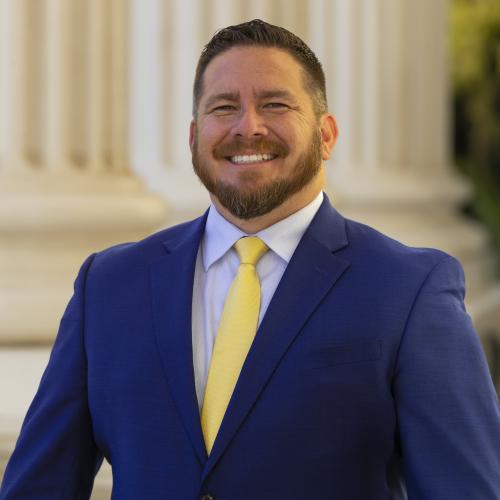
Asm. Juan Alanis
Sponsored bills
Existing law, as amended by the Safe Neighborhoods and Schools Act, enacted as an initiative statute by Proposition 47, as approved by voters at the November 4, 2014, statewide general election, makes it a crime to buy, receive, conceal, sell, or withhold any property that has been stolen or that has been obtained in any manner constituting theft or extortion, knowing that the property has been so obtained. Under existing law, this offense is punishable as either a misdemeanor or a felony, unless the value of the property does not exceed $950, in which case an offense is punishable as a misdemeanor. Existing law establishes the Board of State and Community Corrections to provide statewide leadership, coordination, and technical assistance to promote effective state and local efforts and partnerships in California's adult and juvenile criminal justice system, as specified. Under existing law, the board administers several grant programs, including a mentally ill offender crime reduction grant program, a medication-assisted treatment grant program, and a violence intervention and prevention grant program. This bill would, until January 1, 2030, create the Identifying, Apprehending, and Prosecuting Resale of Stolen Property Grant Program to be administered by the board. The bill would require the board to award grants, on a competitive basis, to county district attorneys' offices and law enforcement agencies, acting jointly to investigate and prosecute receiving stolen goods crimes and criminal profiteering. The bill would require the board to prepare and submit a report to the Legislature, as specified, regarding the impact of the grant program. The bill's provisions would be operative only to the extent that funding is provided, by express reference, in the annual Budget Act or another statute.
Existing law defines "disabled veteran" for purposes of the Vehicle Code as, among other things, a person who, as a result of injury or disease suffered while on active service with the Armed Forces of the United States, has a disability that has been rated at 100% by the Department of Veterans Affairs. Existing law also defines a "disabled veteran" as a veteran who is unable to move without the aid of an assistant device. This bill would instead define a disabled veteran as a veteran who cannot walk without the use of an assistant device. The bill would expand the definition of "disabled veteran" to include a veteran who cannot walk 200 feet without stopping to rest, a veteran who is severely limited in the ability to walk because of an arthritic, neurological, or orthopedic condition, or a veteran who has visual acuity of 20/200 or less, among other conditions, as specified.
Existing law makes it a misdemeanor to report an emergency to specified government entities knowing that report to be false. Existing law makes it a misdemeanor to initiate communication with the 911 emergency system with the intent to annoy or harass another person. This bill would make a second or subsequent violation of these provisions punishable as a misdemeanor or felony for a person who is 18 years of age or older. By increasing the penalty for existing crimes, this bill would impose a state-mandated local program. The California Constitution requires the state to reimburse local agencies and school districts for certain costs mandated by the state. Statutory provisions establish procedures for making that reimbursement. This bill would provide that no reimbursement is required by this act for a specified reason.
(1) Existing law, the Ortiz-Pacheco-Poochigian-Vasconcellos Cal Grant Program, establishes the Cal Grant A and B Entitlement awards, the California Community College Expanded Entitlement awards, the California Community College Transfer Entitlement awards, the Competitive Cal Grant A and B awards, the Cal Grant C awards, and the Cal Grant T awards under the administration of the Student Aid Commission, and establishes eligibility requirements for these awards for participating students attending qualifying institutions. Existing law requires a Cal Grant C award to be used only for occupational or technical training in a course of not less than 4 months. Existing law requires the maximum per-student Cal Grant C award amount to be determined each year in the annual Budget Act. This bill, upon appropriation in the annual Budget Act for this purpose, would set, commencing with the 2025–26 award year, the maximum per-student Cal Grant C award amount at no less than double the maximum per-student Cal Grant C award amount provided for the 2023–24 award year. (2) Existing law, the Cal Grant Reform Act, revises and recasts the provisions establishing and governing the existing Cal Grant Program into a new Cal Grant Program. Existing law authorizes the commission to adopt emergency regulations to implement the Cal Grant Reform Act. Existing law requires the new Cal Grant Program to include a Cal Grant 2 Program with eligibility requirements, as specified. Existing law requires the Cal Grant 2 award to include an access award, covering nontuition expenses, of no less than the maximum per-student amount provided in the 2020–21 award year, as specified. Existing law requires, as a continuation of the Cal Grant C Program, an otherwise eligible student enrolled in a qualifying occupational and technical training program who would have been eligible for aid under the Cal Grant C Program, to be eligible to receive a prorated Cal Grant award as specified in the Budget Act. Existing law specifies that the act becomes operative only if General Fund moneys over the multiyear forecasts beginning in the 2024–25 fiscal year are available to support ongoing augmentations and actions, and if funding is provided in the annual Budget Act to implement the act. This bill would require the prorated Cal Grant award and the per-student Cal Grant 2 access award amounts to be no less than double the maximum award amounts provided for the 2023–24 award year.
Existing law establishes the Aid to Families with Dependent Children-Foster Care (AFDC-FC) program, under which counties provide payments to foster care providers on behalf of qualified children in foster care. Existing law establishes a schedule of basic rates to be paid for the care and supervision of each foster child. Existing law also establishes the Kinship Guardianship Assistance Payment Program (Kin-GAP) , which provides aid on behalf of eligible children who have a kinship guardianship, and the Approved Relative Caregiver Funding Program (ARC) , which provides payments to approved relative caregivers who are caring for children and nonminor dependents who are ineligible for AFDC-FC payments. Existing law requires, when a child is living with a parent who receives AFDC-FC or Kin-GAP benefits, or ARC payments, that the rate paid to the foster care provider on behalf of the parent include an additional amount, known as an infant supplement, for the care and supervision of the child. This bill would increase the infant supplement by $517.24 monthly, to be adjusted as specified for inflation and subject to an appropriation in the annual Budget Act. To the extent the bill would impose new requirements on counties administering the AFDC-FC or Kin-GAP benefits or ARC payments, this bill would impose a state-mandated local program. The California Constitution requires the state to reimburse local agencies and school districts for certain costs mandated by the state. Statutory provisions establish procedures for making that reimbursement. This bill would provide that no reimbursement is required by this act for a specified reason.
Existing law specifies the minimum requirements for a 5-year clear designated subjects career technical education teaching credential, which include, among other requirements, the possession of a valid 3-year preliminary designated subjects career technical education teaching credential and the completion of a program of personalized preparation as approved by the commission. Existing law establishes the Golden State Teacher Grant Program under the administration of the Student Aid Commission to award grants to students enrolled in professional preparation programs leading to a preliminary teaching credential or a pupil personnel services credential who commit to work for 4 years at a priority school or a preschool program, as provided. This bill would expand the program to also award grants to students enrolled in a program of personalized preparation leading to a 5-year clear designated subjects career technical education teaching credential who also commit to work for 4 years at a priority school. The bill would make conforming changes.
Existing law makes it a crime to solicit or encourage a minor to commit specified crimes relating to controlled substances, to hire or employ a minor to transport or sell controlled substances, or to sell or give controlled substances to minors and imposes a punishment of imprisonment for a period of 3, 6, or 9 years. Existing law makes a person who is 18 years of age or older who violates these provisions with respect to heroin, cocaine, or cocaine base on the grounds of, or within certain locations, such as a church, synagogue, or a public swimming pool, among others, or on the grounds of, or within 1,000 feet of, public or private schools, as specified, subject to punishment with an additional enhancement in the state prison of one or 2 years. This bill would make the above-described enhancement applicable to offenses involving fentanyl if the person had knowledge that the specific controlled substance involved was fentanyl. By increasing the penalties for a crime, this bill would create a state-mandated local program. The California Constitution requires the state to reimburse local agencies and school districts for certain costs mandated by the state. Statutory provisions establish procedures for making that reimbursement. This bill would provide that no reimbursement is required by this act for a specified reason.
Existing law makes theft a crime, and distinguishes between grand theft and petty theft. Existing law makes the theft of money, labor, or property petty theft punishable as a misdemeanor, whenever the value of the property taken does not exceed $950. Under existing law, if the value of the property taken exceeds $950, the theft is grand theft, punishable as a misdemeanor or a felony. Existing law makes a first conviction for petty theft involving merchandise taken from a merchant's premises punishable by a mandatory fine and as a misdemeanor. This bill would require the Department of Justice to determine the number of misdemeanor convictions for a crime of theft for which the property was taken from a retail establishment during the Governor's declared state of emergency related to the COVID-19 pandemic, and to report that information to the Legislature on or before January 1, 2026.
Existing federal law, the Victims of Crime Act of 1984, creates the Crime Victims Fund and authorizes federal financial assistance to states for the purpose of supporting eligible crime victim assistance programs. Existing law creates various programs under the Office of Emergency Services related to crime prevention and education, including, among other things, programs concerning family violence prevention and domestic violence prevention. This bill would require the office to allocate funds, upon appropriation by the Legislature, to fill the gap in the federal Victims of Crime Act funding and to prioritize continuity and stability of crime victim services if the federal grant funding that is awarded to the office is 10% or more lower than the amount awarded in the prior year. The bill would require the office to regularly consult, collaborate with, and consider the recommendations regarding allocation of funding from the Victims of Crime Act Steering Committee.