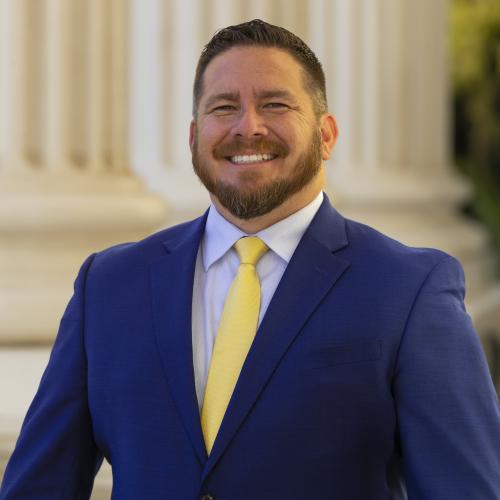
Maddy summaryThis bill is a House Resolution that formally recognizes May 27, 2024, as Memorial Day in California. It serves as a commemorative measure to honor the men and women who have died while serving in the U.S. Armed Forces. The resolution does not alter laws or create new programs but instead expresses the state's gratitude for the sacrifices made by military personnel.
Asm. Juan Alanis
Sponsored bills
Maddy summaryThis bill designates May 17, 2024, as Bike to School Day in California to encourage students to ride bicycles or electric bikes to their schools. The resolution highlights the environmental, health, and recreational benefits of cycling while acknowledging the state's existing bike-friendly infrastructure and recent cycling events. It serves as a commemorative measure rather than a law that changes regulations or funding, and it directs the Assembly's Chief Clerk to distribute copies of the text for public awareness.
The California Healthy Youth Act requires school districts, defined to include county boards of education, county superintendents of schools, the California School for the Deaf, the California School for the Blind, and charter schools, to ensure that all pupils in grades 7 to 12, inclusive, receive comprehensive sexual health education and human immunodeficiency virus (HIV) prevention education, as specified. The act authorizes a school district to provide that education earlier than grade 7 with age-appropriate and medically accurate information. The act requires each school district to notify parents and guardians of pupils about its plan to provide sexual health education and HIV prevention instruction for the upcoming school year and to inform them, among other things, that the written and audiovisual educational materials used in comprehensive sexual health education and HIV prevention education are available for inspection. This bill would require the governing board of a school district to adopt a policy at a publicly noticed meeting specifying how parents and guardians of pupils may inspect the written and audiovisual educational materials used in comprehensive sexual health education and HIV prevention education, including that the materials, including updates or changes to the materials, are made available, within prescribed timeframes, at each schoolsite and, except as provided, publicly posted on the school district's internet website or, if applicable, on a school district's parent or guardian portal, as specified. By imposing additional duties on local educational agencies, the bill would impose a state-mandated local program. The California Constitution requires the state to reimburse local agencies and school districts for certain costs mandated by the state. Statutory provisions establish procedures for making that reimbursement. This bill would provide that, if the Commission on State Mandates determines that the bill contains costs mandated by the state, reimbursement for those costs shall be made pursuant to the statutory provisions noted above.

Existing law authorizes the Attorney General or a district attorney to make an application, as specified, to a judge of a superior court, for an order authorizing the interception of wire or electronic communications. Existing law authorizes a judge, upon a finding of probable cause as that an individual is committing, has committed, or is about to commit offenses involving a substance containing fentanyl or its precursors or analogs that exceeds 10 gallons by liquid volume or 3 pounds of solid substance by weight, to issue an order authorizing the interception. This bill would reduce the above-described amounts for an order authorizing interception to 1.67 gallons by liquid volume and 8 ounces of solid substance by weight of a substance containing fentanyl or its precursors or analogs.
The Personal Income Tax Law, in modified conformity with federal law, generally defines "gross income" as income from whatever source derived, except as specifically excluded, and provides various exclusions from gross income for purposes of computing tax liability. Existing law requires any bill authorizing a new tax expenditure to contain, among other things, specific goals, purposes, and objectives that the tax expenditure will achieve, detailed performance indicators, and data collection requirements. This bill, for taxable years beginning on or after January 1, 2025, and before January 1, 2035, would provide an exclusion from gross income for survivor benefits or payments, not to exceed $20,000 per taxable year, received during the taxable year under the federal Survivor Benefit Plan. Existing law requires any bill authorizing a new tax expenditure to contain, among other things, specific goals that the tax expenditure will achieve, detailed performance indicators, and data collection requirements. This bill would include additional information required for any bill authorizing a new tax expenditure. This bill would take effect immediately as a tax levy.
Existing law requires the Department of General Services, beginning no later than the 2024–25 fiscal year, to ensure that at least 50% of the light-duty vehicles purchased for the state vehicle fleet each fiscal year are zero-emission vehicles, except as provided. This bill would require the department to require a supplier of zero-emission vehicles purchased for the state vehicle fleet to certify that any raw materials used in the manufacturing of the zero-emission vehicles, including, but not limited to, cobalt and lithium, come from mining operations that are free of child labor.
The California Constitution entitles the victim of a crime to restitution. Existing law requires the court to order a person who is convicted of a crime to pay restitution to the victim or victims for the full amount of economic loss. Existing law also requires that order to include noneconomic losses, including, but not limited to, psychological harm, for felony violations of specified crimes relating to child sexual abuse. This bill would expand those provisions to also include noneconomic losses from felony violations of the crime of human trafficking, as specified.
Existing law vests the Public Utilities Commission (PUC) with regulatory authority over electrical corporations. Existing law prohibits the State Energy Resources Conservation and Development Commission from certifying a nuclear fission thermal powerplant, except for specified powerplants, and provides that a nuclear fission thermal powerplant, except those specified powerplants, is not a permitted land use in California, unless certain conditions are met regarding the existence of technology for the construction and operation of nuclear fuel rod processing plants and of demonstrated technology or means for the disposal of high-level nuclear waste, as specified. This bill would require the PUC to conduct a feasibility study on the use of small modular reactors, as defined, for energy generation in the state, including, among other things, an evaluation of the benefits of small modular reactors in comparison with other renewable resources used, or planned for use, in the state. The bill would require the PUC to submit a report on the results of the feasibility study to the Legislature on or before January 1, 2027.
(1) Existing law requires the Commission on Peace Officer Standards and Training to establish and award certain certificates for peace officers to foster the education and experience necessary to perform general police service duties, as specified. Existing law requires the office of the Chancellor of the California Community Colleges to develop a modern policing degree program, and requires the chancellor's office to submit a report on recommendations to the Legislature outlining a plan to implement that program, as specified. Existing law requires the commission to approve and adopt the education criteria for peace officers, based on the recommendations in the report, as specified. This bill, subject to an appropriation, would establish the Law Enforcement Officer Grant Program under the administration of the Student Aid Commission to provide grants of up to $6,000 per year to individuals enrolled in a modern policing degree program at a California community college who commit to work for 4 years as a peace officer at a law enforcement agency, as specified. The bill would require grant recipients to agree to repay the grant to the state if certain conditions for the grant are not met, except as specified. The bill would require, subject to an appropriation, the chancellor's office to develop, in consultation with specified entities, materials to be distributed to counselors' offices in schools serving grades 9 to 12, inclusive. The bill would require those materials to inform high school students about the existence of the modern policing degree program and the grant program described above, among other things. The bill would require the chancellor's office to particularly target the materials for students of historically underserved and disadvantaged communities with barriers to higher education access. (2) Existing law provides for the training and certification of local peace officers, including police and sheriff deputies. Existing law requires criminal justice and delinquency prevention planning districts to be established for the purpose of coordinating local criminal justice activities and planning for the use of state and federal action funds made available through any grant programs. This bill would require, commencing January 1, 2026, and subject to appropriation by the Legislature, the Board of State and Community Corrections to award grants to local law enforcement agencies that are significantly understaffed in order for the agency to provide hiring bonuses for peace officers employed by that agency. The bill would require a peace officer receiving these funds to agree to work for that agency for at least four years, except as specified. The bill would authorize the board to establish additional guidelines for the allocation of these hiring bonuses.
Existing law authorizes the Department of Parks and Recreation to offer to a veteran, as defined, or current active duty or reserve military personnel for the United States Armed Forces or the National Guard of any state a reduced fee or free day use of California state parks, as provided, on Memorial Day and Veterans Day, if proper proof of military service is provided, as specified. This bill would authorize the department to also offer to a veteran or current active duty or reserve military personnel for the United States Armed Forces or the National Guard of any state a reduced fee or free day use of California state parks on any day the department finds appropriate, if proper proof of military service is provided.