

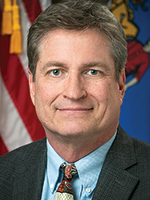
Photo of Tim Carpenter
D Wisconsin Senate · District 3 On the 2026 ballot

Sen. Tim Carpenter

Compare
Total votes
686
all sessions
Attendance
100%
of floor votes
Near the chamber average
With party
95%
of cast votes
Near the chamber average
Bipartisan score
3%
crosses aisle rarely
Near the chamber average
Sponsored
1,345
bills & resolutions
Near the chamber average
Committees
2
assignments
1,345 bills and resolutions

Sponsored bills

Total
1,345
Primary
1,345
Co-sponsor
0
This page
1,345
matching current filters
Primary SB 208
Failed · Wisconsin Senate · Lead sponsor
Relating to: prohibiting hedge funds from acquiring single-family homes in this state. (FE)

Maddy summarySB 208 prohibits hedge funds (defined as entities managing $50 million+ in pooled investor funds) from acquiring or owning single-family homes in the state. It specifically targets new acquisitions after the law's effective date, requiring any violation to forfeit the property to the state, enforced by the attorney general. Existing ownership before the effective date is not affected. The bill directly impacts hedge funds meeting its financial and structural criteria, not other investors or property types. It does not alter existing ownership rights but prevents new purchases by covered hedge funds.

Failed Mar 23, 2026 0 co-sponsors
Primary SB 541
Failed · Wisconsin Senate · Lead sponsor
Relating to: actions in circuit court alleging discrimination in employment, unfair honesty testing, or unfair genetic testing. (FE)

Maddy summarySB 541 creates a new pathway for individuals or the Wisconsin Department of Workforce Development to file civil lawsuits in circuit court alleging employment discrimination, unfair honesty testing (like pre-employment lie detector tests), or unfair genetic testing. The bill sets a 300-day deadline to file such lawsuits and establishes damage caps based on employer size (ranging from $50,000 to $300,000), with automatic annual adjustments using the consumer price index. It clarifies that individuals don’t need to first pursue administrative complaints before suing, and courts must specify whether new damages replace or add to prior relief. This directly affects employees facing these violations and employers subject to such lawsuits.

Failed Mar 23, 2026 0 co-sponsors
Primary SB 465
Failed · Wisconsin Senate · Lead sponsor
Relating to: project labor agreements and public contracts. (FE)

Maddy summarySB 465 removes outdated restrictions on public construction contracts by repealing specific statutes (16.75(1p), 16.855(1p), 66.0901(1)(ae), (am), (6m), and (6s)). It amends Section 66.0901(6) to allow municipalities to set reasonable conditions for worker pay, hours, and qualifications in public building projects (excluding highways), and to classify contractors based on financial responsibility and ability. This directly affects cities and towns awarding construction contracts for public buildings, giving them more flexibility in contract terms. The bill makes no new policy changes but eliminates existing barriers to municipal oversight of worker conditions and contractor qualifications.

Failed Mar 23, 2026 0 co-sponsors
Primary SB 464
Failed · Wisconsin Senate · Lead sponsor
Relating to: state preemption of local employment regulations. (FE)

Maddy summarySB 464 repeals two state laws (statutes 103.007 and 109.09(3)) that previously prevented local governments from creating their own employment regulations. This bill directly affects cities and counties by removing the state's legal barrier to local workplace rules, such as minimum wage or scheduling requirements. The key mechanism is the removal of these preemption statutes, allowing local governments to establish employment standards without state override. The bill focuses solely on changing the legal framework to enable local regulation, without specifying new policies.

Failed Mar 23, 2026 0 co-sponsors
Primary SB 615
Failed · Wisconsin Senate · Lead sponsor
Relating to: the University of Wisconsin Missing-in-Action Recovery and Identification Project and making an appropriation. (FE)

Maddy summarySB 615 appropriates $500,000 annually for the University of Wisconsin Missing-in-Action Recovery and Identification Project during the 2025-27 fiscal biennium. The project, managed by the University of Wisconsin System's Board of Regents, directly supports Wisconsin veterans missing in action by funding recovery and identification efforts. The bill requires the project to submit annual reports to state legislative committees, the governor, and veterans' agencies detailing mission outcomes and how funds were used. This funding provides concrete support for resolving cases of Wisconsin veterans who went missing during military service.

Failed Mar 23, 2026 0 co-sponsors
Primary SJR 98
Failed · Wisconsin Senate · Lead sponsor
Relating to: equality of rights on the basis of sex, gender identity, race, color, sexual orientation, disability, religion, national origin, marital status, family status, age, ancestry, or any other immutable characteristic and creating a private cause of action for violations of those rights by state actors (first consideration).

Maddy summarySJR 98 proposes adding a new constitutional amendment (Section 27) to guarantee equal rights under state law, prohibiting discrimination by state or local governments based on sex, gender identity, race, color, sexual orientation, disability, religion, national origin, marital status, family status, age, ancestry, or other immutable characteristics. It would allow any individual harmed by a violation to sue the state or local government entity responsible in court. The amendment would require all state and local governments to actively protect these guaranteed rights. This is a constitutional amendment proposal, not a law, and it is currently in the early stages of review after introduction in October 2025.

Failed Mar 23, 2026 0 co-sponsors
Primary SB 462
Failed · Wisconsin Senate · Lead sponsor
Relating to: permits authorizing the employment of minors. (FE)

Maddy summarySB 462 updates the rules for permits allowing minors under 16 to work, directly affecting young workers and employers who hire them. The bill adds new exemptions to the permit requirement, including for minors working as election inspectors (as specified in state election law), in home settings, or for nonprofit organizations assisting elderly or disabled individuals. Employers must now maintain these permits on file and produce them for inspection upon request, with failure to do so being treated as evidence of unlawful employment. The bill also repeals an outdated section related to advertising for minor employment.

Failed Mar 23, 2026 0 co-sponsors
Primary SB 639
Failed · Wisconsin Senate · Lead sponsor
Relating to: veterans mental health services and making an appropriation. (FE)

Maddy summarySB 639 allocates $5 million in state funds specifically for veterans' mental health services through the Department of Veterans Affairs. It requires the department to promote veterans' access to community-based mental health care and provide grants to organizations offering these services. The bill also streamlines rulemaking by allowing the department to issue emergency rules for administering these services without usual requirements for emergency rule justification. This directly affects veterans seeking mental health support and community organizations delivering those services. The funding and program structure are established for the 2026 biennium.

Failed Mar 23, 2026 0 co-sponsors
Primary SB 579
Failed · Wisconsin Senate · Lead sponsor
Relating to: collective bargaining for employees of the University of Wisconsin System, granting rule-making authority, and making an appropriation. (FE)

Maddy summarySB 579 standardizes collective bargaining processes for employees of the University of Wisconsin (UW) System, directly affecting faculty, staff, and other workers covered by existing union contracts. The bill requires that pay increases align with approved compensation plans or collective bargaining agreements, and it establishes funding mechanisms to cover costs for grievance arbitrations and training related to bargaining disputes. Key provisions update statutes to clarify that bargaining agreements govern pay decisions and define "governmental body" to exclude bargaining committees. The bill also creates new appropriation accounts to fund administrative functions of the state's employment relations system, including mediation and arbitration services.

Failed Mar 23, 2026 0 co-sponsors
Primary SB 15
Failed · Wisconsin Senate · Lead sponsor
Relating to: increased penalties for crimes against adults at risk; restraining orders for adults at risk; freezing assets of a defendant charged with financial exploitation of an adult at risk; sexual assault of an adult at risk; and providing a penalty.

Maddy summarySB 15 modifies penalty rules for crimes against vulnerable adults by distinguishing between "elder persons" (typically age 60+) and "adults at risk" (vulnerable due to disability or other factors). For elder victims, it eliminates the defense that a defendant didn’t know the victim’s age, automatically applying enhanced penalties. For "adults at risk," penalties only increase if the defendant actually knew the victim’s vulnerable status. The bill applies to crimes like assault, financial exploitation, and sexual assault, changing how courts assess penalties based on victim classification. It does not create new penalties but adjusts existing sentencing rules for these specific victim categories.

Failed Mar 23, 2026 0 co-sponsors
Showing 251 to 260 of 1,345 bills
Previous 1 25 26 27 135 Next