

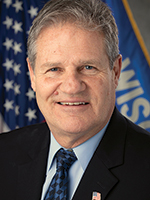
Photo of Paul Melotik
R Wisconsin Assembly · District 22 On the 2026 ballot

Rep. Paul Melotik

Compare
Total votes
377
all sessions
Attendance
100%
of floor votes
Near the chamber average
With party
100%
of cast votes
Near the chamber average
Bipartisan score
0%
crosses aisle rarely
Near the chamber average
Sponsored
328
bills & resolutions
Near the chamber average
Committees
8
assignments
328 bills and resolutions

Sponsored bills

Total
328
Primary
328
Co-sponsor
0
This page
328
matching current filters
Primary AB 717
Failed · Wisconsin Assembly · Lead sponsor
Relating to: listing of carfentanil under the Uniform Controlled Substances Act and providing a penalty.

Maddy summaryAB 717 is a procedural bill that renumbers an existing statute section (changing 961.16 (3) (cm) to 961.14 (2) (nd) 9g) within the Uniform Controlled Substances Act. It does not create new penalties or list carfentanil as a controlled substance; it only adjusts the statutory reference for administrative clarity. This bill directly affects the legal code structure but does not change any existing penalties or substance classifications. The summary is limited to the procedural renumbering, as no substantive policy changes are described in the bill text.

Failed Mar 23, 2026 0 co-sponsors
Primary AB 766
Failed · Wisconsin Assembly · Lead sponsor
Relating to: the commercial driver training grant program. (FE)

Maddy summaryAB 766 amends Wisconsin's commercial driver training grant program rules. It requires training providers to meet federal standards (49 CFR part 380), be listed on the Training Provider Registry (TPR), and deliver training at TPR-registered facilities. The bill also mandates that trainees obtain their initial Wisconsin commercial driver license (CDL) after March 23, 2024 (or a later date for non-training-providers), and prevents multiple grants for the same trainee. These changes directly affect training providers applying for state grants and individuals receiving training under the program.

Failed Mar 23, 2026 0 co-sponsors
Primary AB 707
Failed · Wisconsin Assembly · Lead sponsor
Relating to: managed forest land recording fees. (FE)

Maddy summaryAB 707 modifies fees for land designated as "managed forest land" in Wisconsin. It requires new owners of such land to pay a $100 fee within 30 days of transfer (to certify continued compliance with management plans and obtain department approval), and sets a $300 withdrawal fee if land is removed from the program. The fees are deposited into the conservation fund, with $20 allocated to forestry recording under statute 20.370. This directly affects landowners transferring or withdrawing managed forest land, updating existing fee structures under statutes 77.82 and 77.88.

Failed Mar 23, 2026 0 co-sponsors
Primary AB 704
Failed · Wisconsin Assembly · Lead sponsor
Relating to: fees for snowmobile registration and trail use stickers. (FE)

Maddy summaryAB 704 increases fees for snowmobile registration and trail use stickers in Wisconsin. It raises the public-use registration fee from $30 to $45 (with a $5 fee for political subdivisions), keeps private-use registration fee-free, and increases trail sticker fees: from $49.25 to $69.25 for exempt snowmobiles, $9.25 to $19.25 for club members meeting specific criteria, and $29.25 to $49.25 for others. The bill directly affects snowmobile owners who register their vehicles or use public trails. Key provisions include standardized fee increases and a reduced rate for members of qualifying snowmobile clubs.

Failed Mar 23, 2026 0 co-sponsors
Primary AB 748
Failed · Wisconsin Assembly · Lead sponsor
Relating to: exemptions from food product licensing requirements for sale of pickled fruits and vegetables, baked goods, and other shelf-stable food products prepared in a person’s home and granting rule-making authority. (FE)

Maddy summaryAB 748 exempts home producers of shelf-stable food products (like pickled fruits/vegetables and baked goods) from state licensing requirements, directly affecting small-scale home cooks and cottage food businesses. The bill creates a registration system requiring producers to register with the department, maintain liability insurance, and label products with their registration number, preparation date, and a "made in a private home" statement. It limits annual sales to under $40,000 and mandates specific labeling for allergens, while requiring inspections for producers with sales between $10,000-$40,000. Producers must sell directly to consumers (e.g., farmers' markets or home delivery) and comply with new safety labeling and insurance rules. The bill replaces prior licensing rules with this structured framework for home food sales.

Failed Mar 23, 2026 0 co-sponsors
Primary AB 749
Passed · Wisconsin Assembly · Lead sponsor
Relating to: instruction in blood and organ donation in high school grades. (FE)

Maddy summaryAB 749 requires all public high schools to include instruction about organ and blood donation in at least one grade between 9 and 12. The law mandates that this instruction cover the purpose of donations, the statewide and nationwide need for them, and how students can participate. This applies to all high school curricula starting with the 2026-27 school year. The bill directly affects high school students and school districts by adding this specific health education requirement to their curriculum.

Passed Mar 23, 2026 0 co-sponsors
Primary AB 709
Failed · Wisconsin Assembly · Lead sponsor
Relating to: alternative methods of providing pupil transportation services. (FE)

Maddy summaryAB 709 amends Wisconsin state law to clarify rules for school transportation services, primarily affecting schools, school bus contractors, and emergency transportation providers. It allows school boards to request temporary emergency transportation for 15+ students when regular service isn't available, requiring written approval from the state transportation secretary. The bill also updates insurance requirements: vehicles carrying 9-14 students (not owned/leased by schools) must carry $10,000 property damage and $25,000 per person bodily injury coverage. These changes standardize emergency procedures and ensure minimum insurance coverage for non-school-operated transportation.

Failed Mar 23, 2026 0 co-sponsors
Primary AB 803
Passed · Wisconsin Assembly · Lead sponsor
Relating to: workforce training grants. (FE)

Maddy summaryAB 803 would expand state funding for workforce training grants to specifically include programs preparing individuals to become teachers. The bill creates a new grant category (106.27 (1) (b) 1. b.) for programs offering evidence-based training, leadership development, on-site job experience, and support to build teaching skills. This directly affects teacher preparation programs, including those in dual enrollment settings, by adding them to eligible grant recipients. The key change is codifying support for structured career pathways into teaching, moving beyond current grant scope. The bill is currently pending in the Rules committee after passing its primary committee unanimously.

Passed Mar 23, 2026 0 co-sponsors
Primary AJR 125
Passed · Wisconsin Assembly · Lead sponsor
Relating to: congratulating the Grafton Black Hawks football team for winning the 2025 Wisconsin State Football Championship.

Maddy summaryAJR 125 is a symbolic legislative resolution congratulating the Grafton Black Hawks high school football team for winning the 2025 Wisconsin State Football Championship. It specifically recognizes their perfect 14-0 season record, championship victory at Camp Randall Stadium, and individual honors for players and coaches. The resolution does not create new laws or policies but formally expresses the Wisconsin Legislature's support for the team's achievement. It directly affects the Grafton community and the team members by acknowledging their athletic success.

Passed Mar 23, 2026 0 co-sponsors
Primary AB 794
Failed · Wisconsin Assembly · Lead sponsor
Relating to: independent contractor healthcare workers and healthcare worker platforms.

Maddy summaryAB 794 clarifies that healthcare workers using digital platforms to book shifts at facilities remain independent contractors - not employees - under specific conditions. The bill requires platforms to meet 15 criteria, such as allowing workers to freely accept/reject shifts, set their own rates, avoid mandatory availability, and not restrict other work. It directly affects healthcare workers and platforms connecting them to facilities, ensuring they retain contractor status if all conditions are met. The law explicitly excludes these workers from employee protections under certain statutes, focusing solely on shifts booked through compliant platforms.

Failed Mar 23, 2026 0 co-sponsors
Showing 61 to 70 of 328 bills
Previous 1 … 6 7 8 … 33 Next