

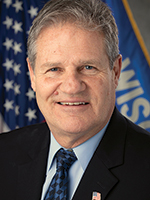
Photo of Paul Melotik
R Wisconsin House · District 22 On the 2026 ballot

Rep. Paul Melotik

Compare
Total votes
377
all sessions
Attendance
88%
49 missed
Near the chamber average
With party
100%
of cast votes
Near the chamber average
Bipartisan score
0%
crosses aisle rarely
Near the chamber average
Sponsored
328
bills & resolutions
Near the chamber average
Committees
8
assignments
328 bills and resolutions

Sponsored bills

Total
328
Primary
328
Co-sponsor
0
This page
328
matching current filters
Primary AJR 133
Signed into law · Wisconsin House · Lead sponsor
Relating to: legislative suspension of rules promulgated by state agencies (first consideration).

Maddy summaryAJR 133 proposes a constitutional amendment allowing the legislature to suspend any state agency rule through a joint resolution approved by a majority of all elected members in both houses. If enacted, the legislature could immediately halt the enforcement of agency rules (for a set period or indefinitely) without requiring governor approval or following standard lawmaking procedures. The suspension would make the rule unenforceable during the suspension period, shifting authority from agencies to the legislature regarding rule implementation. This change would require voter approval after legislative passage, as it modifies the state constitution.

Signed into law May 26, 2026 0 co-sponsors
Primary AJR 102
Signed into law · Wisconsin House · Lead sponsor
Relating to: prohibiting governmental entity discrimination (second consideration).

Maddy summaryAJR 102 is a proposed constitutional amendment that would prohibit state government entities from discriminating against or giving preferential treatment to individuals or groups based on race, sex, color, ethnicity, or national origin. It specifically applies to public employment, education, contracting, and administration by state or local government. If approved by voters in November 2026, it would add Section 27 to the state constitution. This is a second consideration of the same proposal previously introduced as AJR 109 in 2023. The amendment requires voter ratification and is not yet law.

Signed into law May 26, 2026 0 co-sponsors
Primary AB 80
Signed into law · Wisconsin House · Lead sponsor
Relating to: ratification of the Social Work Licensure Compact. (FE)

Maddy summaryAB 80 would allow social workers, marriage and family therapists, and professional counselors licensed in this state to practice in other states that join the Social Work Licensure Compact without needing separate state licenses. The bill amends existing statutes to align state definitions and requirements with the compact framework, ensuring professionals certified under Chapter 457 can work across participating states. It directly affects licensed social work professionals seeking to practice in multiple states and changes how their credentials are recognized in statutes related to child welfare, mental health, and professional practice. The compact aims to streamline licensure for these professionals while maintaining state-specific standards.

Signed into law May 21, 2026 0 co-sponsors
Primary AB 955
Vetoed · Wisconsin House · Lead sponsor
Relating to: the rule-making authority of agencies. (FE)

Maddy summaryAB 955 limits state agencies' ability to interpret laws by requiring explicit statutory permission before creating rules that interpret statutes they enforce. It adds a new section (227.11(1m)) stating agencies cannot interpret laws without specific legislative authorization. The bill also repeals existing language that allowed broader agency interpretation authority and reorganizes related sections. This directly affects all state agencies that develop rules for enforcing or administering laws, ensuring they cannot interpret statutes without clear prior legislative permission. The change focuses on clarifying rule-making boundaries, not altering policy outcomes.

Vetoed May 13, 2026 0 co-sponsors
Primary AB 241
Vetoed · Wisconsin House · Lead sponsor
Relating to: required ratio of journeyworkers to apprentices in apprenticeship programs and contracts.

Maddy summaryAB 241 amends Wisconsin statute 106.015(1) to prohibit requiring more than one journeyworker for every two apprentices in apprenticeship programs or contracts. This directly affects apprenticeship programs, particularly those governed by collective bargaining agreements, by limiting the minimum journeyworker-to-apprentice ratio. The bill prevents state agencies from enforcing or authorizing stricter ratios (e.g., requiring two journeyworkers per apprentice) through rules, program approvals, or contracts. It takes effect for collective bargaining agreements when they expire or are modified, renewed, or extended. The legislation aims to standardize ratio requirements across apprenticeship programs statewide.

Vetoed May 13, 2026 0 co-sponsors
Primary AB 1
Vetoed · Wisconsin House · Lead sponsor
Relating to: changes to the educational assessment program and the school and school district accountability report. (FE)

Maddy summaryAB 1 standardizes how Wisconsin schools and districts are evaluated by requiring consistent assessment metrics. It mandates that the state department use the same cut scores and performance categories for English/language arts and math tests in grades 3-8 that align with national National Assessment of Educational Progress (NAEP) standards. For high school grades 9-11, it requires using the same metrics applied in the 2021-22 school year. This directly affects all public schools and districts in Wisconsin by changing how their accountability reports are calculated. The bill aims to create uniformity in school performance evaluations across the state.

Vetoed May 13, 2026 0 co-sponsors
Primary AB 461
Vetoed · Wisconsin House · Lead sponsor
Relating to: an income tax subtraction for certain overtime compensation. (FE)

Maddy summaryAB 461 creates a new tax deduction for Wisconsin taxpayers who earn qualifying overtime pay. It allows individuals to subtract up to $12,500 (or $25,000 for joint filers) of overtime compensation from their taxable income, provided the overtime was reported to the IRS via standard forms (like Form 1099-NEC). The deduction phases out for higher earners: it decreases by $100 for every $1,000 their modified federal adjusted gross income exceeds $150,000 (or $300,000 for joint filers). This applies only to overtime pay reported to the IRS, excluding tips, and requires taxpayers to include their Social Security number on their return.

Vetoed May 13, 2026 0 co-sponsors
Primary AB 554
Vetoed · Wisconsin House · Lead sponsor
Relating to: the sale, service, and labeling of food products containing lab-grown animal cells and providing a penalty. (FE)

Maddy summaryAB 554 requires clear labeling for food products containing lab-grown meat, directly affecting food manufacturers, restaurants, and state institutions. It mandates that "lab-grown meat" appear in prominent, contrasting text on labels (at least as large as other text), with full ingredient lists and separate labeling for multi-component products. The bill prohibits serving lab-grown meat as a meat substitute in public eateries without customer order or in state institutions (like prisons or hospitals) without specific health authorization. Violations carry fines of $100-$500 for first offenses and up to $1,000 for repeat violations. The law takes effect January 1, 2027.

Vetoed May 13, 2026 0 co-sponsors
Primary AB 549
Vetoed · Wisconsin House · Lead sponsor
Relating to: manufactured home sales and certificates of title and modifying administrative rules of the Department of Safety and Professional Services related to manufactured home purchase contracts. (FE)

Maddy summaryAB 549 updates rules for manufactured home sales and title certificates in the state. It directly affects manufactured home dealers, buyers, and county offices handling title records. Key changes include requiring dealers to provide receipts for title payments, preventing dealers from listing themselves as owners on title applications when reselling, and mandating that title records include the home's location by county. The bill also clarifies when title applications are considered submitted and specifies details required on title documents, such as the home's address and identification number.

Vetoed May 13, 2026 0 co-sponsors
Primary AB 146
Vetoed · Wisconsin House · Lead sponsor
Relating to: requests for information from employers about unemployment insurance claims.

Maddy summaryAB 146 would require Wisconsin employers to provide written reasons for objecting to unemployment insurance claims and give them at least 12 business days to respond to information requests from the unemployment department. The department would also be permitted to seek additional details directly from employees about their eligibility, employment, or wages. This bill applies to claims filed for weeks beginning after its effective date, affecting employers, the unemployment department, and employees involved in claims. It modifies the existing process for handling claim disputes without changing benefit eligibility rules.

Vetoed May 13, 2026 0 co-sponsors
Showing 1 to 10 of 328 bills
1 2 3 33 Next