

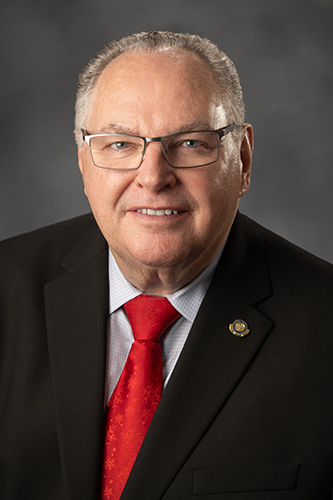
Maddy summaryThis Senate resolution formally recognizes the dedicated public service of Honorable Charles Houston Clements, a former West Virginia state senator. The bill honors Clements for his legislative career, including his service as Chair of the Transportation and Infrastructure Committee and his decision not to seek reelection in 2026. It expresses the Senate's appreciation for his commitment to serving West Virginia citizens and directs the Clerk to send a copy of the resolution to Clements.
Sen. Rollan Roberts
Sponsored bills
Maddy summaryThis legislative resolution asks the Joint Committee on Government and Finance to investigate the ongoing water quality and infrastructure problems in southern West Virginia, especially in McDowell and Wyoming counties. The study will examine causes of poor water quality, potential contamination sources, the condition of existing water systems, and whether state agencies are properly regulating the situation. The committee is required to report its findings and recommendations to the legislature by the 2027 session, with costs covered by legislative funding.
Maddy summarySenate Resolution 50 requests the Joint Committee on Government and Finance to study the Public Service Commission's effectiveness in regulating public utilities. The resolution asks the committee to examine how well the commission regulates utility rates, reviews rate increase requests, maintains transparency in its processes, and ensures utility service reliability for West Virginia residents and businesses. The study will also consider whether commission members should be elected rather than appointed. The committee must report its findings and recommendations to the Senate by January 1, 2027. This resolution does not change any laws but initiates a review of the commission's current operations.
Maddy summarySJR 9 proposes amending West Virginia's constitution to require all voters to be U.S. citizens. It would change the voting eligibility rule to state: "Only citizens of the state who are citizens of the United States shall be entitled to vote at all elections." This would affect all voters in West Virginia elections by eliminating current exceptions allowing non-citizen residents to vote in certain local elections. The amendment must be approved by voters in the 2026 general election to take effect.
Maddy summarySB 805 adds "abortion pill reversal" to West Virginia's Mothers and Babies Pregnancy Support Program, allowing funding for this service through eligible pregnancy help organizations. The bill defines "abortion pill reversal" as using progesterone to counteract the abortion pill (mifepristone) and specifies that only organizations that do not support or perform abortions can receive program funds for this purpose. Abortion industry organizations are explicitly excluded from receiving these funds. This is a procedural change to the existing program's funding eligibility, not a new law restricting abortion access.
Maddy summarySJR 11 proposes a constitutional amendment to increase West Virginia's homestead exemption from $20,000 to $25,000 for qualifying homeowners. It would exempt the first $25,000 of assessed value on primary residences owned by residents aged 65+ or permanently disabled. The amendment requires voter approval in the 2026 general election to take effect. This change would directly affect eligible homeowners by reducing their property tax burden on their primary residence. The bill is a constitutional proposal, not an immediate law, and must be ratified by voters.
Maddy summarySB 144 would gradually increase West Virginia's homestead property tax exemption for eligible homeowners aged 65+ or permanently disabled residents. The bill phases in a higher exemption amount (beyond the current $20,000) over time, but only if voters approve a related constitutional amendment. It also repeals a provision limiting how much property tax rates can rise when property appraisals increase. This change directly affects qualifying homeowners by reducing their property tax burden, contingent on constitutional approval.
Maddy summarySB 669 clarifies when West Virginia's Public Service Commission (PSC) can approve utility rate increases and requires a biennial review of these increases. It directly affects utilities, particularly small municipal water/sewer systems serving fewer than 4,500 customers or with under $3 million in annual revenue, and their wholesale/resale customers. Key provisions include: a 30-day window for customers to file rate complaints after municipal changes, a 120-day resolution deadline for the PSC, and a requirement that rate increases must be supported by evidence showing costs are fairly matched to benefits received by customers. The bill also restricts the PSC from ordering refunds for rates collected during complaint proceedings unless specific refund conditions apply.
Maddy summarySB 540 requires Child Protective Services (CPS) workers in West Virginia to wear body-worn cameras during investigations of child abuse or neglect, but only after obtaining consent from the person being investigated in private settings where privacy is expected. CPS workers may skip using the camera if it would compromise a child's privacy or hinder the investigation, but they must document the reason in the case file. All audio and video recordings must be kept confidential, stored until all appeals are resolved, and treated as part of the official child welfare record, not subject to public disclosure. This bill directly affects CPS workers and individuals involved in child welfare investigations.
Maddy summarySB 981 imposes a one-year pause (July 1, 2026-June 30, 2027) on the Public Service Commission approving new rate increases for electric, natural gas, and water utilities serving residential, commercial, and industrial customers in West Virginia. It allows the Commission to reduce rates, disallow costs, or approve refunds during this period but prohibits new rate hikes. The bill requires a comprehensive study of methods to lower utility rates and mandates a report on findings and recommendations. This directly affects utilities and their customers by temporarily halting rate increases while evaluating long-term affordability solutions.