

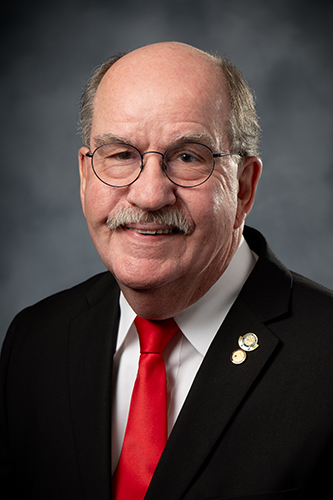
Photo of Bill Hamilton
R West Virginia Senate · District 11 On the 2026 ballot

Sen. Bill Hamilton

Compare
Total votes
2,027
all sessions
Attendance
100%
5 missed
Higher than 80% of chamber peers
With party
95%
of cast votes
Lower than 79% of chamber peers
Bipartisan score
3%
crosses aisle rarely
Near the chamber average
Sponsored
711
bills & resolutions
Higher than 84% of chamber peers
Committees
14
assignments
711 bills and resolutions

Sponsored bills

Total
711
Primary
139
Co-sponsor
572
This page
711
matching current filters
Co-sponsor SB 774
Passed · West Virginia Senate · Co-sponsor
Allowing certain county EMS officers to participate in EMS Retirement System

Maddy summarySB 774 allows county emergency medical services (EMS) officers to join the Emergency Medical Services Retirement System (EMSRS), removing a prior requirement that they be certified as law enforcement officers. It enables current EMS officers enrolled in the Public Employees Retirement System (PERS) to elect to switch to the EMSRS and transfer their eligible service years to the new system. The bill clarifies how retirement benefits are calculated for these officers, ensuring their prior service counts toward future benefits. This change directly affects county EMS officers by providing them with a retirement system tailored to their profession.

Passed Mar 13, 2026 1 co-sponsor
Co-sponsor SB 473
Passed · West Virginia Senate · Co-sponsor
Creating felony offense of using electronic device to threaten violence

Maddy summarySB 473 creates felony penalties for threatening to commit violent crimes using electronic devices (like texts, social media, or emails) when the threat causes a building evacuation, widespread fear, or serious disruption. It directly affects individuals who send such threats, making it a felony if the communication causes significant public alarm or evacuation. The law specifies that prosecutors must prove the threat was viewed as threatening by a reasonable person, and it prohibits defenses like claiming the threat wasn't "real." Penalties include fines up to $10,000 or prison terms of 1-10 years for these offenses.

Passed Mar 12, 2026 1 co-sponsor
Co-sponsor SB 440
Passed · West Virginia Senate · Co-sponsor
Increasing penalty for transporting telecommunication devices into jails

Maddy summaryThis bill amends West Virginia law to specifically prohibit transporting telecommunications devices (like cell phones) into correctional facilities, including federal prisons. It increases penalties for delivering such devices to inmates or unauthorizedly bringing them onto facility grounds, with felony charges carrying fines up to $5,000 or up to 10 years in prison, and misdemeanor charges for lesser violations. The law directly affects visitors, family members, staff, or others attempting to bring devices into jails or prisons without authorization. It expands existing restrictions by explicitly naming telecommunications devices and updating their definition within the legal framework.

Passed Mar 11, 2026 1 co-sponsor
Co-sponsor SB 426
Passed · West Virginia Senate · Co-sponsor
Preventing damage to underground facilities

Maddy summaryWest Virginia's SB 426 establishes a mandatory "call before you dig" notification system to prevent damage to underground infrastructure. It requires excavators (e.g., construction crews) to notify utility operators of planned digging activities before starting work, covering facilities like gas lines, water mains, sewer systems, and fiber optic cables. The bill creates an Underground Facilities Damage Prevention Board to enforce these rules, with penalties collected from violators funding the board directly instead of the state treasury. This affects all entities performing excavation work in the state, aiming to reduce accidental damage to critical underground utilities.

Passed Mar 10, 2026 1 co-sponsor
Co-sponsor SB 928
Passed · West Virginia Senate · Co-sponsor
Relating to manufacture, sale, and distribution of low-proof spirit alcohol products

Maddy summarySB 928 defines "Low-Proof Spirit Alcohol Products" as beverages containing 0.5% to 15.5% alcohol by volume (not including wine, beer, or nonintoxicating beer), packaged in containers under 25 fluid ounces. It establishes new regulatory requirements for manufacturers, distributors, and retailers of these products, including specific sales and distribution rules. The bill also specifies a tax methodology for these products and grants the West Virginia Alcohol Beverage Control Commission authority to create implementing rules. This legislation directly affects businesses producing or selling low-proof alcohol beverages, creating a distinct regulatory category separate from traditional spirits, beer, or wine.

Passed Mar 9, 2026 1 co-sponsor
Co-sponsor SJR 8
Passed · West Virginia Senate · Co-sponsor
Sheriff's Succession Amendment

Maddy summarySJR 8 proposes a constitutional amendment to West Virginia's Constitution (Article IX, Section 3) regarding sheriff term limits. It modifies the rule that prevents someone from serving two consecutive terms as sheriff by adding an exception: if a sheriff is appointed to fill a term with less than two years remaining, they would be eligible to run for two consecutive full terms afterward. This directly affects county sheriffs in West Virginia who are appointed to finish short remaining terms. The amendment, titled the "Sheriff's Succession Amendment," requires voter approval at the 2026 general election to take effect.

Passed Mar 5, 2026 1 co-sponsor
Co-sponsor SR 56
Passed · West Virginia Senate · Co-sponsor
Honoring Sergeant First Class Bill Brown for his distinguished military service

Maddy summaryThis Senate resolution honors Sergeant First Class Bill Brown of Beckley, West Virginia, for his distinguished military service during the Vietnam War. The bill formally recognizes his three tours of duty in Southeast Asia, where he served in command roles and was severely wounded in 1971, resulting in a bilateral leg amputation. It acknowledges his receipt of 16 military medals, including the Silver Star and a rare South Vietnamese award, and directs the Senate Clerk to send a copy of the resolution to him.

Passed Mar 3, 2026 1 co-sponsor
Co-sponsor SR 55
Passed · West Virginia Senate · Co-sponsor
Recognizing honeybees and their importance to agriculture and economy in WV

Maddy summaryThis Senate resolution formally recognizes honeybees and their vital role in West Virginia's agriculture and economy. It highlights that honeybees pollinate crops worth billions of dollars annually and supports over 16,000 beekeeping colonies in the state. The document also notes challenges like disease and habitat loss that threaten bee populations while affirming the state's commitment to supporting beekeepers and healthy pollinator populations. This measure does not change laws or create new regulations but serves as an official acknowledgment of honeybees' importance.

Passed Mar 3, 2026 1 co-sponsor
Co-sponsor SB 1077
Passed · West Virginia Senate · Co-sponsor
Requiring vocational education agriculture programs be offered to all students

Maddy summarySB 1077 (West Virginia Senate Bill 1077) prevents county school boards from reducing funding for vocational agriculture programs during the 2027 fiscal year below what they spent in the current fiscal year. It directly affects county boards of education across West Virginia by requiring them to maintain existing funding levels for these programs. The bill’s key provision, added as §18-5-55 to the state code, aims to protect these programs from budget cuts during fiscal year 2027. It does not create new programs or require universal student enrollment, but rather safeguards existing vocational agriculture funding. This is a procedural funding protection measure, not a new educational mandate.

Passed Mar 3, 2026 1 co-sponsor
Co-sponsor SB 972
Passed · West Virginia Senate · Co-sponsor
Relating to education placements during child abuse and neglect investigations

Maddy summarySB 972, or "Raylee's Law," temporarily restricts custodial parents or guardians from arranging home instruction for their child during an active West Virginia Department of Human Services (DHS) child abuse or neglect investigation where they are the alleged perpetrator. The law prohibits withdrawing a child from school for home instruction or resuming home instruction as the primary provider during the investigation. This restriction ends when DHS closes the case without substantiation or a court orders otherwise. The bill explicitly states it does not create a presumption of guilt, permanently ban home education, or limit court authority to order alternative educational placements for the child’s safety.

Passed Mar 2, 2026 1 co-sponsor
Showing 31 to 40 of 711 bills
Previous 1 3 4 5 72 Next