

Maddy summaryThis bill updates West Virginia's food safety law by adding specific dyes (like FD&C Yellow No. 5) to the list of substances deemed "poisonous or injurious to health" if proven harmful through scientific evidence. It requires that such substances be explicitly designated as unsafe under state law before restrictions apply. Food manufacturers must now clearly label mixtures with ingredient percentages and use specific font sizes for "compound" or "mixture" labels. The changes take effect January 1, 2028, directly affecting food producers and sellers in West Virginia.
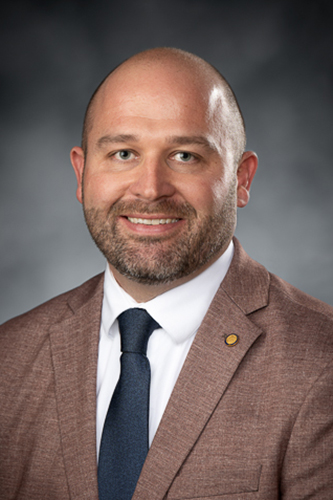
Del. Adam Burkhammer
Sponsored bills
Maddy summaryHB 4352 prohibits cameras and recording devices in the bedrooms and bathrooms of foster children in West Virginia foster homes. The bill directly affects foster children and their caregivers, banning all such devices except under specific medical exemptions. Exemptions apply only if a child has a medical diagnosis of severe physical, behavioral, cognitive, or psychological disability, and even then, any permitted devices must be placed visibly - not hidden. The law requires foster homes to maintain privacy in these personal spaces while allowing limited medical monitoring with clear visibility.
Maddy summaryThis House Resolution honors the life and legacy of the late West Virginia legislator Larry D. Kump, who passed away on February 28, 2026. The resolution formally expresses the House of Delegates' condolences to Kump's family and acknowledges his service as a representative for Berkeley County across three different terms. It recognizes his career in criminal justice and mediation, his commitment to limited government, and his role as a devoted family member and church leader. The document is a ceremonial tribute rather than a law that changes policy or affects public programs.
Maddy summaryHB 5529 requires West Virginia's Department of Human Services to implement performance-based contracts with child-placing agencies by July 1, 2026. The bill mandates contracts that link payments to measurable outcomes like child safety, permanency, well-being, and foster parent recruitment, while requiring agencies to use evidence-based practices. It also establishes a minimum $1,000 payment per finalized adoption for agencies and allows performance-based payment incentives to encourage timely permanency for children. The law directly affects child-placing agencies, foster parents, and the Department of Human Services by changing how services are funded based on results.
Maddy summaryHB 4587 prohibits West Virginia state and local public funds from supporting postsecondary degree programs classified as "low-earning outcome" under federal standards. It requires the Higher Education Policy Council to adopt rules blocking state funding - including student aid, operational costs, and capital grants - for these programs, and to annually report on prohibited programs and fiscal impacts. The bill directly affects public colleges, universities, and students enrolled in degrees deemed low-earning by federal criteria (per Public Law 119-21, Section 84001). It takes effect immediately upon passage, restricting state and local government funding for specific degree programs without specifying exact income thresholds.
Maddy summaryThis bill (HB 4604) amends West Virginia law to clarify payment procedures for public defender panel attorneys handling abuse and neglect cases. It requires attorneys to submit detailed time and expense records via electronic vouchers within 90 business days of case completion, with payments processed within 45 days if approved. If payments are rejected or reduced, the bill establishes a 15-day appeal process to the appointing court, prohibiting the requirement of privileged client information during disputes. The changes directly affect public defender offices and appointed attorneys, streamlining payment accountability without altering case handling standards.
Maddy summaryHB 4355 creates a new $10 "upland game bird" stamp that hunters can purchase alongside their standard license. It directly affects hunters targeting specific species: ruffed grouse, bobwhite quail, ring-necked pheasant, woodcock, and snipe. Proceeds from the stamp will fund the West Virginia Division of Natural Resources to buy and release these birds into designated Wildlife Management Areas. The bill defines the bird species and requires the Division to administer the program.
Maddy summaryHB 4359 amends West Virginia law to add specific exemptions from the certificate of need (CON) process for health care facilities. The bill lists 18 exemptions, including allowing hospitals to move within 10 miles without a new license (as referenced in the title), acquiring CT scanners under certain conditions, adding research services, renovating facilities without expanding size, and establishing community mental health centers. These exemptions directly affect hospitals, clinics, and health care providers seeking to modify services, equipment, or locations without state approval. The key mechanism requires facilities to file applications and meet specific criteria, such as maintaining accreditation for CT scanners or avoiding bed capacity changes during renovations. The bill focuses on streamlining regulatory processes for existing health care providers.
Maddy summaryHB 5668 establishes the Central West Virginia Economic Development and Rural Revitalization Program to address economic challenges in eight specific counties: Webster, Clay, Braxton, Roane, Calhoun, Wirt, Lewis, and Gilmer. The bill creates a state program within the Department of Commerce that provides grants, loans, and technical assistance for projects like business development, infrastructure improvements, broadband expansion, and tourism initiatives. It also introduces a 25% tax credit for businesses making qualified investments in the region that create or retain full-time jobs. Projects must be located in the designated counties and prioritize job creation, private funding leverage, and support for economically distressed communities.
Maddy summaryHB 5645 would impose work requirements for Medicaid and SNAP (food stamp) eligibility in West Virginia. It limits SNAP benefits for able-bodied adults without dependents to three months in a 36-month period unless they work, participate in job training, or volunteer at least 20 hours weekly. The bill requires verification of citizenship status, prohibits non-citizens from receiving SNAP benefits, and mandates hospitals to report certain patient information to the Department of Human Services. It also includes provisions for counties to qualify for work requirement exemptions based on unemployment data, though all counties will lose such exemptions after October 2022. The bill affects low-income adults seeking Medicaid or SNAP benefits who do not have children.