

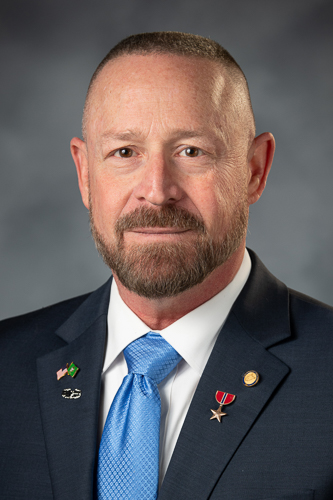
Maddy summaryThis resolution requests that the West Virginia Division of Highways name a specific segment of Route 20 in Webster County (from the Upshur/Webster County line to Mount Zion Road) as the "U.S. Army Sergeant Major Charles Grant Hoke Memorial Road." It commemorates Sergeant Major Charles Grant Hoke, a WWII and Korean War veteran with multiple military awards, who was born in Upshur County and raised in Cleveland, Webster County. The resolution asks the Division of Highways to install signs identifying this road segment and directs the House Clerk to forward the resolution to the agency. This is a commemorative measure with no funding or policy changes, directly affecting the named road segment in Webster County.
Del. Doug Smith
Sponsored bills
Maddy summaryHCR 78 is a non-binding resolution urging West Virginia's Division of Highways to prioritize completing I-73 (the "King Coal Highway") across Wayne, Mingo, McDowell, Mercer, and Wyoming counties. It requests the highway agency treat the project as a high priority to improve economic development and emergency access, especially after recent flooding exposed transportation challenges in the region. The resolution asks the state to provide necessary funding and executive support to expedite the highway's completion but does not allocate new funds or create new law. It directly affects the Division of Highways and residents of the five specified counties by formally advocating for this infrastructure project.
Maddy summaryHB 3452 transfers administration of Advanced Career Education (ACE) programs - from high school courses preparing students for specific careers - from county school boards to community and technical colleges. The bill amends education code to end current county board oversight (repealing §18-5-19b) and establishes community colleges as the new administrators for ACE programs, including approval of curricula and credentials. This directly affects high school students enrolled in ACE pathways, county schools currently managing these programs, and community colleges taking on this responsibility. The change aims to align career education with college-level technical training structures, though it does not alter program content or funding mechanisms.
Maddy summaryHCR 72 designates March 20, 2025 as "Black Lung Awareness Day" in West Virginia. It honors coal miners affected by black lung disease (coal worker's pneumoconiosis), a preventable occupational lung condition caused by coal dust exposure. The resolution does not create new laws, funding, or policy changes - it serves as a ceremonial observance recognizing the disease's impact and existing protections like the Black Lung Benefits Act. It follows the Federal Coal Mine Health and Safety Act's emphasis on miner safety without altering current regulations.
Maddy summaryHB 2158 removes the expiration dates (sunset clauses) for additional registration fees on pet food in West Virginia. Specifically, it eliminates the temporary deadlines (June 30, 2027 for bulk pet food and June 1, 2027 for smaller packages) that currently require businesses to pay extra fees. These fees - $50 per product for bulk pet food and $35 per product for smaller packages - will now be permanently collected. The funds will continue flowing into the West Virginia Spay Neuter Assistance Fund, which supports spay/neuter services provided by licensed veterinarians statewide. This change directly affects pet food manufacturers and distributors who must register their products.
Maddy summaryHB 2056 establishes a process for West Virginia to consent to concurrent juvenile jurisdiction with the U.S. government on military installations within the state. It requires military installation officials to submit written requests detailing the scope of jurisdiction (including juvenile delinquency cases), boundary descriptions, and future land expansions to the Governor. Upon approval, the Governor must file these documents with the Secretary of State, enabling state courts to handle juvenile cases on military lands instead of federal authorities. This directly affects juveniles under 18 involved in offenses on military installations, state agencies, and military installation leadership. The bill does not change existing juvenile laws but clarifies state-federal coordination for cases occurring on U.S. military property.
Maddy summaryHB 2422 would require all municipal elections in West Virginia to be held on the same day as statewide primary or general elections, which occur on the Tuesday after the first Monday in November during even-numbered years for general elections. This change would directly affect cities and towns (municipalities), eliminating separate local election dates and mandating coordination with county commissions on election timing, administrative costs, and election official use. Municipalities would share election costs based on their proportion of registered voters in the county, and must comply with existing rules for county election official coordination. The bill aims to streamline election administration by aligning municipal elections with the established statewide election cycle.
Maddy summaryHB 2618 would automatically restore firearm rights to West Virginia residents who complete sentences for nonviolent felonies, eliminating the need for separate court petitions. It specifically applies to individuals convicted of nonviolent crimes but excludes those convicted of violent felonies, certain drug offenses (like Schedule I-III controlled substances except marijuana), or domestic violence misdemeanors. The bill amends West Virginia law to remove automatic firearm prohibitions once sentences and court-ordered penalties like fines are fully served. This changes current practice where individuals must seek judicial restoration of rights after completing their sentence. The bill is currently pending in the House Judiciary Committee after being introduced on February 19, 2025.
Maddy summaryHB 2659 creates a new "Class S4N" permit allowing qualified non-profit organizations (under WV Code §31E-1-1) to sell liquor, wine, nonintoxicating beer, and nonintoxicating craft beer at events held exclusively in municipal-approved private outdoor areas. To qualify, non-profits must secure municipal approval for their outdoor space, pay a $1,500 annual fee (prorated in the first year), and submit event dates 60 days in advance. The permit requires operations to stay within municipal-designated outdoor areas and comply with all state alcohol laws. This bill directly affects non-profits seeking to serve alcohol at outdoor events without needing a standard liquor license.
Maddy summaryHB 2760 establishes a partnership between Workforce West Virginia and the State Board of Education to implement a STEM-focused online learning platform for high schools and technical schools in West Virginia, with an initial emphasis on chemistry education. Starting in the 2025-2026 school year, the program will begin with 10 selected schools, expanding to all participating schools after two years. Participating schools will receive instructional resources and teacher training using the platform, which complements existing digital literacy standards. The program requires an evaluation by January 2027 to assess student impact and recommend continuation, expansion, or termination.