

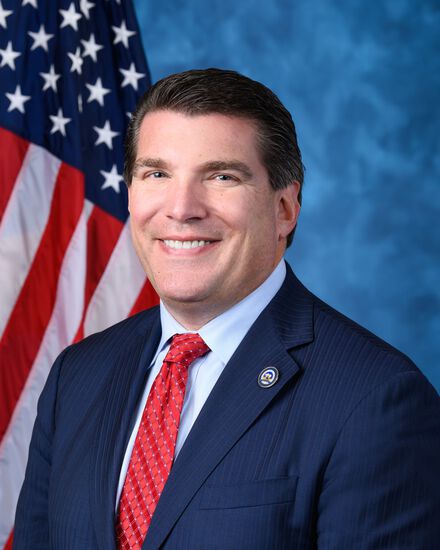
Photo of Jay Obernolte
R United States House · District 23 · California On the 2026 ballot

Rep. Jay Obernolte

Compare
Total votes
2,818
all sessions
Attendance
99%
33 missed
Near the chamber average
With party
91%
of cast votes
Near the chamber average
Bipartisan score
5%
crosses aisle rarely
Near the chamber average
Sponsored
820
bills & resolutions
Near the chamber average
Committees
7
assignments
820 bills and resolutions

Sponsored bills

Total
820
Primary
68
Co-sponsor
752
This page
820
matching current filters
Co-sponsor HRES 670
In committee · Utah House · Co-sponsor
Expressing support for the designation of September 22 as "National Military and Veterans Suicide Awareness Day".

Maddy summaryHRES 670 is a symbolic resolution (not a law) expressing congressional support for designating September 22 as "National Military and Veterans Suicide Awareness Day." It aims to raise public awareness about mental health challenges and suicide prevention within military service members and veterans, acknowledging their sacrifices and the need to reduce stigma around seeking help. The resolution does not create new programs, allocate funding, or change existing policies - it simply encourages national attention during Suicide Prevention Awareness Month in September. This designation directly affects the military and veteran communities by promoting dialogue about their mental health needs.

In committee Sep 2, 2025 1 co-sponsor
Co-sponsor HR 4999
In committee · Utah House · Co-sponsor
Fusion Workforce Act

Maddy summaryThe Fusion Workforce Act (HR 4999) creates dedicated funding streams - $20 million annually for the National Science Foundation and $10 million annually for the Department of Energy - to support workforce development in fusion-related fields. It directly affects institutions of higher education (including community colleges, minority-serving institutions, and Tribal Colleges), National Laboratories, and industry partners by requiring grants for developing fusion-focused curricula, teacher training, hands-on learning experiences, and industry partnerships. Key mechanisms include establishing a national Fusion Education and Workforce Coordination Hub to share resources and address workforce gaps, supporting industry professional instructors in classrooms, and prioritizing outreach to underrepresented groups and rural communities. The bill mandates concrete activities like creating stackable credentials, modernizing lab facilities, and connecting students to internships, all aligned with fusion industry needs.

In committee Aug 19, 2025 1 co-sponsor
Co-sponsor HR 4792
In committee · Utah House · Co-sponsor
Protecting Air Ambulance Services for Americans Act of 2025

Maddy summaryThis bill amends Medicare rules to improve payment for air ambulance services. It requires air ambulance providers to submit detailed cost and revenue data every three years (including fixed costs per base, utilization rates, and revenue) to the Medicare Secretary. The Secretary must then revise fee schedules based on this data and stakeholder input, aiming to better align payments with actual costs. A separate provision mandates the GAO to study average operating costs, payment adequacy, geographic variations, and make recommendations within one year of data collection starting. The bill directly affects Medicare beneficiaries using air ambulances and the providers operating those services.

In committee Jul 29, 2025 1 co-sponsor
Co-sponsor HR 4661
In committee · Utah House · Co-sponsor
AMERICA DRIVES Act

Maddy summaryThe AMERICA DRIVES Act (HR 4661) allows commercial trucks equipped with Level 4 or Level 5 automated driving systems (ADS) to operate interstate without a human driver onboard or a remote operator. It directly affects commercial trucking companies and autonomous vehicle manufacturers by preempting state laws requiring human drivers and mandating the Department of Transportation (DOT) to update regulations by 2027. Key provisions include revising rules around hours of service, drug testing, and driver licensing to apply to driverless vehicles, while defining ADS based on industry standards (SAE J3016). The bill ensures regulatory parity for ADS-equipped trucks and excludes automated technologies from width calculations under safety standards.

In committee Jul 24, 2025 1 co-sponsor
Co-sponsor HR 4686
In committee · Utah House · Co-sponsor
LIFT Act of 2025

Maddy summaryThe LIFT Act of 2025 streamlines regulations for drone and eVTOL (electric air taxi) operations in the U.S. It requires the Transportation Secretary to create new safety rules enabling routine drone flights beyond visual range (BVLOS) within six months and use AI to speed up approval requests for drone waivers. The bill also establishes a 3-year pilot program giving grants to state, local, tribal, and territorial governments to test eVTOL operations - prioritizing projects using U.S.-manufactured drone technology and focusing on applications like medical response and cargo transport. This directly affects drone operators, local governments implementing air mobility projects, and U.S. drone manufacturers by accelerating regulatory approvals and funding for safe integration into national airspace.

In committee Jul 24, 2025 1 co-sponsor
Co-sponsor HR 4698
In committee · Utah House · Co-sponsor
PAAW Act

Maddy summaryHR 4698, the PAAW Act, prohibits the National Institutes of Health (NIH) from conducting or funding research that causes significant pain or distress to dogs or cats. This directly affects NIH-funded studies involving these animals, specifically banning research assigned to USDA-defined severe pain categories (D or E). The law takes effect 90 days after enactment and relies on existing USDA pain classification standards under the Animal Welfare Act. It creates a clear policy change limiting NIH research involving dogs and cats when severe pain is anticipated.

In committee Jul 23, 2025 1 co-sponsor
Co-sponsor HR 740
In committee · Utah House · Co-sponsor
Veterans’ ACCESS Act of 2025

Veterans' Assuring Critical Care Expansions to Support Servicemembers Act of 2025 or the Veterans' ACCESS Act of 2025 This bill addresses the administration of the Veterans Community Care Program (VCCP) and other Department of Veterans Affairs (VA) health care matters. Among other provisions regarding the VCCP, the bill establishes in statute access standards that determine when a veteran is eligible to receive non-VA care through the VCCP, requires the VA to notify veterans regarding their eligibility for care within two business days after the VA is aware the veteran is seeking care, and extends the deadline for the submittal of claims under the VCCP by health care entities and providers. The VA must address its mental health treatment programs by establishing a standardized screening process to determine whether a veteran satisfies criteria for priority or routine admission to a mental health residential rehabilitation treatment program or a program for residential care for mental health and substance abuse disorders, tracking the performance of medical facilities and Veterans Integrated Service Networks in meeting the requirements for mental health treatment screenings and timely admission to treatment programs under such screenings, and establishing an appeal process for when a veteran is denied admission to a covered treatment program or is accepted into a program but not offered bed placement in a timely manner. Additionally, the VA must establish an online self-service module for veterans to request and manage appointments, track referrals, and appeal and track decisions related to requests for care.

In committee Jul 23, 2025 1 co-sponsor
Co-sponsor HR 4576
In committee · Utah House · Co-sponsor
Build More Housing Near Transit Act of 2025

Maddy summaryThis bill amends federal transit grant rules to incentivize local housing policies near transit. It defines "pro-housing policies" as actions removing regulatory barriers (like eliminating parking minimums or streamlining approvals for multi-family housing) and adds a 1-point scoring boost in grant evaluations for projects demonstrating such policies within walking distance of transit. Local governments and developers seeking federal transit capital grants can earn this boost by documenting these policies, with HUD consulted to assess expected housing outcomes. The policy directly affects how transit projects are scored for funding, aiming to align housing production with transit access.

In committee Jul 22, 2025 1 co-sponsor
Co-sponsor HR 4511
In committee · Utah House · Co-sponsor
Uncheck the Box Act

Maddy summaryThis bill would require federal political campaigns to obtain explicit, active consent from donors before charging them repeatedly for contributions. It prohibits campaigns from using pre-checked boxes or passive actions (like failing to uncheck a box) as valid consent for recurring donations. Campaigns would need to send clear receipts showing the next charge date and provide simple cancellation methods upon request. The law directly affects donors to federal election campaigns and the campaigns themselves, mandating transparent handling of recurring payments.

In committee Jul 17, 2025 1 co-sponsor
Showing 151 to 160 of 820 bills
Previous 1 15 16 17 82 Next