

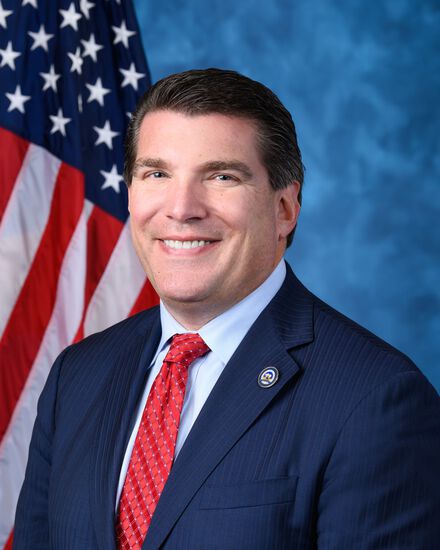
Photo of Jay Obernolte
R United States House · District 23 · California On the 2026 ballot

Rep. Jay Obernolte

Compare
Total votes
2,818
all sessions
Attendance
99%
33 missed
Near the chamber average
With party
91%
of cast votes
Near the chamber average
Bipartisan score
5%
crosses aisle rarely
Near the chamber average
Sponsored
820
bills & resolutions
Near the chamber average
Committees
7
assignments
820 bills and resolutions

Sponsored bills

Total
820
Primary
68
Co-sponsor
752
This page
820
matching current filters
Co-sponsor HR 5488
In committee · Utah House · Co-sponsor
Special Diabetes Program for Indians Reauthorization Act of 2025

Maddy summaryThis bill reauthorizes the Special Diabetes Program for Indians (SDPI) through fiscal year 2030, extending annual funding of $160 million per year. It directly affects American Indian and Alaska Native communities, which face significantly higher rates of diabetes, by ensuring continued federal support for diabetes prevention and treatment programs. The key provision amends the Public Health Service Act to add $160 million in annual funding for fiscal years 2026 through 2030, with funds remaining available until expended. This reauthorization maintains existing program funding levels without altering eligibility or program structure.

In committee Sep 18, 2025 1 co-sponsor
Co-sponsor HR 5454
In committee · Utah House · Co-sponsor
Medicare Advantage Prompt Pay Act

Maddy summaryHR 5454, the Medicare Advantage Prompt Pay Act, requires Medicare Advantage plans to pay 95% of valid claims (with complete data) within 14 days for electronic claims or 30 days for paper claims, starting January 1, 2027. Plans that miss these deadlines must pay interest at standard government rates and face $25,000 civil penalties per violation. The bill also mandates annual reports showing payment rates for in-network versus out-of-network claims and interest paid. This directly affects Medicare Advantage insurers and healthcare providers (like doctors and hospitals) who bill these plans.

In committee Sep 18, 2025 1 co-sponsor
Co-sponsor HR 5441
In committee · Utah House · Co-sponsor
Fusion Advanced Manufacturing Parity Act

Maddy summaryHR 5441, the Fusion Advanced Manufacturing Parity Act, provides a 25% tax credit for manufacturers selling specialized fusion energy components. It directly affects companies producing items like high-temperature superconducting magnets, vacuum vessels, cooling systems, and fusion targets used in fusion energy machines. The credit phases out gradually - 75% in 2032, 50% in 2033, 25% in 2034, and ends after 2034 - and applies to components produced and sold after December 31, 2025. The bill defines these components through detailed technical specifications to clarify eligible products.

In committee Sep 17, 2025 1 co-sponsor
Co-sponsor HR 5343
In committee · Utah House · Co-sponsor
Ensuring Patient Access to Critical Breakthrough Products Act

Maddy summaryThis bill ensures Medicare coverage for new medical devices designated as "breakthrough devices" during a 4-year period after FDA approval. To qualify, devices must meet specific criteria, including FDA priority review, clinical data from Medicare beneficiaries, and a safety review showing benefits outweigh risks. Medicare must finalize coverage decisions within 6 months of manufacturer applications and before the 4-year period ends. The law appropriates $10 million annually (2025-2030) for Medicare to administer this process.

In committee Sep 17, 2025 1 co-sponsor
Co-sponsor HR 5401
In committee · Utah House · Co-sponsor
Pay Our Troops Act of 2026

Maddy summaryHR 5401, the Pay Our Troops Act of 2026, ensures military personnel, civilian Defense workers, and supporting contractors receive pay during government funding gaps in fiscal year 2026. It appropriates emergency funds for active-duty service members, reserves, and their supporting personnel (including Coast Guard staff under DHS) if regular appropriations aren't enacted by the end of the fiscal year. The bill provides necessary pay and allowances during any period when full-year funding is unavailable, covering both active service and support roles. Funding expires when regular appropriations are passed, a funding resolution is enacted, or January 1, 2027, whichever comes first. This is a procedural measure to prevent pay delays for military and support staff during fiscal year 2026 funding lapses.

In committee Sep 16, 2025 1 co-sponsor
Primary HR 5332
In committee · Utah House · Lead sponsor
Liquid Cooling for AI Act of 2025

Maddy summaryThis bill (HR 5332) mandates a federal review of liquid cooling technologies for data centers, requiring the Government Accountability Office (GAO) to assess their research needs, costs, benefits, and market adoption within 90 days. The study will evaluate how liquid cooling compares to air cooling for efficiency, safety, and heat reuse, including waste heat capture for secondary uses. It directly affects federal agencies operating data centers (like the Department of Energy) by informing future infrastructure decisions. The GAO report and subsequent Department of Energy assessment will guide potential policy but do not fund or require adoption of liquid cooling.

In committee Sep 11, 2025 0 co-sponsors
Co-sponsor HRES 695
In committee · Utah House · Co-sponsor
Honoring Charlie Kirk following his assassination on September 10, 2025, in Orem, Utah.

Maddy summaryHRES 695 is a commemorative resolution honoring Charlie Kirk, a conservative speaker and Turning Point USA leader, following his assassination on September 10, 2025, in Orem, Utah. The resolution condemns the attack, offers condolences to his family, and recognizes first responders. It reaffirms the First Amendment right to peaceful assembly and emphasizes that violence cannot silence democratic participation. This non-binding resolution does not create new laws or policies but serves as a symbolic tribute to Kirk's memory and the principles of democratic engagement.

In committee Sep 10, 2025 1 co-sponsor
Co-sponsor HR 2591
Passed · Utah House · Co-sponsor
Mental Health in Aviation Act of 2025

Maddy summaryThe Mental Health in Aviation Act of 2025 requires the Federal Aviation Administration (FAA) to update regulations within two years to encourage pilots and air traffic controllers to seek mental health care and disclose conditions without fear of losing medical clearance. It mandates annual reviews to improve the medical clearance process for mental health conditions - such as approving additional safe medications, enhancing examiner training, and reducing backlogs - and allocates $13.74 million yearly (2026-2029) to hire more aviation medical examiners. The bill also directs the FAA to implement recommendations from a mental health rulemaking committee and fund a public campaign to reduce stigma around mental health care in aviation. These provisions aim to support aviation workers' well-being while streamlining safety-related medical evaluations.

Passed Sep 9, 2025 1 co-sponsor
Co-sponsor HR 5195
In committee · Utah House · Co-sponsor
Advancing Toward Impact Aid Full Funding Act

Maddy summaryThis bill increases federal funding for Impact Aid, which supports school districts that serve students on federal property (like military bases) or have high numbers of children with disabilities. It authorizes specific annual funding amounts for four key areas: payments for federal property acquisition, basic support for heavily impacted districts, aid for children with disabilities, and school construction. The funding grows incrementally each year from 2026 through 2031, with total annual amounts rising from $85 million to $250 million for property payments, and from $1.49 billion to $2.35 billion for basic district support. This directly affects school districts in communities with significant federal land or federal facility presence.

In committee Sep 8, 2025 1 co-sponsor
Co-sponsor HR 1510
In committee · Utah House · Co-sponsor
Due Process Continuity of Care Act

Maddy summaryHR 1510, the Due Process Continuity of Care Act, expands Medicaid eligibility to cover individuals in jail or custody while awaiting trial or disposition of charges, at a state's option. This allows states to provide Medicaid benefits to this population without requiring them to be convicted first. The bill provides $50 million in planning grants to states to develop implementation plans, including assessing healthcare needs, recruiting providers (especially for behavioral health and substance use treatment), and creating electronic billing systems for correctional facilities and outpatient providers. States must also consult with stakeholders like jails, providers, and Medicaid advocates before finalizing their plans.

In committee Sep 8, 2025 1 co-sponsor
Showing 141 to 150 of 820 bills
Previous 1 14 15 16 82 Next