

Social Media Privacy Protection and Consumer Rights Act of 2021 This bill requires online platform operators to inform a user, prior to a user creating an account or otherwise using the platform, that the user's personal data produced during online behavior will be collected and used by the operator and third parties. The operator must provide a user the option to specify privacy preferences, and an operator may deny certain services or complete access to a user if the user's privacy elections create inoperability in the platform. The operator must (1) offer a user a copy of the personal data of the user that the operator has processed, free of charge, and in an electronic format; and (2) notify a user within 72 hours of becoming aware that the user's data has been transmitted in violation of the security platform. A violation of the bill's privacy requirements shall be considered an unfair or deceptive act or practice under the Federal Trade Commission Act. The Federal Trade Commission (FTC) may enforce this bill against common carriers regulated by the Federal Communications Commission under the Communications Act of 1934 and nonprofit organizations. Currently, common carriers regulated under that Act are exempt from the FTC's enforcement authority, and nonprofit organizations are subject to FTC enforcement only if they provide substantial economic benefit to their for-profit members. A state may bring a civil action in federal court regarding such violations.
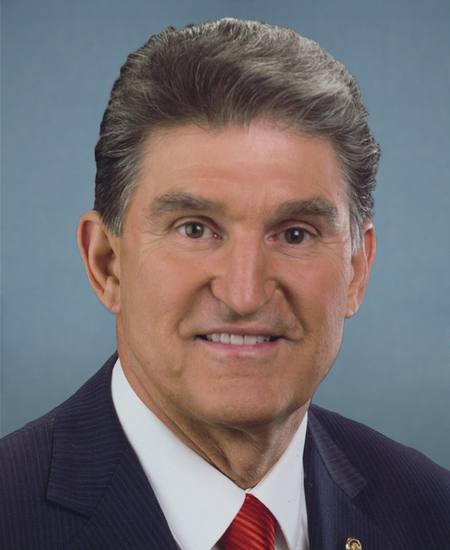
Sen. Joe Manchin, III
Sponsored bills
This resolution designates the week of May 9-May 15, 2021, as National Police Week.
FDA Review of Efficacy of EERW Double-Blinds of Opioids Act or the FREED of Opioids Act This bill requires the Food and Drug Administration (FDA) to take certain actions to determine whether to permit the use of a certain methodology for drug clinical trials. Specifically, the FDA must seek to contract with the National Academy of Sciences (NAS) for the NAS to conduct a study on the effectiveness of using enriched enrollment randomized withdrawal methodology in demonstrating the efficacy of opioid drugs in treating chronic pain. The FDA must also convene a meeting of two specified FDA advisory committees to review the NAS study and vote on whether to permit the use of this methodology in drug clinical trials.
This resolution expresses support for the goals and ideals of National Nurses Week.
DEA Enforcement and Authority Act of 2021 This bill modifies enforcement authorities of the Drug Enforcement Administration (DEA). First, the bill modifies the required elements of an order to show cause issued by the DEA before it denies, revokes, or suspends a registration due to a violation of the Controlled Substances Act. Specifically, the bill eliminates the requirement that an order to show cause must notify the registrant of the opportunity to submit a corrective action plan. Second, the bill modifies the standard of review for an immediate suspension order. Currently, the DEA may immediately suspend the registration of a controlled substances manufacturer, distributor, or dispenser to prevent imminent danger to the public health or safety. This bill lowers the standard for determining imminent danger to the public health or safety—from substantial likelihood of an immediate threat of harm to probable cause that harm will occur.
Carried Interest Fairness Act of 2021 This bill modifies the tax treatment of carried interest, which is compensation that is typically received by a partner of a private equity or hedge fund and is based on a share of the fund's profits. (Under current law, carried interest is taxed as investment income rather than at ordinary income tax rates.) This bill includes provisions that set forth a special rule for the inclusion in gross income of partnership interests transferred in connection with the performance of services, treat as ordinary income the net capital gain with respect to an investment services partnership interest except to the extent such gain is attributable to a partner's qualified capital interest, exempt income from investment services partnership interests from treatment as qualifying income of a publicly traded partnership, exempt certain family partnerships from the application of this bill, increase the penalty for underpayments of tax resulting from failure to treat income from an investment services partnership interest as ordinary income, and include income and loss from an investment services partnership interest for purposes of determining net earnings from self-employment and applicable self-employment taxes. The bill defines investment services partnership interest as any interest in a partnership held by a person who provides services to a partnership by (1) advising the partnership about investing in, purchasing, or selling specified assets; (2) managing, acquiring, or disposing of specified assets; or (3) arranging financing with respect to acquiring specified assets.
Improving Medicaid Programs' Response to Overdose Victims and Enhancing Addiction Care Act or the IMPROVE Addiction Care Act This bill establishes additional requirements for state Medicaid drug-use review programs with respect to individuals who experience opioid-related overdoses. Specifically, programs must include protocols that (1) connect individuals who have experienced an opioid-related overdose within a certain period to appropriate treatment; (2) notify providers who prescribe opioids about subsequent fatal overdoses; (3) ensure providers are notified about an individual's history of opioid-use disorder, overdoses, or poisonings; and (4) educate providers about proper prescribing practices for these individuals.
This resolution thanks the teachers of the United States and promotes the teaching profession by encouraging students, parents, school administrators, and public officials to recognize National Teacher Appreciation Week.
Revitalizing the Economy of Coal Communities by Leveraging Local Activities and Investing More Act of 2021 or the RECLAIM Act of 2021 This bill revises requirements concerning the Abandoned Mine Reclamation Fund, including by expanding the eligible uses of the fund. Specifically, the bill allows the fund to be used to provide support for economic revitalization, diversification, and development in economically distressed mining communities through the reclamation and restoration of land and water resources adversely affected by abandoned coal mines. In addition, it requires specified amounts to be annually distributed from the fund through FY2026 to states and Indian tribes for reclaiming and restoring lands and waters so affected.
Military Hunger Prevention Act This bill requires the Department of Defense (DOD) to pay a basic needs allowance to certain low-income members of the Armed Forces. Specifically, those eligible for the basic needs allowance are members who (1) have completed initial entry training, (2) have a gross household income that did not exceed an amount equal to 130% of the federal poverty guidelines of the Department of Health and Human Services (HHS), and (3) do not elect to decline the allowance. In situations where a household contains two or more eligible members, the bill specifies that only one allowance may be paid per year to one member they jointly elect. The amount of the allowance must be the aggregate amount equal to 130% of the HHS federal poverty guidelines minus the gross household income of the covered member during the preceding year divided by 12. The Defense Finance and Accounting Service (DFAS) of DOD must notify, in writing, individuals determined to be eligible for the allowance. The notice must include information regarding financial management and assistance programs administered by DOD for which the individuals are also eligible. Individuals who seek to receive the allowance must submit specified information to DFAS.