Chesapeake Bay Science, Education, and Ecosystem Enhancement Act of 2021 This bill reauthorizes through FY2025 the National Oceanic and Atmospheric Administration's Chesapeake Bay Office and revises requirements concerning the office and its activities. It also authorizes the office to establish a Chesapeake Bay watershed education and training program as well as a program to support coordinated management, protection, characterization, and restoration of priority habitats and living resources.
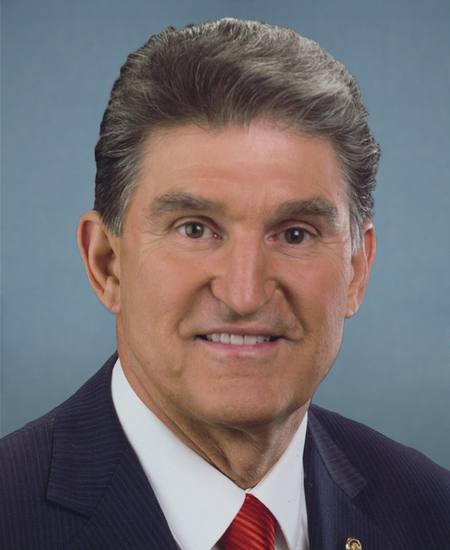
Sen. Joe Manchin, III
Sponsored bills
Conrad State 30 and Physician Access Reauthorization Act This bill modifies the Conrad 30 Waiver program, which incentivizes qualified foreign physicians to serve in underserved communities. It also extends statutory authority for the program for three years from this bill's enactment. Aliens coming to the United States under a J-1 nonimmigrant visa to receive medical training typically must leave the country and reside for two years abroad before being eligible to apply for an immigrant visa or permanent residence. The Conrad program waives this requirement for individuals who meet certain qualifications, including serving for a number of years at a health care facility in an underserved area. The bill increases the number of waivers that a state may obtain each fiscal year from 30 to 35 if a certain number of waivers were used the previous year, and provides for further adjustments depending on demand. An alien physician may be employed at an academic medical center to meet the Conrad program's employment requirements if the alien's work is in the public interest, even if the medical center is not in an underserved area. Employment contracts for alien physicians under the Conrad program shall contain certain information, such as the maximum number of on-call hours per week the physician shall have to work. Certain alien physicians (along with the physician's spouse and children) shall be exempt from the direct annual numerical limits on immigration, including those physicians that have met certain requirements related to visas for physicians to serve in underserved areas.
Dentist and Optometric Care Access Act of 2021 or the DOC Access Act of 20 21 This bill prohibits private health insurance plans from setting rates for items and services, except for dental cleanings, provided by a doctor of optometry, of dental surgery, or of dental medicine for which the plan does not pay a substantial amount. Additionally, an agreement between a plan and such a doctor for limited scope dental or vision benefits may last longer than two years only with the prior acceptance of the doctor for each term extension. Plans also may not restrict such a doctor's choice of laboratories or suppliers. Such doctors may elect to waive the application of the payment amount and choice of laboratories provisions of this bill. The bill establishes a private right of action for a person adversely affected by a violation of this bill. The bill does not supersede state laws regarding health insurers and dental or vision benefit plans.
This resolution recognizes April 30, 2021, as National Arbor Day and encourages the people of the United States to participate in National Arbor Day activities.
National Center for the Advancement of Aviation Act of 202 1 This bill establishes the National Center for the Advancement of Aviation to serve as a national independent forum to facilitate collaboration and cooperation between aviation and aerospace stakeholders to support and promote civil and military aviation and aerospace. The center must perform the following duties support the development of aviation and aerospace education curricula; support the professional development of educators using such curricula; promote aviation and aerospace employment opportunities; support Armed Forces personnel seeking to transition to a career in civil aviation or an aerospace-related field through outreach, training, apprenticeships, or other means; serve as a central repository for publicly available economic data, safety data, and research efforts related to the aviation and aerospace sectors; and serve as a forum, through symposiums, conferences, and other means as appropriate, for cross-disciplinary collaboration among aviation and aerospace stakeholders. Additionally, the center may issue grants to organizations that have experience in, and knowledge of, creating, developing, and delivering or updating (1) high school aviation curricula; or (2) aviation curricula used at institutions of higher education, secondary educations institutions, or by technical training and vocational schools.

Budgeting for Opioid Addiction Treatment Act This bill imposes an excise tax on the sale of any active opioid. The tax is equal to one cent per milligram so sold and it is imposed on the manufacturer, producer, or importer of the opioid. The term active opioid means any controlled substance that is opium, an opiate, or any derivative thereof. The bill provides block grants for substance abuse treatment programs. The Department of Health and Human Services must report on the impact of this bill on (1) the retail cost of active opioids; (2) patient access to such opioids, particularly cancer and hospice patients; and (3) the use of tax revenues to improve substance abuse treatment efforts. The report must also make suggestions for improving access to opioids for cancer and hospice patients and substance abuse treatment efforts.
Eliminating Barriers to Rural Internet Development Grant Eligibility Act or the E-BRIDGE Act This bill authorizes the Department of Commerce to award economic development grants for public-private partnerships and certain consortiums to carry out specified broadband projects. Such projects shall be to provide, extend, expand, or improve high-speed broadband service through (1) planning, technical assistance, or training; (2) land acquisition or development; or (3) acquisition, construction, or improvement of facilities. Title to real or personal property acquired or improved with grant funds, or another acceptable possessory interest, must be vested in a public partner or eligible nonprofit organization or association for the useful life of the project. In addition, grant funds may be combined with amounts made available under any other federal program, and Commerce may provide credit toward the nonfederal share of a broadband project's cost.
Postal Service Reform Act of 2021 This bill addresses the finances and operations of the U.S. Postal Service (USPS). The bill requires the Office of Personnel Management to establish, within the Federal Employees Health Benefits Program, the Postal Service Health Benefits Program for USPS employees and retirees and provides for coordinated enrollment of retirees under this program and Medicare. The bill repeals the requirement that the USPS annually prepay future retirement health benefits. Additionally, the USPS may establish a program to enter into agreements with an agency of any state government, local government, or tribal government, and with other government agencies, to provide certain nonpostal products and services that reasonably contribute to the costs of the USPS and meet other specified criteria. The USPS must develop and maintain a publicly available dashboard to track service performance and must report regularly on its operations and financial condition. The bill requires mail delivery to occur at least six days a week. The Postal Regulatory Commission must annually submit to the USPS a budget of its expenses. It must also conduct a study to identify the causes and effects of postal inefficiencies relating to flats (e.g., large envelopes). The USPS Office of Inspector General shall perform oversight of the Postal Regulatory Commission.
Delivering Envelopes Judiciously On-time Year-round Act or the DEJOY Act This bill requires the U.S. Postal Service (USPS) to maintain the service standards for first-class mail that were in effect on January 1, 2021. The Postmaster General proposed in March 2021 a 10-year restructuring plan for the USPS that would lengthen the permissible mail-delivery window.
Credit for Caring Act of 2021 This bill allows an eligible caregiver a tax credit of up to $5,000 for 30% of the cost of long-term care expenses that exceed $2,000 in a taxable year. The bill defines eligible caregiver as an individual who has earned income for the taxable year in excess of $7,500 and pays or incurs expenses for providing care to a spouse or other dependent relative with long-term care needs.