

Maddy summaryThe Raise the Wage Act of 2023 would gradually increase the federal minimum wage to $17.00 per hour by 2028, with specific annual steps: $9.50 in year one, $11.00 in year two, $12.50 in year three, $14.00 in year four, $15.50 in year five, and $17.00 starting in year six. It also phases out separate minimum wage rates for tipped workers (raising their base wage to match the standard minimum wage by year six) and for workers under 20 (phasing out their lower rate by year five). The bill requires annual minimum wage adjustments after year six based on increases in the median hourly wage of all employees, as tracked by the Bureau of Labor Statistics. Additionally, it eliminates special minimum wage certificates for workers with disabilities by 2028, requiring all such workers to receive the standard minimum wage.
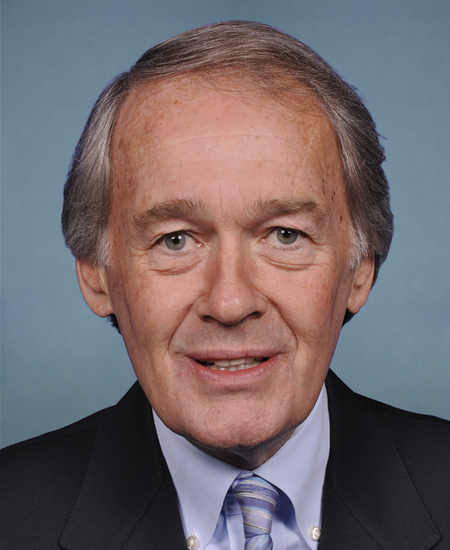
Sen. Edward J. Markey
Sponsored bills
Maddy summaryThis bill, S 2484, requires all states to allow the possession, distribution, and use of fentanyl and xylazine test strips - devices that detect dangerous drugs in user substances - without criminal penalties. It directly affects people who use drugs by removing legal barriers to accessing these life-saving tools, which help prevent overdoses by revealing adulterants like fentanyl. The law overrides current state laws that still classify these strips as "drug paraphernalia" in some states, particularly for xylazine detection. It mandates state compliance with federal authorization for these products, which are already legal in 36 states but restricted in others. The bill aims to expand nationwide access to these strips, which studies show reduce overdose risks when used before drug consumption.
Maddy summaryThe CHARGE Act of 2023 requires the Federal Energy Regulatory Commission (FERC) to establish new rules for planning and cost allocation of electricity transmission infrastructure. It mandates transmission providers to engage in interregional planning, consider multiple benefits of transmission investments (including reliability, renewable energy integration, and cost savings), and use grid-enhancing technologies like dynamic line ratings and power flow control. The bill also requires transparency by making hourly grid data, including emissions data and congestion costs, publicly accessible through a centralized database. This legislation directly affects transmission providers, utilities, and consumers who rely on the electricity grid, with implementation requiring FERC to promulgate final rules within 18 months of enactment.
Maddy summaryS 2494, the Communications, Video, and Technology Accessibility Act of 2023, requires closed captioning and audio description for all video programming delivered via internet protocol (streaming services), with implementation deadlines up to 6 years depending on programming type (live, near-live, or prerecorded). The bill mandates that video playback devices include accessible controls for captioning and audio description, and establishes advisory committees to develop technical standards for these requirements. It directly affects streaming platforms, content providers, and device manufacturers, aiming to improve accessibility for people with hearing, visual, and speech disabilities.
Maddy summary# Summary of Proposed Election Reform Legislation This comprehensive legislative document outlines a wide-ranging election reform bill with multiple titles addressing various aspects of voting rights, election administration, and election integrity. Key provisions include: 1. **Democracy Restoration** (Title I): - Restores voting rights for citizens with criminal convictions (except those serving felony sentences in correctional institutions) - Requires states to notify individuals of restored voting rights upon completion of sentence or release from custody - Includes enforcement mechanisms for states to comply with the restoration provisions 2. **Voter Identification Requirements** (Title II): - Establishes a standardized system for voter identification requirements - Specifies acceptable forms of identification (including many government-issued documents) - Requires states to provide free identification documents to eligible voters - Includes funding ($5 million annually for 5 years) to cover costs 3. **Voter List Maintenance** (Title III): - Prohibits "voter caging" (using undeliverable mail to challenge voter eligibility) - Requires states to verify voter ineligibility using objective and reliable evidence - Limits removal of voters from registration lists to specific circumstances (death, permanent move) - Mandates notice requirements for voters removed from lists 4. **Election Integrity** (Title IV): - Prohibits interference with voter registration (Section 612) - Restricts removal of local election administrators to cases of inefficiency, neglect, or malfeasance - Prohibits harassment and intimidation of election workers - Bans deceptive practices in elections (false information about voting procedures, qualifications, or endorsements) The legislation aims to expand voting access while maintaining election integrity, with specific focus on eliminating barriers for people with criminal convictions, ensuring fair voter list maintenance, and protecting election workers from harassment and intimidation. It also includes provisions for enforcement through civil actions, criminal penalties, and reporting requirements.
Maddy summaryS 2427 requires group health plans and health insurance issuers (both group and individual plans) to cover a full year's supply (up to 365 days) of contraceptives that are already mandated to be covered under existing law. This means enrollees can obtain a one-time refill for a full year's supply without any additional cost-sharing (like copays or deductibles). The rule applies to all plans with coverage effective January 1, 2024, and requires federal agencies to inform providers and enrollees about the new requirement within 90 days of the law's enactment. The bill directly affects people with health insurance who use prescribed contraceptives, ensuring easier access without extra out-of-pocket costs for a full year's supply.
Maddy summaryS 2435, the Improving Access to Nutrition Act of 2023, eliminates work requirements for participants in the Supplemental Nutrition Assistance Program (SNAP). This change directly affects approximately 6.1 million individuals currently subject to SNAP work requirements, particularly vulnerable populations including families with children and people with health barriers that prevent meeting such requirements. The bill amends Section 6 of the Food and Nutrition Act of 2008 to remove these requirements and includes necessary conforming changes to related laws. By eliminating these requirements, the bill aims to increase SNAP participation and access to food assistance without adding administrative barriers. The law would take effect 180 days after enactment.
Maddy summaryThe Bridging the SNAP Gap Act of 2023 raises the age for excluding income from SNAP eligibility calculations from 17 to 21, potentially expanding access for young adults aged 18-21. It revises the standard medical expense deduction to base the amount on the Medicare Part B premium rate (set annually by the Social Security Act), removing the previous requirement that deductions only applied to households with elderly or disabled members. The deduction amount for each fiscal year will align with the Medicare Part B premium effective October 1 of that year. States may establish a higher deduction if it meets cost neutrality standards without increasing federal costs.
Maddy summaryThe Insuring Fairness for Family Farmers Act of 2023 modifies how crop insurance agents are compensated by adjusting A&O subsidies (administrative/operating expense payments). It sets fixed minimum and maximum subsidy amounts per policyholder (with the max no more than 400% above the min) and ties subsidies to policy complexity (e.g., number of crops, policy types) rather than premium size. The bill adds 10% bonuses for small farms (<180 acres), specialty crops, or first-time insurance buyers. It requires public data reporting on subsidies by state, crop, and policy type, and mandates a GAO report on federal crop insurance program structure. This directly affects crop insurance agents and farmers, particularly small family farms, by reshaping subsidy distribution.
Maddy summaryThe Securing Gene Synthesis Act (S 2400) requires gene synthesis providers (companies creating custom DNA/RNA) and manufacturers of gene synthesis equipment to implement screening protocols to detect potential misuse of synthetic genetic material. It mandates that these entities be verified for compliance, with federal funding tied to adherence - non-compliant entities risk funding revocation. The bill defines key terms like "gene synthesis product" (excluding basic chemicals or sequencing byproducts) and sets a 2026 deadline for federal agencies to report compliance policies. This directly affects providers and equipment makers by imposing new screening and verification obligations under federal health law.