

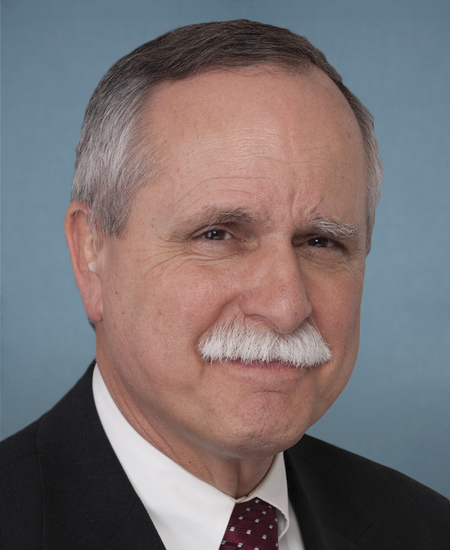
Hearing Protection Act This bill removes silencers from the definition of firearms for purposes of the National Firearms Act. It also treats persons acquiring or possessing a firearm silencer as meeting any registration and licensing requirements of such Act. The Department of Justice must destroy certain records relating to the registration, transfer, or making of a silencer. The bill also revises the definitions of firearm silencer and firearm muffler under the federal criminal code and includes such items in the 10% excise tax category.
Rep. David B. McKinley
Sponsored bills
Concealed Carry Reciprocity Act This bill establishes a federal statutory framework to regulate the carry or possession of concealed firearms across state lines. Specifically, an individual who is eligible to carry a concealed firearm in one state may carry or possess a concealed handgun (other than a machine gun or destructive device) in another state that allows its residents to carry concealed firearms. It sets forth requirements for the lawful concealed carry across state lines. The bill preempts most state and local laws related to concealed carry and establishes a private right of action for a person adversely affected by interference with a concealed-carry right established by this bill.
Protecting Providers Everywhere in America Act or the PPE in America Act This bill makes temporary changes to the management of the inventory of diagnostic testing supplies and personal protective equipment in the Strategic National Stockpile. Through FY2026, the Department of Health and Human Services (HHS) must source a certain amount of those products from domestic manufacturers. Additionally, HHS must periodically assess and take steps to manage the inventory of those products. This includes, as appropriate, transfers or sales to federal agencies and health care facilities. The bill also provides HHS with additional authorities to manage the inventory. For example, HHS may enter into arrangements with manufacturers to establish revolving stockpiles to mitigate the risk of products expiring. HHS must report on its efforts to maintain the stockpile's inventory of testing supplies and personal protective equipment.
Public Buildings Renewal Act of 2021 This bill allows tax-exempt financing of certain government-owned buildings by expanding the definition of exempt facility bond to include bonds used for qualified government buildings. A qualified government building is a government-owned building or facility that consists of one or more of the following an elementary or secondary school; facilities of a state college or university used for educational purposes; a public library; a court; hospital, health care, laboratory, or research facilities; public safety facilities; or offices for government employees. The bill excludes buildings or facilities that include specified recreational equipment or are used for the primary purpose of providing retail food and beverage services, recreation, or entertainment. The bill establishes (1) a $5 billion limit on the amount of tax-exempt financing which may be provided for government buildings, and (2) procedures for allocating and applying for the financing of a building, including a certification that the project owner will use reasonable efforts to ensure against job losses. The bill also allows an exemption from the volume cap for private activity bonds used to finance government buildings.
Nuclear Prosperity and Security Act This bill directs the Department of Energy to establish and operate a uranium reserve to ensure the availability of uranium mined in the United States in the event of a market disruption and support strategic fuel cycle capabilities in the United States. Uranium that is mined in the United States by an entity that is owned or controlled by Russia or the People's Republic of China or is incorporated in either country must be excluded from the reserve.
Telehealth Modernization Act This bill modifies requirements relating to coverage of telehealth services under Medicare. Specifically, the bill extends certain flexibilities that were initially authorized during the public health emergency relating to COVID-19 (i.e., coronavirus disease 2019). Among other things, the bill allows (1) rural health clinics and federally qualified health centers to serve as the distant site (i.e., the location of the health care practitioner); (2) the home of a beneficiary to serve as the originating site (i.e., the location of the beneficiary) for all services (rather than for only certain services); and (3) all types of practitioners to furnish telehealth services, as determined by the Centers for Medicare & Medicaid Services.
K2 Veterans Care Act of 2021 This bill establishes a presumption of service-connection for certain diseases becoming manifest in a veteran who served on active duty at Karshi-Khanabad (K2) Air Base in Uzbekistan between January 1, 2001, and December 31, 2005. Specifically, there must be a presumption of service-connection for veterans who manifest illnesses that have a positive association with exposure to jet fuel, volatile organic compounds, high levels of particulate matter, depleted uranium, asbestos, or lead-based paint, as determined by the National Academies of Sciences, Engineering, and Medicine (NASEM). Under a presumption of service-connection, specific conditions diagnosed in certain veterans are presumed to have been caused by the circumstances of their military service. Health care benefits and disability compensation may then be awarded. Veterans who served at K2 Air Base during the specified period are eligible for Department of Veterans Affairs hospital care, medical services, and nursing home care for an illness that has been determined by NASEM to have a positive association with exposure to jet fuel, volatile organic compounds, high levels of particulate matter, depleted uranium, asbestos, or lead-based paint.
New Markets Tax Credit Extension Act of 2021 This bill makes the new markets tax credit permanent. It also modifies the credit to (1) provide for an inflation adjustment to the limitation amount for the credit after 2021, and (2) allow an offset against the alternative minimum tax for the credit (determined with respect to qualified equity investments initially made after 2020).
Hospitality and Commerce Job Recovery Act of 2021 This bill extends existing and establishes new tax credits that assist the hospitality and restaurant industry. Specifically, it allows a conventionand trade show restart tax credit; extends the employee retention tax credit through 2021; suspends for taxable years 2021 through 2022, the limitation on entertainment expenses related to a trade or business, allows a restaurant and dining restart credit for businesses closed or forced to reduce services due to COVID-19 (i.e., coronavirus disease 2019); allows a 50% tax credit for travel expenditures; and allows a tax credit for unmerchantable inventory for the period between December 31, 2019, and before April 1, 2021.
Keystone XL Pipeline Construction and Jobs Preservation Act This bill authorizes the TransCanada Keystone Pipeline to construct, connect, operate, and maintain the pipeline facilities in Phillips County, Montana, for the import of oil from Canada to the United States.