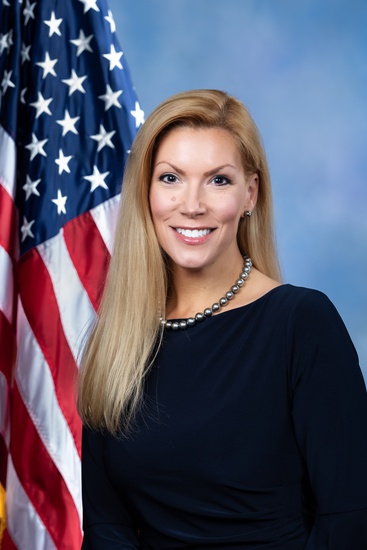
Photo of Beth Van Duyne
R United States House · District 24 · Texas On the 2026 ballot

Rep. Beth Van Duyne

Compare
Total votes
2,837
all sessions
Attendance
99%
19 missed
Higher than 78% of chamber peers
With party
94%
of cast votes
Near the chamber average
Bipartisan score
3%
crosses aisle rarely
Near the chamber average
Sponsored
913
bills & resolutions
Near the chamber average
Committees
8
assignments
913 bills and resolutions

Sponsored bills

Total
913
Primary
111
Co-sponsor
802
This page
913
matching current filters
Co-sponsor HR 10308
In committee · United States House · Co-sponsor
To amend the Internal Revenue Code of 1986 to allow for payments to certain individuals who dye fuel, and for other purposes.

Maddy summaryHR 10308 would create a refund program for businesses that handle permanently dyed diesel or kerosene fuel used off-road (like for farming or construction). It allows eligible businesses to receive a payment equal to taxes previously paid on this fuel, which is legally marked with indelible dye and exempt from highway taxes. The refund applies when the fuel is removed from a terminal, and the program would begin 180 days after the bill becomes law. This affects fuel distributors and businesses managing legally dyed off-road fuel.

In committee Dec 5, 2024 1 co-sponsor
Co-sponsor HR 10300
In committee · United States House · Co-sponsor
Chevron Re-Review Act

Maddy summaryHR 10300, the Chevron Re-Review Act, establishes a new process for Congress to review and disapprove federal agency rules that relied on Chevron deference (the legal doctrine where courts defer to agency interpretations of ambiguous laws). The bill requires agencies to provide Congress with specific information about such rules - including cost-benefit analyses and litigation history - within 30 days of a disapproval resolution's introduction. If Congress passes a joint resolution disapproving a rule, the rule is treated as if it never took effect. This procedural bill directly affects agencies and Congress, applying only to rules explicitly based on Chevron deference or upheld by courts using that doctrine.

In committee Dec 5, 2024 1 co-sponsor
Co-sponsor HR 10258
In committee · United States House · Co-sponsor
Kairo Act of 2024

Maddy summaryThe Kairo Act of 2024 requires child care providers receiving federal funds (like Child Care Development Block Grants or Head Start) to create a "parent’s bill of rights" document. This document must include specific information for parents, such as child abuse hotline contacts, access to facility inspection reports, procedures for reviewing video recordings of incidents, and policies on staff training. Providers must distribute this written document to parents within 45 days of the law’s effective date or before a child’s first day in care. The law applies directly to center-based, family, and religious child care providers receiving federal funding, aiming to increase transparency and parent access to facility records.

In committee Nov 26, 2024 1 co-sponsor
Co-sponsor HR 7233
In committee · United States House · Co-sponsor
Jenna Quinn Law of 2024

Maddy summaryHR 7233, the Jenna Quinn Law of 2024, creates new federal grants to fund innovative child sexual abuse awareness and prevention programs. The bill authorizes the Secretary to award up to 5-year grants to schools, child-serving organizations, and other entities for projects that: (1) teach students age-appropriate abuse recognition and reporting, (2) train teachers and mandatory reporters, and (3) provide parents with prevention resources. Grantees must submit annual reports detailing participants, services, and outcomes. Additionally, the Comptroller General must evaluate the program's effectiveness and check for duplication with other federal efforts within five years, reporting findings to relevant congressional committees.

In committee Nov 26, 2024 1 co-sponsor
Co-sponsor HR 915
In committee · United States House · Co-sponsor
Motor Carrier Safety Selection Standard Act

Maddy summaryHR 915 requires businesses that contract with motor carriers (like shippers, brokers, or freight forwarders) to verify three safety and compliance details before shipping goods: 1) the carrier's valid registration, 2) minimum required insurance coverage, and 3) that the carrier is not disqualified for safety reasons by the Federal Motor Carrier Safety Administration (FMCSA) or a state. This verification must occur 45 days before shipment. The bill creates a temporary standard that expires when new FMCSA regulations are issued within 18 months of enactment. It does not change carrier safety rules but sets a new requirement for businesses selecting carriers.

In committee Nov 26, 2024 1 co-sponsor
Co-sponsor HR 10228
In committee · United States House · Co-sponsor
Sheila Jackson Lee Stop Human Trafficking in School Zones Act

Maddy summaryThis bill increases penalties for certain crimes involving minors near schools. It adds a mandatory 5-year prison term (to run consecutively with other sentences) when offenders knowingly commit human trafficking, coercion, sexual abuse, child exploitation, or related offenses against minors who are: - Enrolled in school and present within a school zone or within 1,000 feet of school activities, or - Enrolled in a college/university and on or within 1,000 feet of campus. The bill amends multiple sections of the U.S. Code (including trafficking, sexual abuse, and exploitation laws) to apply these enhanced penalties specifically in school-related settings, as defined by existing education laws. It directly affects offenders of these crimes who target minors in or near educational environments.

In committee Nov 21, 2024 1 co-sponsor
Co-sponsor HR 6951
In committee · United States House · Co-sponsor
College Cost Reduction Act

Maddy summary# Summary of Proposed Higher Education Act Amendments This document outlines significant proposed amendments to the Higher Education Act of 1965, primarily as part of the "College Cost Reduction Act." The key elements include: ## Accreditation Reform - Major overhaul of accreditation standards, requiring accrediting agencies to demonstrate independence from trade associations - New requirements for accrediting agencies to assess student achievement outcomes, including median value-added earnings relative to median total price charged - Introduction of an "Alternative Quality Assurance Experimental Site Initiative" to test non-accredited institutions - Protections for religious institutions, including a new process for appealing accreditation decisions related to religious mission - Removal of "litmus tests" that would require institutions to support specific political viewpoints ## Student Success Initiatives - Establishment of "Postsecondary Student Success Grants" to increase participation, retention, and completion rates for high-need students - Focus on evidence-based practices, with tiered requirements (tier 1, 2, and 3 reforms) - Mandatory inclusion of high-need student populations (low-income, first-generation, military-connected, etc.) - Requirements for institutions to report on completion rates, retention rates, and student demographics ## Regulatory Changes - Repeal of numerous existing regulations including: * Closed school discharges * Borrower defense to repayment * Pre-dispute arbitration * False certification requirements * Ability-to-benefit rules * Financial responsibility regulations - New restrictions on incentive compensation for recruiters - Changes to third-party servicer definitions and regulations ## Transfer and Credit Policies - New requirement that institutions cannot deny transfer credit based solely on the source of accreditation - Requirements for transparent transfer policies - Changes to reverse transfer policies ## Other Key Provisions - Modifications to the National Advisory Committee on Institutional Quality and Integrity (NACIQI) - New definitions for "total price" and "value-added earnings" - Changes to the process for institutions to change accrediting agencies - New requirements for institutions to report on student outcomes The overall focus of these proposed amendments is to reduce regulatory burden on institutions, promote transparency, improve student outcomes (particularly for high-need students), modernize accreditation processes, and protect religious institutions' rights in accreditation decisions.


In committee Nov 18, 2024 1 co-sponsor
Co-sponsor HR 5342
Failed · United States House · Co-sponsor
Equal Treatment of Public Servants Act of 2023

Maddy summaryThis bill would change how Social Security benefits are calculated for public servants who worked in jobs not covered by Social Security (such as many state and local government positions). It replaces the current Windfall Elimination Provision with a new formula that accounts for both covered and noncovered earnings when calculating benefits, rather than reducing benefits based on noncovered employment. The bill would provide additional monthly payments of $100 for some affected individuals and $50 for others, starting 270 days after enactment. It also requires Social Security account statements to show noncovered earnings and directs the Social Security Administration to study ways to improve information sharing with state pension systems about noncovered pensions. The changes would apply to benefits payable starting January 1, 2025.

Failed Nov 12, 2024 1 co-sponsor
Co-sponsor HRES 1547
In committee · United States House · Co-sponsor
Honoring the investiture of Texas A&M University's 27th President, retired Air Force General Mark A. Welsh III, and extending best wishes to Aggies everywhere.

Maddy summaryThis is a ceremonial resolution (HRES 1547) honoring retired Air Force General Mark A. Welsh III upon his investiture as Texas A&M University's 27th president. It formally recognizes his military service, leadership, and connection to the university (including his family's Aggie legacy), and extends best wishes to Texas A&M students and alumni ("Aggies"). The resolution has no policy impact or effect on any individuals or programs - it is a non-binding expression of support from the U.S. House of Representatives.

In committee Oct 22, 2024 1 co-sponsor
Co-sponsor HR 9920
In committee · United States House · Co-sponsor
BE GONE Act

Maddy summaryHR 9920 (the BE GONE Act) amends the Immigration and Nationality Act to expand the definition of "aggravated felonies" by adding "sexual assault and aggravated sexual violence" as a specific category. This change directly affects non-citizens convicted of these offenses, as it triggers mandatory deportation under existing immigration law. The bill does not create new penalties or enforcement procedures but alters the legal definition that determines deportation eligibility. It is a definitional amendment to existing immigration law, not a new enforcement measure.

In committee Oct 4, 2024 1 co-sponsor
Showing 361 to 370 of 913 bills
Previous 1 … 36 37 38 … 92 Next