

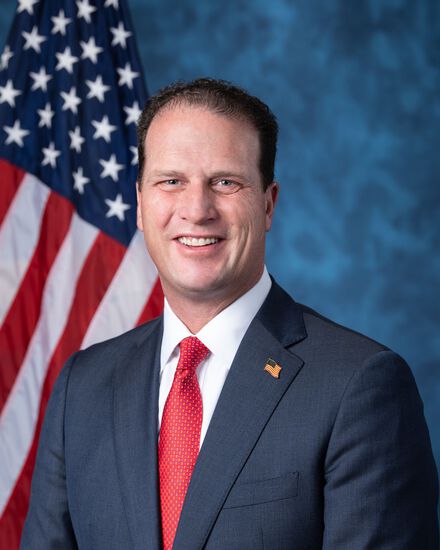
Photo of August Pfluger
R United States House · District 11 · Texas On the 2026 ballot

Rep. August Pfluger

Compare
Total votes
2,837
all sessions
Attendance
99%
37 missed
Near the chamber average
With party
96%
of cast votes
Higher than 93% of chamber peers
Bipartisan score
2%
crosses aisle rarely
Lower than 94% of chamber peers
Sponsored
1,085
bills & resolutions
Near the chamber average
Committees
6
assignments
1,085 bills and resolutions

Sponsored bills

Total
1,085
Primary
159
Co-sponsor
926
This page
1,085
matching current filters
Co-sponsor HR 9001
In committee · United States House · Co-sponsor
Physician Led and Rural Access to Quality Care Act

Maddy summaryThis bill creates an exemption from certain physician self-referral rules for specific rural hospitals. It defines a "covered rural hospital" as one located more than 35 miles (or 15 miles in mountainous terrain) from another hospital or critical access hospital, primarily affecting rural facilities in remote areas. The bill also removes restrictions preventing physician-owned hospitals from expanding their services. These changes directly impact rural hospitals meeting the new distance criteria and physicians owning hospitals in those areas, while leaving most existing Medicare self-referral rules unchanged.

In committee Dec 17, 2024 1 co-sponsor
Co-sponsor HR 8702
In committee · United States House · Co-sponsor
Improving Seniors’ Timely Access to Care Act of 2024

Maddy summaryThis bill requires Medicare Advantage plans to implement electronic prior authorization systems by 2027 and publish detailed data on their approval and denial rates for medical services by 2026. It directly affects Medicare Advantage plans (private insurers offering Medicare coverage) and their enrollees (seniors 65+), mandating transparency about prior authorization decisions, processing times, and appeal outcomes. Key provisions include requiring plans to report annual statistics on request approvals/denials, average processing times, and use of technology, with this data published publicly by the Centers for Medicare & Medicaid Services. The bill also sets timelines for plan responses to prior authorization requests and mandates reports to Congress on implementation and impacts.

In committee Dec 17, 2024 1 co-sponsor
Co-sponsor HR 8631
Passed · United States House · Co-sponsor
Decoupling from Foreign Adversarial Battery Dependence Act

Maddy summaryThis bill prohibits the Department of Homeland Security (DHS) from using federal funds to purchase batteries produced by specific Chinese companies starting October 1, 2027. It directly affects DHS procurement by banning purchases from entities like CATL, BYD, and Envision Energy, and any successors to these companies. The law defines "produced by" to include both final assembly and majority component sourcing, ensuring the restriction covers broader supply chains. Waivers are possible only if DHS certifies no national security risks, no alternatives exist, or purchases are for research - requiring congressional notification. The policy aims to reduce reliance on batteries from entities linked to national security concerns.

Passed Dec 17, 2024 1 co-sponsor
Co-sponsor HR 8458
In committee · United States House · Co-sponsor
Increasing Mental Health Options Act of 2024

Maddy summaryThe Increasing Mental Health Options Act of 2024 would expand access to mental health care in rural and underserved areas by providing a 10% financial incentive to clinical psychologists who serve Medicare patients in designated health professional shortage areas starting in 2025. It also removes requirements for clinical psychologists to have physician supervision in specific Medicare-covered settings - such as outpatient rehabilitation centers, skilled nursing facilities, and home health services - when state law permits. These changes aim to encourage more clinical psychologists to work in areas with mental health provider shortages. The bill directly affects clinical psychologists and Medicare beneficiaries in underserved communities by streamlining access to mental health services.

In committee Dec 17, 2024 1 co-sponsor
Co-sponsor HR 8404
In committee · United States House · Co-sponsor
ROCR Value Based Program Act

Maddy summaryThe ROCR Value Based Program Act establishes a new Medicare payment system for radiation oncology services, replacing the current fee-for-service model with a per-episode payment structure. This program affects radiation therapy providers (hospital outpatient departments) and suppliers (physician practices or freestanding centers) treating Medicare beneficiaries with specific cancer types (including breast, prostate, lung, and brain metastases). Key provisions include 80% of the payment being paid upfront within 30 days of treatment start, with the remaining 20% paid later; a health equity add-on payment of $500 per patient for transportation services to patients reporting transportation insecurity (using ICD-10 code Z59.82); and quality incentives for accredited providers through a 0.5% payment increase for meeting accreditation requirements. The program aims to stabilize payments, improve access to radiation therapy, enhance quality, leverage technology, and contain costs while maintaining Medicare savings.

In committee Dec 17, 2024 1 co-sponsor
Primary HR 8411
In committee · United States House · Lead sponsor
Defending American Property Abroad Act

Maddy summaryHR 8411, the Defending American Property Abroad Act, blocks U.S. government funding for activities involving foreign ports or terminals where a U.S. entity owns the land needed for access, and a foreign government has taken actions like nationalizing that land or nullifying a related contract. It requires the Homeland Security Secretary to designate such "prohibited property" within 60 days, then prohibits funding for vessels using these locations to import goods, dock, or receive maintenance. The bill mandates annual reports to Congress tracking designated properties, affected vessels, and the foreign actions triggering designations, along with assessments of economic and national security impacts. This directly affects U.S. businesses with foreign port access and U.S. agencies managing maritime activities.

In committee Dec 17, 2024 0 co-sponsors
Co-sponsor HR 8267
In committee · United States House · Co-sponsor
Old Drugs, New Cures Act

Maddy summaryHR 8267, the "Old Drugs, New Cures Act," creates a process for drug manufacturers to request "priority research drug" status for existing medications (approved over 10 years ago) being studied for new medical uses that address significant unmet needs. To qualify, the new use must target diseases affecting at least 33% of Medicare/Medicaid beneficiaries, as defined by claims data. If designated, these drugs are excluded from specific Medicaid and Medicare pricing rules that typically apply to "line extensions" or "best price" calculations. This change directly affects drug manufacturers seeking to study older drugs for new indications and impacts how Medicare/Medicaid programs calculate drug pricing for these medications.

In committee Dec 17, 2024 1 co-sponsor
Co-sponsor HR 8018
In committee · United States House · Co-sponsor
ABC Act

Maddy summaryHR 8018, the ABC Act, requires Medicare, Medicaid, CHIP, and Social Security Administration to review their eligibility processes, forms, and communications to simplify interactions for family caregivers. It targets reducing duplicate paperwork, improving website accessibility (including ADA compliance), and enhancing staff communication - such as shorter call waits and multilingual support - to better serve caregivers supporting individuals enrolled in these programs. The review must include input from caregivers and organizations, with results reported to Congress within one year. This procedural bill does not change program benefits but mandates systemic improvements to reduce administrative burdens.

In committee Dec 17, 2024 1 co-sponsor
Co-sponsor HR 7623
In committee · United States House · Co-sponsor
Telehealth Modernization Act of 2024

Maddy summaryThe Telehealth Modernization Act of 2024 extends Medicare's temporary telehealth coverage rules permanently, removing the previous 2024 expiration date. It expands who can provide telehealth services by allowing more healthcare professionals (like certain nurse practitioners) to bill Medicare for these services, and ensures Federally Qualified Health Centers and Rural Health Clinics can continue billing for telehealth under existing payment rules after 2024. The bill also explicitly permits audio-only telehealth calls for Medicare coverage and allows telehealth for hospice face-to-face visits and home dialysis assessments as clinically appropriate, without time limits. These changes directly affect Medicare beneficiaries, healthcare providers, and community health centers offering telehealth services.

In committee Dec 17, 2024 1 co-sponsor
Co-sponsor HR 7476
In committee · United States House · Co-sponsor
Countering Communist China Act

Maddy summary# Summary of Proposed Legislation This document outlines a comprehensive U.S. legislative proposal with several key components: 1. **Research Restrictions**: - Requires certification from Federal research grant recipients that they are not Chinese citizens or participants in Chinese talent programs - Prohibits employment of Chinese nationals in federally funded research - Requires institutions receiving Federal assistance to agree not to knowingly employ individuals participating in Chinese talent programs 2. **Foreign Gifts and Contracts Disclosure**: - Mandates disclosure of foreign gifts/contracts over $50,000 to universities - Requires public reporting of restricted/conditional gifts/contracts - Creates a searchable public database of foreign gifts to universities - Requires institutions to maintain policies regarding foreign gifts to faculty and staff 3. **Investment Restrictions**: - Restricts tax-exempt organizations from holding investments in "disqualified Chinese companies" (defined as corporations incorporated in China or with significant Chinese government ownership) - Requires annual reporting on such investments - Allows limited waivers with public disclosure 4. **Taiwan Policy**: - Prohibits U.S. government from recognizing PRC claims to sovereignty over Taiwan without Taiwan's consent - Requires U.S. government to treat Taiwan's democratically elected government as the legitimate representative of the people of Taiwan - Requires a strategy to protect U.S. businesses from Chinese coercion efforts 5. **Additional Provisions**: - Requires participants in Chinese talent programs to register as agents of the Chinese government - Amends economic espionage laws to include education and research - Mandates disclosure of certain funds received by visa holders The legislation represents a significant effort to limit Chinese influence in U.S. academic institutions, research, and business sectors while establishing a more robust policy framework regarding Taiwan.

In committee Dec 17, 2024 1 co-sponsor
Showing 431 to 440 of 1,085 bills
Previous 1 … 43 44 45 … 109 Next