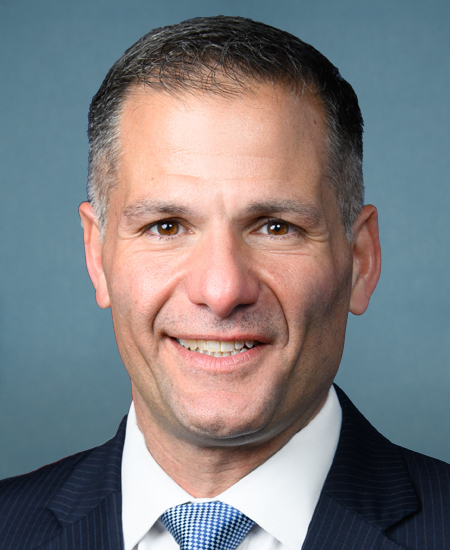
Photo of Marcus J. Molinaro
R United States House · District 19 · New York

Rep. Marcus J. Molinaro

Compare
Total votes
1,210
all sessions
Attendance
96%
45 missed
Near the chamber average
With party
85%
of cast votes
Lower than 92% of chamber peers
Bipartisan score
8%
crosses aisle rarely
Higher than 91% of chamber peers
Sponsored
528
bills & resolutions
Higher than 78% of chamber peers
Committees
0
assignments
528 bills and resolutions

Sponsored bills

Total
528
Primary
48
Co-sponsor
480
This page
528
matching current filters
Co-sponsor HR 5131
In committee · United States House · Co-sponsor
Erie Canal Bicentennial Commemorative Coin Act

Erie Canal Bicentennial Commemorative Coin Act This bill directs the Department of the Treasury to mint and issue 50,000 $5 gold coins, 400,000 $1 silver coins, and 750,000 half-dollar clad coins in recognition of the bicentennial of the Erie Canal. The designs of the coins must be emblematic of the Erie Canal and its impact on the development of the United States and New York. All sales of coins issued under this bill must include a surcharge to be paid to the Erie Canalway Heritage Fund, Inc., to support the historic preservation and community development of the Erie Canalway National Heritage Corridor in New York and for educational and commemorative programs.

In committee Aug 1, 2023 1 co-sponsor
Co-sponsor HR 5066
In committee · United States House · Co-sponsor
Tech to Save Moms Act

Maddy summaryThe Tech to Save Moms Act expands access to telehealth services and technology-enabled maternal health care for pregnant and postpartum individuals in underserved communities, including rural areas, health professional shortage zones, and populations with high maternal mortality and severe maternal morbidity rates. It authorizes $6 million annually for grants to train healthcare providers on implicit bias and maternal health best practices, develop digital tools for remote monitoring of pregnancy complications, and evaluate technology's impact on care quality and health outcomes. The legislation specifically targets racial and ethnic health disparities by focusing on American Indian/Alaska Native communities and other medically underserved populations through technology-enabled collaborative learning models. It also requires a study on artificial intelligence and patient monitoring devices in maternity care to assess and reduce racial biases in these technologies. The bill mandates reports to Congress on the effectiveness of these initiatives after 4 years to inform future policy decisions.

In committee Jul 28, 2023 1 co-sponsor
Co-sponsor HR 4974
In committee · United States House · Co-sponsor
Local 9–8–8 Response Act of 2023

Maddy summaryThis bill requires phone calls, texts, and chats to 9-8-8 (the national suicide prevention and mental health crisis hotline) to be routed to the nearest participating crisis center within 90 days of enactment, while protecting caller privacy by not revealing precise location. It mandates all phone carriers to transmit every 9-8-8 call or text - including those from prepaid or non-initialized handsets - and updates phone systems to allow direct 9-8-8 dialing without extra steps. The law affects crisis centers (by directing calls to their area), callers (through improved routing and privacy), and phone carriers (by requiring transmission compliance). These changes aim to make the 9-8-8 system more efficient and accessible for those seeking mental health support.

In committee Jul 28, 2023 1 co-sponsor
Co-sponsor HR 4127
In committee · United States House · Co-sponsor
Fair Access to Agriculture Disaster Programs Act

Fair Access to Agriculture Disaster Programs Act This bill waives the adjusted gross income limitations for payments or benefits under specific Department of Agriculture (USDA) disaster assistance programs for a person or legal entity that derives a portion of their income from agriculture. (Currently, a person or entity is not eligible to receive certain benefits during a crop, fiscal, or program year if their average gross income exceeds $900,000.) Specifically, in the case of an excepted payment or benefit, the adjusted gross income limitation is waived if 75% or more of the average adjusted gross income for the person or entity is derived from farming, ranching, or silviculture activities. These activities include agritourism, direct-to-consumer marketing of agricultural products, and the sale of agricultural equipment owned by such person or entity. The bill applies to the USDA Livestock Indemnity Program; Livestock Forage Disaster Program; Emergency Assistance for Livestock, Honey Bees, and Farm-Raised Fish Program; Tree Assistance Program; and Noninsured Crop Disaster Assistance Program.

In committee Jul 28, 2023 1 co-sponsor
Primary HR 4125
In committee · United States House · Lead sponsor
Dairy Farm Resiliency Act

Dairy Farm Resiliency Act This bill updates the Dairy Margin Coverage (DMC) program. (The DMC program was enacted in the 2018 farm bill to support dairy operations by allowing producers to buy a guaranteed margin for their milk production. The margin is the difference between the Department of Agriculture's [USDA's] national all milk price and a calculated feed cost, which provides producers optional risk protection on price and feed costs.) The bill requires that a dairy operation's production history for DMC be based on the most recent three-year history and be recalculated every five years. (A participating dairy producer must have an established milk production history with USDA's Farm Service Agency.) The bill also increases Tier 1 margin coverage for annual milk production to 6 million pounds or less (currently 5 million pounds or less) and Tier 2 margin coverage to over 6 million pounds (currently over 5 million pounds).

In committee Jul 28, 2023 0 co-sponsors
Co-sponsor HR 3955
In committee · United States House · Co-sponsor
Increasing Land Access, Security, and Opportunities Act

Increasing Land Access, Security, and Opportunities Act This bill provides statutory authority for and expands the Farm Service Agency's (FSA's) Increasing Land, Capital, and Market Access Program (the Increasing Land Access Program) for farmers, ranchers, and forest owners. Specifically, the FSA must make competitive grants to, enter into cooperative agreements with, or provide other capital support to eligible entities (e.g., state or local governments, Indian tribes, nonprofit organizations, and institutions of higher education) to provide direct assistance to farmers, ranchers, and forest owners who are (1) historically underserved, or (2) operating in high-poverty areas. The bill specifically excludes from assistance any foreign-based or foreign-owned corporation. The direct assistance may include payments to intended beneficiaries to acquire real property (including air rights and water rights), secure clear title on an heirs' property farmland, and improve or remediate land, water, and soil. Eligible entities may also use grants (1) to provide direct assistance to intended beneficiaries in assessing, purchasing, acquiring, or retaining eligible land; (2) for activities designed to support farm establishment and long-term viability; and (3) to provide technical assistance. The FSA must establish a stakeholder committee and, in collaboration with the committee, develop a process for evaluating proposals and distributing funds to eligible entities. In developing this process, the FSA must consider perspectives from diverse stakeholders, diverse geographic distribution, and diverse farming models, practices, and purposes.


In committee Jul 28, 2023 1 co-sponsor
Co-sponsor HR 3990
In committee · United States House · Co-sponsor
Forest Data Modernization Act of 2023

Maddy summaryThe Forest Data Modernization Act of 2023 updates the U.S. Forest Service's national forest inventory program to improve data collection on forest resources, with specific focus on forest carbon. It mandates new surveys of timber products and woodland owners, standardizes definitions for forest data reporting, and requires the Forest Service to develop a strategic plan every five years integrating remote sensing technology and carbon data (including soil carbon). The bill ensures collected data is publicly accessible while protecting the confidentiality of individual landowners' non-aggregated information. These changes aim to enhance the accuracy of forest resource tracking for management and policy decisions across public and private lands.

In committee Jul 28, 2023 1 co-sponsor
Co-sponsor HR 3894
In committee · United States House · Co-sponsor
Greyhound Protection Act of 2023

Maddy summaryThis bill prohibits federal involvement in commercial greyhound racing, live lure training, and open field coursing by banning interstate activities related to these practices. It makes it unlawful to conduct betting on greyhound races (including remote gambling), use live animals as bait, or transport animals for these purposes. The law specifically targets the declining greyhound racing industry (now operating at only two tracks in West Virginia), banning federal facilitation of betting, live bait use, and interstate transport of animals for racing or training. It does not affect horse racing or state laws already prohibiting these activities in most states.

In committee Jul 28, 2023 1 co-sponsor
Co-sponsor HR 3922
In committee · United States House · Co-sponsor
Expanding Childcare in Rural America Act of 2023

Maddy summaryThis bill establishes a USDA initiative (2024-2028) to prioritize funding for childcare improvements in rural and agricultural communities. It directs existing USDA programs - like the Essential Community Facilities program and RISE grants - to give priority to projects addressing childcare availability, quality, or cost in farming-dependent counties (using 2015 ERS county codes). Qualified applicants must be licensed childcare providers meeting state health/safety standards. The USDA must evaluate funded projects and report on impacts within three years.

In committee Jul 28, 2023 1 co-sponsor
Co-sponsor HR 3867
In committee · United States House · Co-sponsor
Spotted Lanternfly Research and Development Act

Maddy summaryThis bill adds spotted lanternfly control to the list of high-priority research initiatives funded by the USDA. It enables federal grants for developing and sharing practical tools to combat this invasive insect pest, directly affecting agricultural researchers and farmers in affected areas (like Pennsylvania, where the pest causes significant crop damage). The key provision modifies existing law to specifically include lanternfly research under funding programs, without changing current grant rules. The bill also extends the funding authorization period for such initiatives through 2028.

In committee Jul 28, 2023 1 co-sponsor
Showing 311 to 320 of 528 bills
Previous 1 … 31 32 33 … 53 Next