

Maddy summaryHR 5293, the Youth Voting Rights Act, would improve voting access for young people aged 18-29 through several concrete changes. The bill requires public colleges and universities to serve as voter registration agencies, establishes pre-registration for 16-year-olds, mandates on-campus polling locations for all institutions of higher education, and prohibits age-based restrictions on voting by mail. It also requires states to accept student ID cards as valid voter identification and provides grants to states for youth voter engagement programs. The bill would collect data on voting trends by age to help identify barriers to youth participation. These changes aim to address systemic barriers that have led to lower youth voter turnout and higher ballot rejection rates among young voters.
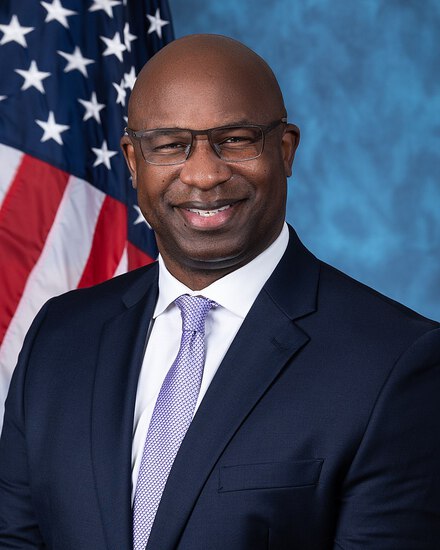
Rep. Jamaal Bowman
Sponsored bills
Maddy summaryThe Sustaining Our Democracy Act creates a federal program to provide states with annual funding to improve election administration and increase voting access. It allocates $2 billion each year from 2024-2033 through the State Election Assistance and Innovation Trust Fund to support activities like upgrading voting equipment, training election workers, and expanding voting access for underserved communities, people with disabilities, and voters on Indian lands. States must submit detailed plans for using funds, which cannot be used for activities that restrict voting access or target election officials. The Act establishes an Office of Democracy Advancement and Innovation to administer the program, monitor fund usage, and oversee compliance with its requirements.
Maddy summaryThe Unhoused Voter Opportunity Through Elections Act (HR 5294) protects voting rights for people experiencing homelessness by prohibiting states from denying voting access based on living in a "nontraditional abode" like shelters, public spaces, or locations where someone is considered homeless under federal law. Key provisions require election officials to make ballot drop boxes accessible to unhoused individuals, accept written attestations of residence instead of traditional proof, allow homeless shelters to be used as voting addresses, and mandate outreach to shelters about registration deadlines and election dates. The bill also creates a grant program to fund mobile voting centers and direct outreach services specifically for unhoused individuals. These changes would directly affect homeless individuals and election officials across all states, implementing concrete policy changes to improve voting access for a population often excluded from the electoral process.
Maddy summaryHR 5295, the Expanding the VOTE Act, modifies Section 203 of the Voting Rights Act to expand language access for voters. It requires states and localities to provide voting materials (including ballots and instructions) in the language of covered language minority groups, with new provisions for American Indian and Alaska Native languages requiring tribal government consultation for unwritten languages. The bill creates $15 million in grants to help jurisdictions provide voting materials in languages that don’t currently trigger Section 203 coverage, while mandating continued provision for those groups in future elections. It also directs a study to evaluate lowering population thresholds for language protections and expanding the definition of covered languages.
Maddy summaryThe Unhoused Persons Bill of Rights (HRES 634) is a non-binding congressional resolution that outlines 19 specific civil and human rights for unhoused individuals, including the right to housing, healthcare, access to public facilities, and freedom from discrimination based on housing status. It calls for the federal government to commit to ending homelessness by 2027 through specific policy changes, including $20 billion from the defense budget for housing programs, expanded rental assistance, and improved access to healthcare services. The resolution requires federal agencies to implement measures such as 24-hour shelter access, removal of hostile architecture in public spaces, and improved data collection methods to better address homelessness. It also calls for the Department of Health and Human Services to declare the unhoused crisis a public health emergency and establishes legal protections for unhoused people against discrimination and harassment.
This resolution condemns racism and invidious discrimination as evil and antithetical to the U.S. Constitution and declares unconditional war on racism and invidious discrimination in America. (Invidious discrimination generally refers to discrimination based on a classification that is arbitrary or irrational and not related to a legitimate purpose.) The resolution also expresses the intention of the House of Representatives to pass legislation establishing a Cabinet-level Department of Reconciliation. The department shall be charged with developing and coordinating the implementation of a comprehensive national strategy to eliminate racism and invidious discrimination.
Maddy summaryThe CHARGE Act of 2023 modernizes U.S. electricity transmission planning and cost allocation to better support renewable energy integration and grid reliability. It requires transmission providers to conduct interregional planning every five years, allocate costs based on multiple benefits (including reduced consumer costs, renewable energy access, and grid resilience), and make hourly operational data publicly available. The bill establishes an Office of Transmission within the Federal Energy Regulatory Commission (FERC) and creates an Independent Transmission Monitor to oversee planning processes. These changes aim to reduce costs for consumers, improve grid reliability, and support the transition to cleaner energy sources through concrete regulatory reforms.
Maddy summaryThis bill authorizes increased federal funding for early childhood special education programs under the Individuals with Disabilities Education Act (IDEA). It specifically restores funding for Part C (services for infants and toddlers with disabilities) and Section 619 (preschool programs for children with disabilities ages 3-5) by setting annual appropriations from $503 million to $1.22 billion for Section 619 and $932 million to $1.73 billion for Part C through 2028. These funds would directly support states in delivering high-quality early intervention and preschool services to children with disabilities and their families. The bill aims to reverse decades of reduced per-child funding, which had fallen significantly from historical highs.
Maddy summaryThe Ethics in Energy Act of 2023 prohibits large energy companies (including major electric utilities and natural gas providers) from charging customers for political influence spending. It requires these "covered utilities" to stop recovering expenses like lobbying, campaign contributions, or PR campaigns aimed at shaping regulations or elections from customer rates. Utilities must submit detailed annual reports on such spending to the Federal Energy Regulatory Commission (FERC), and FERC can impose penalties (up to triple the amount recovered) that must be refunded to customers. Penalties are split: half goes to ratepayers as rebates, half funds FERC’s enforcement.
Maddy summaryHJRES 84 designates August 20 as "Slavery Remembrance Day" to commemorate the arrival of the first enslaved Africans in what is now Virginia on August 20, 1619. The resolution urges the President to issue an annual proclamation encouraging Americans to observe the day with ceremonies and activities reflecting on slavery's history. It specifically honors 21 Black Congress members from the Reconstruction Era as honorary cosponsors and calls for acknowledging the enduring impacts of slavery. As a symbolic resolution, it does not create new laws or directly affect any group beyond establishing an annual observance.