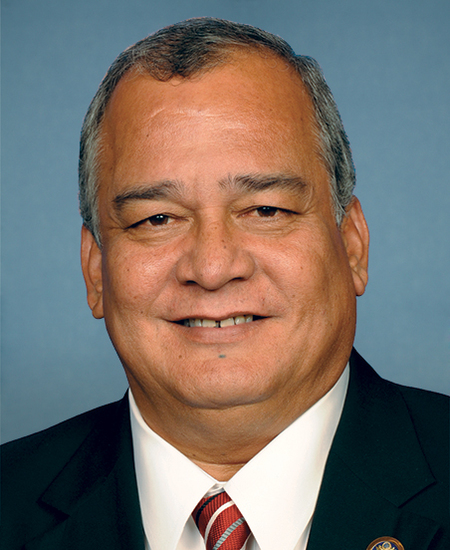
Mark Takai Atomic Veterans Healthcare Parity Act This bill includes veterans who participated in the cleanup of Enewetak Atoll in the Marshall Islands between January 1, 1977, and December 31, 1980, as radiation-exposed veterans for purposes of the Department of Veterans Affairs presumption of service-connection for specified cancers. Under a presumption of service-connection, specific conditions diagnosed in certain veterans are presumed to have been caused by the circumstances of their military service. Health care benefits and disability compensation may then be awarded.
Rep. Gregorio Kilili Camacho Sablan
Sponsored bills
This concurrent resolution (1) affirms, on the 400th anniversary of the arrival of the first slave ship, that the nation owes a debt of remembrance not only to those who lived through the injustices of slavery but also to their descendants; and (2) urges the establishment of a U.S. Commission on Truth, Racial Healing, and Transformation to properly acknowledge, memorialize, and be a catalyst for progress, including toward permanently eliminating persistent racial inequities.
This resolution expresses appreciation to the officers of the U.S. Capitol Police, the Metropolitan Police Department of the District of Columbia, and other law enforcement personnel for their service in responding to the assault on the U.S. Capitol on January 6, 2021. Further, it encourages all U.S. educational and media institutions to teach and celebrate the heroism of these officers, and it calls upon all Americans to read and revere the U.S. Constitution.
Protecting America's Workers Act This bill expands the coverage of requirements governing workplace safety and health to include protection for federal, state, and local government employees. However, the bill does not cover working conditions otherwise covered by federal requirements for mine safety and health. The bill revises requirements governing worker protection, including by expanding protections for whistle-blowers, such as protections for employees who refuse to perform work because they reasonably believe the work would result in serious injury or illness and for employees who aid inspections; directing employers to furnish a hazard-free place of employment to all individuals performing work, not just employees; directing employers to report work-related deaths or certain injuries, illnesses, or hospitalizations; requiring the Department of Labor to investigate fatalities or significant incidents in the workplace; establishing rights for victims, or representatives of victims, with respect to inspections or investigations of work-related bodily injuries or deaths; setting the permitted period for employers to correct serious, willful, or repeated violations while citations for the violations are being contested; increasing civil and criminal penalties for certain violations; expanding enforcement requirements relating to state occupational safety and health plans; expanding requirements for workplace health hazard evaluations by the National Institute for Occupational Safety and Health; and requiring Labor to provide training programs concerning employee rights and employer responsibilities.
Do No Harm Act This bill prohibits the application of the Religious Freedom Restoration Act of 1993 (RFRA) to specified federal laws or the implementation of such laws. Currently, RFRA prohibits the government from substantially burdening a person's exercise of religion even if the burden results from a rule of general applicability, except in furtherance of a compelling governmental interest when using the least restrictive means. Under the bill, RFRA is inapplicable to laws or the implementation of laws that protect against discrimination or the promotion of equal opportunity (e.g., the Civil Rights Act of 1964); require employers to provide wages, other compensation, or benefits, including leave; protect collective activity in the workplace; protect against child labor, abuse, or exploitation; or provide for access to, information about, referrals for, provision of, or coverage for, any health care item or service. The bill prevents RFRA from being used to deny (1) goods or services the government has contracted, granted, or made an agreement to provide to a beneficiary of or participant in a program or activity funded by such government contract, grant, agreement, or other award; or (2) a person's full and equal enjoyment of a government-provided good, service, benefit, facility, privilege, advantage, or accommodation. In order for a person to assert a RFRA claim or defense in a judicial proceeding, the government must be a party to the proceeding.

U.S. Citizenship Act This bill establishes a path to citizenship for certain undocumented individuals. The bill also replaces the term alien with noncitizen in the immigration statutes and addresses other related issues. Specifically, the bill establishes a new status of lawful prospective immigrant . This status shall be available to an applying noncitizen who meets certain requirements, including being continually present in the United States from January 1, 2021, and passing background checks. After at least five years with this status, an eligible noncitizen may apply for and receive permanent resident status. The bill also provides permanent resident status to certain applying noncitizens, specifically for eligible noncitizens who (1) entered the United States as a minor, (2) were eligible for temporary protected status or deferred enforced departure on January 1, 2017, or (3) worked a certain amount of agricultural labor in the five years prior to applying. Among other things, the bill also redefines for immigration purposes the term conviction to exclude convictions that have been expunged or vacated, requires the Department of State to implement a strategy to advance reforms in Central America and address key factors contributing to migration from the region to the United States, requires the State Department to establish refugee processing centers in Central America, requires Customs and Border Patrol sectors and stations to have a certain number of employees with certain qualifications such as paramedic training, generally prohibits religious discrimination in granting or denying immigration benefits, and establishes grant programs for providing training and services to immigrants.
Elijah E. Cummings Lower Drug Costs Now Act This bill establishes several programs and requirements relating to the prices of prescription drugs. In particular, the bill requires the Department of Health and Human Services (HHS) to negotiate prices for certain drugs (current law prohibits HHS from doing so). Specifically, HHS must negotiate maximum prices for single-source, brand-name drugs that lack certain generics and that are among either the 125 drugs that account for the greatest national spending or the 125 drugs that account for the greatest Medicare spending. HHS must negotiate the prices of at least 25 such drugs for 2024 and of at least 50 such drugs thereafter and must also negotiate prices for certain newly approved drugs and for insulin products. The negotiated prices must be offered under Medicare and may also be offered under private health insurance unless the insurer opts out. The negotiated maximum price may not exceed (1) 120% of the average price in Australia, Canada, France, Germany, Japan, and the United Kingdom; or (2) if such information is not available, 85% of the U.S. average manufacturer price. Drug manufacturers that fail to comply with the bill's negotiation requirements are subject to civil and tax penalties. The bill also makes a series of additional changes to Medicare prescription drug coverage and pricing, including by (1) requiring drug manufacturers to issue rebates to the Centers for Medicare & Medicaid Services for covered drugs that cost $100 or more and for which the average manufacturer price increases faster than inflation, and (2) capping annual out-of-pocket spending under the Medicare prescription drug benefit. The bill also requires drug manufacturers to report specified information for certain high-cost drugs, and it provides funds for opioid epidemic initiatives and biomedical research.
This resolution urges (1) the President to issue a proclamation recognizing Earth Day; and (2) governments and people to continue building upon the Paris Agreement and other efforts to ensure that future generations inherit a livable, sustainable, and ecologically rich planet. The resolution reaffirms that immediate action is needed to reduce greenhouse gas emissions and ameliorate environmental injustices in order to protect our planet, public health, and overall well-being of all people and wildlife. In addition, it encourages the American people to mark Earth Day by working to address environmental challenges, educate others about the need for year-round action, and honor the stewardship ethic for which Senator Gaylord Nelson stood.
Child Care for Working Families Act This bill provides funds and otherwise revises certain child care and early learning programs for low- to moderate-income families. Specifically, the bill provides funds for the Child Care and Development Block Grant program and reestablishes it as a child care and development assistance program. The bill also allocates program funds for states to provide services and supports to infants, toddlers, and children with disabilities. Further, the bill revises the program to require each state to create a tiered and transparent system for measuring the quality of child care providers, which must include evidence-based standards and payment rates that are based on a certain cost estimation model; ensure that copayments are based on a sliding scale and that no family receiving assistance pays more than 7% of its household income on child care; and use quality child care amounts for certain activities, such as increasing the supply of child care providers. The bill also provides funds and establishes grants for states to create preschool programs for low- to moderate-income children between the ages of three and five years. The Department of Health and Human Services (HHS) must make grants to Head Start agencies to provide children with access to full-school-year and full-school-day services, provide access to additional service hours for migrant and seasonal agencies, or enhance the quality of existing services. Finally, the bill requires, and provides funds for, HHS to assist Head Start agencies with ensuring their teachers and staff are paid a living wage.
National Origin-Based Antidiscrimination for Nonimmigrants Act or the NO BAN Act This bill imposes limitations on the President's authority to suspend or restrict aliens from entering the United States. It also prohibits religious discrimination in various immigration-related decisions, such as whether to issue an immigrant or nonimmigrant visa, unless there is a statutory basis for such discrimination. The President may temporarily restrict the entry of any aliens or class of aliens after the Department of State determines that the restriction would address specific and credible facts that threaten U.S. interests such as security or public safety. The bill also imposes limitations on such restrictions, such as requiring the President, State Department, and the Department of Homeland Security (DHS) to (1) only issue a restriction when required to address a compelling government interest, and (2) narrowly tailor the suspension to use the least restrictive means to achieve such an interest. Before imposing a restriction, the State Department and DHS shall consult with Congress. The State Department and DHS shall report to Congress about the restriction within 48 hours of the restriction's imposition. If such a report is not made, the restriction shall immediately terminate. Individuals or entities present in the United States and unlawfully harmed by such a restriction may sue in federal court. DHS may suspend the entry of aliens traveling to the United States on a commercial airline that failed to comply with regulations related to detecting fraudulent travel documents.