

This resolution calls for the creation of a Green New Deal with the goals of achieving greenhouse gas and toxic emissions reductions needed to stay under 1.5 degrees Celsius of warming; establishing millions of high-wage union jobs and ensuring economic security for all; investing in infrastructure and industry; securing clean air and water, climate and community resiliency, healthy food, access to nature, and a sustainable environment for all; and promoting justice and equality. The resolution calls for accomplishment of these goals through a 10-year national mobilization effort. The resolution also enumerates the goals and projects of the mobilization effort, including building smart power grids (i.e., power grids that enable customers to reduce their power use during peak demand periods); upgrading all existing buildings and constructing new buildings to achieve maximum energy and water efficiency; removing pollution and greenhouse gas emissions from the transportation and agricultural sectors; cleaning up existing hazardous waste and abandoned sites; ensuring businesspersons are free from unfair competition; and providing higher education, high-quality health care, and affordable, safe, and adequate housing to all.
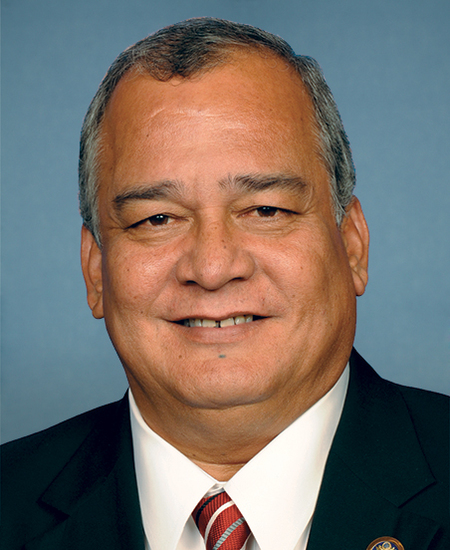
Rep. Gregorio Kilili Camacho Sablan
Sponsored bills
This resolution rejects the Supreme Court's decisions in the Insular Cases (a series of cases regarding the application of constitutional rights in U.S. territories) and recognizes that constitutional and democratic principles apply throughout the states and territories of the United States.
Voter Empowerment Act of 2021 This bill expands voter registration and voting access. Specifically, the bill expands voter registration by requiring states to (1) make available online voter registration, (2) establish automatic voter registration systems, (3) permit same-day voter registration, and (4) accept voter registration applications from individuals under age 18. Further, the bill limits removing voters from voter rolls and prohibits interference with voter registration or voting. Next, the bill requires states to allow individuals with disabilities to use absentee registration procedures and to vote by absentee ballot in federal elections. The bill also prohibits voter caging (the practice of sending mail to addresses on voter rolls, compiling a list of the undeliverable mail, and using the list to remove registered voters from voter rolls). Next, the bill expands voting access by requiring states to allow early voting and voting by mail without additional conditions. It also requires states to provide secured drop boxes at which individuals may drop off their completed absentee ballots. In addition, the bill declares that the right of a U.S. citizen to vote in any federal election shall not be denied or abridged because that individual has been convicted of a criminal offense unless, at the time of the election, such individual is serving a felony sentence. Finally, the bill permanently reauthorizes the Election Assistance Commission (EAC). It also directs the EAC to make grants to states for specified activities, including to implement automatic voter registration systems.
Medication Access and Training Expansion Act of 2021 or the MATE Act of 2021 This bill requires health care providers, as a condition of receiving or renewing a registration to prescribe potentially addictive drugs, to complete a one-time training on managing patients with substance use disorders. In addition, the Department of Health and Human Services must award grants to health professional associations and education programs for integrating substance use disorder training into relevant curricula.
Veterans Census-Enabled National Treatment Equitable Resource Supplement for Mental Health Act of 2021 or the Vet CENTERS for Mental Health Act of 2021 This bill requires the Department of Veterans Affairs (VA) to ensure the number of Vet Centers in certain states is increased by at least one additional center if the VA determines the state meets specified requirements. The VA must also establish a community-based outpatient clinic in each state that does not share a land border with another state, is located at least 2,000 miles from the contiguous United States, and contains no such clinic.
Making Advances in Mammography and Medical Options for Veterans Act This bill addresses the Department of Veterans Affairs (VA) provision of mammograms and breast cancer treatment. Among other requirements, the VA must submit a strategic plan for improving breast imaging services for veterans, implement a three-year pilot program to provide telemammography services for veterans who live in locations where access to breast imaging services at a VA facility is difficult or unfeasible, upgrade all mammography services at its facilities to use three-dimensional breast imaging, update guidelines to increase the use of testing for the breast cancer gene and genetic counseling for veterans diagnosed with breast cancer, and update its policies and directives to ensure that it confirms the accessibility of a breast imaging site when referring a veteran with a spinal cord injury or disorder to a non-VA provider. In addition, the VA must enter into a partnership with at least one cancer center of the National Cancer Institute of the National Institutes of Health in each Veterans Integrated Service Network to expand access to high-quality cancer care for women veterans. In implementing such partnerships, the VA must ensure that veterans with breast cancer who reside in rural areas or states without a partner cancer center are able to receive care through telehealth. Finally, the VA must collaborate with the Department of Defense and report on all current research and health care collaborations between the departments on treating veterans and members of the Armed Forces with breast cancer.
This resolution expresses support for the recognition of U.S. Territories Day. The resolution further encourages educators to set aside time on this day to teach students about the U.S. territories, encourages specified actions by the President and the Senate, and requests the Smithsonian Institution to make certain educational materials publicly available for educators.
Prince Jonah Kūhiō Kalaniana'ole Protecting Family Legacies Act This joint resolution consents to the Hawaii legislature's amendments to the Hawaiian Homes Commission Act. In 2017, the Hawaii legislature reduced the minimum Native Hawaiian blood quantum required for an individual to inherit a homestead lease under the act.
This resolution recognizes the achievements and goals of institutions of higher education that are designated as Asian American and Native American Pacific Islander-Serving Institutions on Asian American and Native American Pacific Islander-Serving Institutions Week and encourages eligible institutions to obtain the designation.
Agricultural Fairs Rescue Act This bill directs the Agricultural Marketing Service of the Department of Agriculture to establish a program to award grants to states or state departments of agriculture to provide support to agricultural fairs for losses sustained by such fairs due to COVID-19. As a condition of receiving a grant, recipients shall agree to (1) prioritize supporting agricultural fairs in the state facing the greatest financial hardship, and (2) use not more than 5% of grant funds for administrative costs incurred in providing support to agricultural fairs.