

Maddy summaryThis bill (HR 366, Korean American VALOR Act) changes VA healthcare eligibility rules to include Korean American veterans who served with South Korea's military in Vietnam during specific periods. It directly affects Korean American individuals who served as part of the Republic of Korea's armed forces in Vietnam between January 1962 and May 1975 (or a period the VA later determines). The key provision adds a new eligibility category under VA law, allowing these individuals to access the same healthcare benefits as U.S. veterans under the same rules and conditions. This is a concrete policy change that removes a prior barrier to VA healthcare for this group.
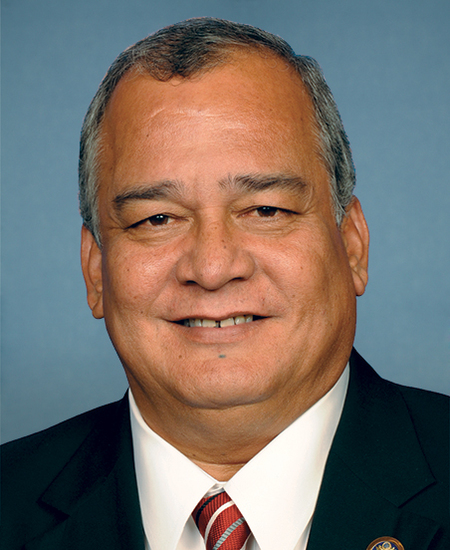
Rep. Gregorio Kilili Camacho Sablan
Sponsored bills
Maddy summaryHR 6121, the Filipino Veterans Fairness Act of 2023, expands U.S. veterans benefits for individuals who served in the Philippine Army, Philippine Scouts, or recognized guerrilla forces during World War II. It directly affects Filipino veterans who previously faced challenges proving service due to limited documentation. The bill allows the Secretary of Veterans Affairs to consider alternative records beyond the National Personnel Records Center rosters when determining eligibility, requires annual reports to Congress on applications and approvals, and clarifies that the Filipino Veterans Equity Compensation Fund does not apply to these veterans. These changes aim to streamline access to benefits for this specific group of veterans.
Maddy summaryHRES 831 is a symbolic congressional resolution supporting October as "National Domestic Violence Awareness Month." It does not create new laws or allocate funding, but formally expresses the House of Representatives' support for the goals of raising awareness about domestic violence. The resolution urges Congress to continue highlighting domestic violence's impact and backing programs that prevent and address it. It directly affects public awareness efforts and serves as a non-binding statement of congressional support for victims and advocacy organizations.
Maddy summaryThe Rape Kit Backlog Progress Act of 2023 requires states and local governments receiving federal crime-fighting grants to conduct comprehensive inventories of all sexual assault kits (both tested and untested) and report key details to the Attorney General. It mandates that jurisdictions document victim consent for testing, upload DNA results to the national CODIS database, establish electronic tracking systems for victims, and implement victim notification protocols. States must submit these reports annually to maintain eligibility for federal grants, with the Attorney General publishing a public annual report on backlog status and compliance. This law directly affects state/local law enforcement agencies and prosecutors handling sexual assault cases, aiming to improve transparency and accountability in processing evidence.
Maddy summaryThis bill amends federal Medicaid law to exclude certain costs spent by State Medicaid Fraud Control Units (MFCUs) in Guam, the Northern Mariana Islands, and American Samoa from federal payment limits. Specifically, it ensures that if these territories qualify for a payment under a specific Medicaid funding provision for a calendar quarter, their MFCU expenditures won't count toward the federal funding cap for that period. The change directly affects these three U.S. territories' Medicaid programs by providing additional flexibility in how fraud prevention costs are accounted for in federal funding calculations. This is a procedural adjustment to existing Medicaid financing rules, not a new benefit or service.
Maddy summaryThis resolution commemorates October 2023 as Filipino American History Month, honoring the contributions and cultural heritage of Filipino Americans to the United States. It directly recognizes the Filipino American community - now the third-largest Asian American and Pacific Islander group - with a population of approximately 4.5 million - and highlights their historical roles, including WWII service and community leadership. The resolution has no legal effect or funding provisions; it is purely ceremonial, urging the public to observe the month through educational programs and activities. It follows prior congressional recognitions of Filipino American History Month since 2009.
Maddy summaryThis resolution supports designating September 2023 as "National Recovery Month" to raise awareness about substance use disorder recovery. It cites pandemic-related challenges like increased overdoses (over 110,000 fatal drug/alcohol overdoses in 2022) and barriers to treatment. The resolution makes no policy changes but symbolically acknowledges recovery efforts, stigma reduction, and peer support communities. It is a non-binding congressional statement, not a law affecting specific groups or programs.
Maddy summaryHRES 736 is a House resolution designating September 25-October 1, 2023, as "Asian American and Native American Pacific Islander-Serving Institutions Week" to recognize institutions that serve high proportions of Asian American, Native Hawaiian, and Pacific Islander students. These institutions - enrolling over 46% of such students despite representing only 6.5% of U.S. colleges - provide critical support for low-income, first-generation students through culturally relevant programs. The resolution encourages eligible institutions to seek funding and urges the public to observe the week with activities celebrating their educational contributions. It has no legal effect but serves as a symbolic acknowledgment of their role in higher education.
Maddy summaryThis bill replaces "Columbus Day" with "Indigenous Peoples’ Day" as the official federal holiday observed on the second Monday in October. It directly affects federal government operations and all federal documents, rules, or laws that previously referenced "Columbus Day" by automatically updating those references to "Indigenous Peoples’ Day" upon enactment. The key mechanism is a simple amendment to federal law (5 U.S.C. § 6103(a)) to change the holiday name and a provision ensuring all existing federal references to Columbus Day are legally treated as referring to Indigenous Peoples’ Day instead. This is a procedural change to federal holidays and references, not a new policy or program.
Maddy summaryHR 5191, the Renewable Energy for U.S. Territories Act, establishes a federal grant program administered by the Secretary of Agriculture to fund renewable energy projects in U.S. territories (Puerto Rico, Guam, U.S. Virgin Islands, American Samoa, and Northern Mariana Islands). Covered entities - defined as eligible not-for-profit organizations - can use grants to develop renewable energy systems, improve energy efficiency, build storage or microgrids, or train local residents, but cannot fund fossil fuel or nuclear projects. The bill also mandates a GAO study on renewable energy potential in territories, focusing on grid modifications, microgrid expansion, and energy resiliency, with findings to be reported to Congress. This program aims to directly support territorial energy infrastructure upgrades and workforce development through concrete funding mechanisms.