

Maddy summaryHR 7056, the Access to Family Building Act, establishes federal rights for individuals to access assisted reproductive technology (ART) like IVF without unreasonable restrictions, directly affecting patients seeking fertility treatments and health care providers offering ART services. The bill prohibits states from imposing limitations on ART that are more burdensome than those for comparable medical procedures, fail to advance safety, or unduly restrict access, while allowing health and safety regulations that are necessary and least restrictive. It creates federal enforcement mechanisms, including lawsuits by the Attorney General or affected individuals to challenge violating state laws, and preempts conflicting state regulations. The bill explicitly preserves state authority over health/safety regulations and does not alter existing state insurance coverage laws for ART.
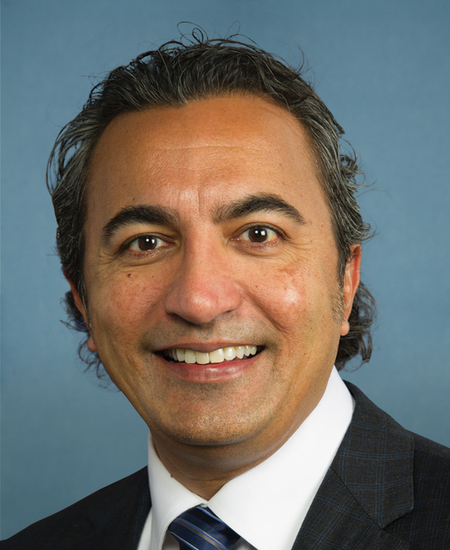
Rep. Ami Bera
Sponsored bills
Maddy summaryHR 6081 amends the short title of the Lake Tahoe Restoration Act (Public Law 106-506) to honor Senator Dianne Feinstein, renaming it the "Dianne Feinstein Lake Tahoe Restoration Act." This change applies to all federal references in laws, maps, regulations, documents, or records that previously cited the original title. The bill does not alter the Act's policies or funding but updates its official name and all related references. It directly affects federal agencies and documents that reference the legislation. This is a purely procedural renaming with no substantive policy changes.
Maddy summaryThis bill establishes a 16-member Fiscal Commission in Congress to develop bipartisan recommendations for improving the federal budget and debt situation. The Commission must identify policies to balance the budget, stabilize the debt-to-GDP ratio at or below 100%, and improve long-term fiscal outlook, with recommendations requiring approval from at least 3 Republican and 3 Democratic members. The Commission must submit its report and legislative language by November 15, 2024, including economic and budgetary effects, after which Congress would consider the proposals through expedited procedures. The Commission would terminate 30 days after submitting its final report.
Maddy summaryHRES 963 is a symbolic resolution honoring Korean American Day, which commemorates the January 13, 1903 arrival of the first large wave of Korean immigrants to the U.S. It recognizes Korean Americans' contributions to U.S. society, including their economic, cultural, and military impacts, and marks the 121st anniversary of this historic migration. The resolution urges all Americans to observe Korean American Day to appreciate these contributions. As a commemorative measure, it does not create new policies or affect specific groups beyond this ceremonial recognition.
Maddy summaryHR 6980, the DOCTORS Act, reallocates unused J-1 visa waivers that states did not use for foreign medical graduates. Each state must report unused waivers by September 30 annually, and the State Department will redistribute them equally over three years for the next fiscal year. Ten percent of redistributed waivers must support doctors working in facilities serving medically underserved communities. This directly affects state agencies managing visa waivers and impacts foreign doctors seeking permanent U.S. residency after training.
Maddy summaryHRES 955 is a resolution commending Taiwan for its democratic election history and supporting Taiwan's democratic institutions. It recognizes Taiwan's transition to democracy since the late 1980s, including 7 presidential and 9 legislative elections held since then, all deemed free and fair. The resolution specifically expresses support for Taiwan's upcoming January 13, 2024, elections and condemns interference by the Chinese Communist Party. It affirms U.S. commitment to a strong partnership with Taiwan across multiple domains and supports Taiwan's self-defense and liberty. As a procedural resolution, it does not create new law but formally expresses congressional support for Taiwan's democratic development.
Maddy summaryThe Affordable Connectivity Program Extension Act of 2024 allocates $7 billion in funding for the Affordable Connectivity Program (ACP) during fiscal year 2024. The ACP provides subsidies to low-income households to help cover the cost of internet service and connected devices like laptops or tablets. This funding ensures the program can continue supporting eligible households throughout the year, with the money remaining available until fully spent. The bill extends existing program funding without changing eligibility criteria or service requirements.
Maddy summaryHRES 936 is a symbolic resolution commemorating the 80th anniversary of the Magnuson Act of 1943, which repealed the Chinese Exclusion Act of 1882. It honors the contributions of Chinese Americans and acknowledges the historical injustice of laws that excluded Chinese immigrants and denied them citizenship. The resolution celebrates Chinese American communities and reaffirms commitment to equal civil rights for all, regardless of race. As a commemorative measure, it does not create new laws or alter policies.
Maddy summaryThis resolution urges the Biden administration to facilitate the safe, timely, and sufficient delivery of humanitarian aid to civilians in Gaza. It specifically calls for expanding aid convoys, opening additional border crossings, providing fuel to aid organizations, establishing safe shelters, and renewing humanitarian pauses to address the severe crisis. The resolution directly affects civilians in Gaza, where infrastructure damage, contaminated water, and shortages of medical supplies have created a dire humanitarian situation. It does not create new laws but expresses Congress's position on improving aid access.
Maddy summaryHR 6694, the 7 October Hamas Attack Evaluation and Intelligence Sharing Act, requires U.S. intelligence agencies to produce a report within 30 days on Hamas's training, weapons, and foreign support for the October 7, 2023, attack on Israel. The bill also mandates two reviews: one on whether increased intelligence sharing with Israel about Hamas, Hezbollah, and Iran improves U.S. and allied security, and another on how such sharing can reduce civilian harm and aid in the Israel-Hamas conflict. Additionally, it directs the Defense Department's Inspector General to assess whether policies to minimize civilian harm are being followed in intelligence sharing with Israel. All findings must be submitted to relevant congressional committees within the specified deadlines.