

Maddy summaryHR 7770, the Rosie the Riveter Commemorative Coin Act, authorizes the U.S. Mint to produce and sell three commemorative coins honoring women who worked on the U.S. home front during World War II. It specifies $5 gold coins (max 50,000), $1 silver coins (max 400,000), and half-dollar coins (max 750,000), all to be issued between January 1, 2025, and December 31, 2025. Each coin sale includes a surcharge ($35 for gold, $10 for silver, $5 for half-dollar), with all surcharge funds directed to the Rosie the Riveter Trust for maintaining the Rosie the Riveter WWII Home Front National Historical Park and educational programs. The coins will feature designs reflecting the legacy of diverse women workers and must meet specific weight, diameter, and composition standards.
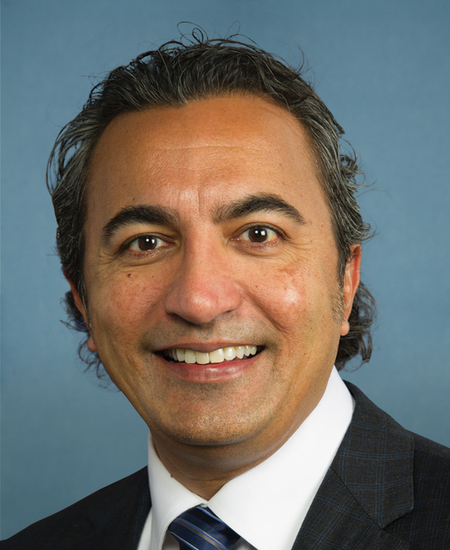
Rep. Ami Bera
Sponsored bills
Maddy summaryHR 6727 establishes the United States Foundation for International Conservation, a nonprofit organization that will provide grants to support long-term management of protected and conserved areas in eligible countries. The Foundation requires a 2:1 cost match from other sources, demands host country and community consent through binding agreements, and prioritizes areas with high biodiversity or species of significant importance. It will be governed by a Board of Directors including government officials and private sector experts, operate for 10 years with $1 million authorized for 2024 and $100 million annually from 2025-2035, and must follow international conservation standards while prohibiting funding for countries supporting terrorism or violating human rights.
Maddy summaryHRES 1079 is a symbolic House resolution condemning Russia's claimed suspension of the New START nuclear arms control treaty, which the U.S. considers legally invalid. It calls on Russia to immediately return to full compliance with New START, including resuming inspections and data sharing, and emphasizes the importance of arms control for global stability. The resolution urges the Biden administration to continue arms control talks with Russia and China to prevent a nuclear arms race. As a non-binding resolution, it does not change U.S. policy but expresses congressional support for maintaining the New START framework, which limits Russia's nuclear arsenal to 1,550 warheads.
Maddy summaryHR 7629, the Protect Our Letter Carriers Act of 2024, allocates $1.4 billion annually (2025-2029) to the U.S. Postal Service for high-security collection boxes and replacing physical universal mailbox keys with electronic versions, directly affecting USPS operations and letter carriers. It requires the Attorney General to appoint specialized prosecutors in each district to coordinate investigations and prosecutions of postal-related crimes, such as assaults on carriers or mail theft. The bill also mandates the U.S. Sentencing Commission to adjust guidelines so that assaults or robberies against postal employees are treated with the same severity as assaults against law enforcement officers. These provisions aim to enhance safety through infrastructure upgrades, improved prosecution, and stricter sentencing for crimes targeting postal workers.
Maddy summaryThis bill establishes a framework to deepen cooperation among the U.S., Australia, India, and Japan (the Quad). It requires the State Department to submit a strategy within 180 days detailing U.S. engagement with the Quad on shared challenges like climate, infrastructure, and security. The bill also creates a U.S. parliamentary working group (with 24 members split between House and Senate) to coordinate with Quad partners, funded at $1 million annually. This affects U.S. foreign policy implementation and congressional oversight of Quad relations.
Maddy summaryThe Uyghur Policy Act of 2023 establishes a U.S. Special Coordinator for Uyghur Issues within the State Department to coordinate policy and advocate for the protection of Uyghur cultural, religious, and linguistic identity in Xinjiang. It authorizes $250,000 annually for Uyghur human rights advocates to speak at public diplomacy events in Muslim-majority countries and mandates Uyghur language training for U.S. diplomats. The bill also directs the U.S. government to support United Nations monitoring of Xinjiang human rights issues and oppose efforts to block discussions of Xinjiang at the UN. These provisions focus on diplomatic advocacy and information-sharing, not direct sanctions or enforcement actions against China.
Maddy summaryHR 7381, the HEALTH AI Act, establishes a National Institutes of Health (NIH) grant program to fund research on using generative artificial intelligence (AI) in healthcare. The grants support projects that aim to improve clinical documentation, reduce administrative burdens for healthcare workers, speed up insurance claims, and enhance patient care services. Eligible recipients include universities, nonprofits, and government agencies, with priority given to projects addressing clinician burnout, health disparities, and improving care for medically underserved populations. The bill focuses on concrete research into AI applications that directly support healthcare practitioners and patients, without specifying implementation outcomes.
Maddy summaryHRES 1014 is a symbolic House resolution commemorating the Ukrainian people's sacrifices two years after Russia's February 24, 2022, invasion. It recognizes the war's devastating toll, including over 10,000 civilian deaths, 19,000 abducted children, and 10 million displaced people, while condemning Russia's actions. The resolution reaffirms U.S. support for Ukraine, condemns Vladimir Putin's regime, and stands in solidarity with Ukraine's defense of democratic values. As a commemorative resolution, it has no binding effect but formally acknowledges Ukraine's struggle and resilience. It directly honors Ukrainian civilians, soldiers, and those displaced by Russia's war of aggression.
Maddy summaryHRES 1002 is a symbolic House resolution recognizing the cultural and historical significance of Lunar New Year (celebrated as the Year of the Dragon in 2024). It acknowledges the holiday's 4,000-year history in China, its celebration across Asia (including Seollal and Tết), and its significance to Asian Americans and others in the U.S. The resolution expresses respect for those observing the holiday and wishes them a happy new year, but it does not create new laws, policies, or funding. As a ceremonial resolution, it has no direct effect on legislation or constituents.
Maddy summaryThis bill restricts how credit reporting companies share homebuyers' credit reports during mortgage applications. It prevents companies from sending these reports to third parties (like marketers) just because a lender requested them for a mortgage. Only specific entities can receive the reports: the mortgage lender who originated the loan, the company servicing the loan, or the bank holding the homebuyer's account. This directly protects homebuyers' privacy by limiting unauthorized sharing of their financial data.