

Maddy summaryThe Clean Competition Act establishes a carbon intensity charge on covered primary goods produced domestically or imported into the United States, affecting companies in specific industries including petroleum refining, steel, cement, and chemical manufacturing. The charge is calculated based on a facility's carbon intensity (greenhouse gas emissions per unit of production) compared to industry averages, with the charge amount determined by how much a facility's carbon intensity exceeds a percentage of the industry average. Domestic producers and importers of covered primary goods will pay charges calculated using an annual carbon price that increases with inflation, with exemptions for goods from least developed countries that produce at least 3% of global exports of that good. The bill also includes a rebate program for exports of covered primary goods and establishes a grant program to help companies invest in technologies that reduce carbon intensity.
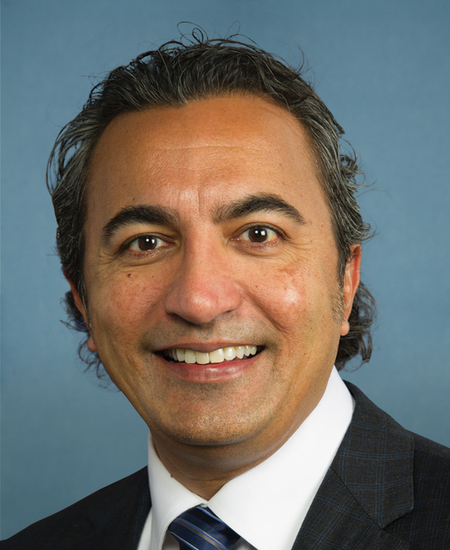
Rep. Ami Bera
Sponsored bills
Maddy summaryHR 6592, the Fight Book Bans Act, provides federal grants to reimburse public school districts for legal costs when they choose to keep instructional or library materials after parental objections. It directly affects school districts (covered local educational agencies) that select materials for students and handle challenges to their removal. The bill authorizes up to $100,000 per case in grants to cover attorney fees and court costs, provided the district didn’t remove the materials and wasn’t reimbursed by the state. Funding of $15 million is authorized for fiscal years 2024-2028. The grants are strictly for legal challenges to decisions not to remove materials, not for the content of the materials themselves.
Maddy summaryThis bill targets U.S. business activities that could help specific countries of concern (North Korea, China, Russia, and Iran) develop critical technologies. It requires the President to identify "covered sectors" (including semiconductors, artificial intelligence, quantum technology, hypersonics, and high-performance computing) and prohibit U.S. persons from engaging in certain activities involving these technologies with entities in countries of concern. The bill also mandates that U.S. persons submit notifications about certain activities involving these technologies, with requirements for public comment and transparency. It establishes reporting requirements for the President to Congress on implementation and impact, and includes provisions for national interest waivers.
Maddy summaryHRES 895 is a resolution introduced in the U.S. House of Representatives on November 28, 2023, that condemns statements by some members of Congress calling for the expulsion of Palestinians from the United States. The resolution states such rhetoric is un-American, bigoted, and dangerous because it unfairly conflates Palestinians with Hamas and ignores the U.S. history of welcoming immigrants of all backgrounds. It specifically references H.R. 6211 (introduced November 2, 2023) as an example of harmful rhetoric. This resolution has no legal effect - it is a symbolic statement expressing the House's position.
Maddy summaryHRES 793 is a resolution passed by the U.S. House of Representatives calling on Hamas to immediately release all 199 hostages taken during Hamas' October 7, 2023 attack on Israel. The resolution condemns Hamas for the attack, the taking of hostages, and threats against hostages, while stating that holding hostages violates international humanitarian law under the Geneva Conventions. It demands the immediate release of all hostages and expresses sympathy for victims and their families. As a symbolic resolution, it does not create legal obligations but formally expresses the House's position.
Maddy summaryHR 6451, the Mental Health Justice Act of 2023, provides $250 million in federal grants to states, tribes, and localities to hire mental health professionals as first responders for specific emergencies. It directs these professionals to replace police in situations involving mental health crises, substance use, or intellectual/developmental disabilities - such as when a 911 caller describes a mental health emergency or a first responder identifies someone needing mental health support. The bill requires grantees to train responders in de-escalation techniques, link individuals to community-based services (not incarceration), and report on outcomes like reduced arrests or use of force. It also mandates data collection on demographics and prevents funneling people into institutional settings, with annual reports to Congress on program effectiveness.
Maddy summaryThis bill amends federal transit grant rules to encourage housing near transit by adding incentives for projects that support "pro-housing policies." It defines such policies as local actions removing regulatory barriers to housing construction, including reducing parking minimums, creating faster approval processes for multi-family housing, and eliminating height restrictions. Transit project applicants can earn an extra point in their grant rating if they submit evidence of these policies in areas near transit, with the Department of Transportation consulting the Housing Secretary to assess how the policies will increase housing supply. The bill directly affects state and local governments implementing these policies and transit project applicants seeking federal capital investment grants.
Maddy summaryHR 6288, the Data for Pediatric Brain Cancer Act of 2023, establishes a federal program to create a real-world data registry for children with rare brain tumors, initially focusing on atypical teratoid rhabdoid tumor (ATRT). The bill directs the Secretary to develop and maintain a registry collecting treatment data from routine clinical practice, which can be used to form external control groups for clinical trials when randomized trials are impractical due to the disease's rarity. It authorizes $2 million for fiscal year 2025 to fund grants for academic institutions and support data infrastructure, analysis, and collaboration with experts. This registry aims to accelerate research for pediatric brain cancer treatments by providing real-world data benchmarks for trial design, directly affecting children with rare brain tumors and the research community studying them.
Maddy summaryThis bill establishes a federal working group under the Department of Health and Human Services to standardize how loneliness and isolation are measured across government agencies and research. The Working Group, composed of HHS agencies, state representatives, and experts, will develop consistent definitions and measurement tools to improve data collection for public health research and healthcare planning. It aims to create reliable methods for tracking these issues across populations and fields, with a report due to Congress within one year of enactment. The effort expires in 2026, focusing solely on measurement standards rather than direct services or funding.
Maddy summaryHR 6121, the Filipino Veterans Fairness Act of 2023, expands U.S. veterans benefits for individuals who served in the Philippine Army, Philippine Scouts, or recognized guerrilla forces during World War II. It directly affects Filipino veterans who previously faced challenges proving service due to limited documentation. The bill allows the Secretary of Veterans Affairs to consider alternative records beyond the National Personnel Records Center rosters when determining eligibility, requires annual reports to Congress on applications and approvals, and clarifies that the Filipino Veterans Equity Compensation Fund does not apply to these veterans. These changes aim to streamline access to benefits for this specific group of veterans.