

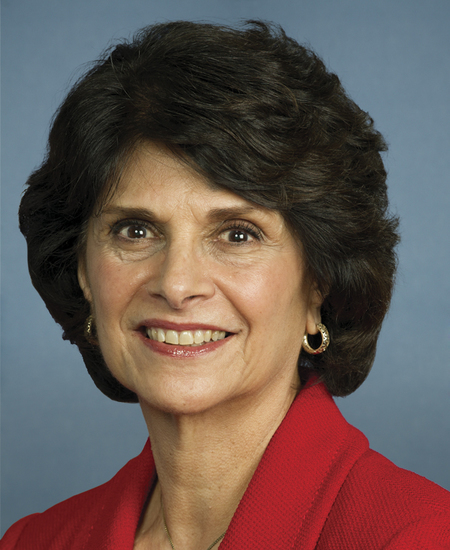
Photo of Lucille Roybal-Allard
D United States House · District 40 · California

Rep. Lucille Roybal-Allard

Compare
Total votes
958
all sessions
Attendance
99%
6 missed
Near the chamber average
With party
99%
of cast votes
Higher than 90% of chamber peers
Bipartisan score
0%
crosses aisle rarely
Lower than 91% of chamber peers
Sponsored
613
bills & resolutions
Higher than 83% of chamber peers
Committees
0
assignments
613 bills and resolutions

Sponsored bills

Total
613
Primary
17
Co-sponsor
596
This page
613
matching current filters
Co-sponsor HR 5348
In committee · United States House · Co-sponsor
ESP Family Leave Act

ESP Family Leave Act This bill allows education support professionals to meet the hours of service requirements for family and medical leave if they have worked a number of hours equal to not less than 60% of the total monthly hours expected for their job descriptions and duties, as assigned for the previous school year. Education support professionals are employees within a public school or public institution of higher education which may include specified staff, such as paraeducators, administrative support staff, custodians, skilled trade workers, and nursing support staff. The Department of Labor may provide a method for calculating such leave for these professionals.

In committee Sep 23, 2021 1 co-sponsor
Co-sponsor HR 5342
In committee · United States House · Co-sponsor
Tyler Clementi Higher Education Anti-Harassment Act of 2021

Tyler Clementi Higher Education Anti-Harassment Act of 2021 This bill addresses harassment at institutions of higher education (IHEs). Specifically, the bill requires each IHE to include in its annual security report a statement of policy regarding harassment on the basis of a student's actual or perceived race, color, national origin, sex (including sexual orientation, gender identity, pregnancy, childbirth, a medical condition related to pregnancy or childbirth, and a sex stereotype), disability, or religion. In addition, the Department of Education may award grants to IHEs to initiate, expand, or improve programs to (1) prevent the harassment of students; (2) provide counseling or redress services to students who have been harassed or accused of subjecting other students to harassment; or (3) educate and train students, faculty, or staff to prevent harassment or address harassment if it occurs.

In committee Sep 22, 2021 1 co-sponsor
Co-sponsor HR 5307
In committee · United States House · Co-sponsor
Keeping Renters Safe Act of 2021

Keeping Renters Safe Act of 2021 This bill expressly authorizes the Department of Health and Human Services (HHS) to place a moratorium on residential evictions to prevent the spread of communicable diseases. The bill also requires HHS to implement a moratorium nationwide to reduce the spread of COVID-19. This moratorium must remain in effect for at least 60 days following the termination of the COVID-19 public health emergency. Current law authorizes HHS to take measures to prevent the spread of communicable diseases. As part of the COVID-19 response, HHS delegated this authority to the Centers for Disease Control and Prevention (CDC), which then issued (and extended) several orders banning residential evictions. Whether these orders exceed the CDC's statutory and constitutional authority has been the subject of multiple legal challenges; the Supreme Court blocked enforcement of the most recent order on August 26, 2021.

In committee Sep 22, 2021 1 co-sponsor
Co-sponsor HR 4
Passed · United States House · Co-sponsor
John R. Lewis Voting Rights Advancement Act of 2021

John R. Lewis Voting Rights Advancement Act of 2021 This bill establishes new criteria for determining which states and political subdivisions must obtain preclearance before changes to voting practices may take effect. Preclearance is the process of receiving preapproval from the Department of Justice (DOJ) or the U.S. District Court for the District of Columbia before making legal changes that would affect voting rights. A state and all of its political subdivisions shall be subject to preclearance of voting practice changes for a 10-year period if 15 or more voting rights violations occurred in the state during the previous 25 years; 10 or more violations occurred during the previous 25 years, at least 1 of which was committed by the state itself; or 3 or more violations occurred during the previous 25 years and the state administers the elections. A political subdivision as a separate unit shall also be subject to preclearance for a 10-year period if three or more voting rights violations occurred there during the previous 25 years. States and political subdivisions that meet certain thresholds regarding minority groups must preclear covered practices before implementation, such as changes to methods of election and redistricting. Further, states and political subdivisions must notify the public of changes to voting practices. Next, the bill authorizes DOJ to require states or political subdivisions to provide certain documents or answers to questions for enforcing voting rights. The bill also outlines factors courts must consider when hearing challenges to voting practices, such as the extent of any history of official voting discrimination in the state or political subdivision.

Passed Sep 14, 2021 1 co-sponsor
Co-sponsor HR 4811
In committee · United States House · Co-sponsor
Medicare Negotiation and Competitive Licensing Act of 2021

Medicare Negotiation and Competitive Licensing Act of 2021 This bill establishes several requirements relating to the prices of prescription drugs. Specifically, the bill requires the Centers for Medicare & Medicaid Services (CMS) to negotiate with pharmaceutical companies regarding prices for drugs covered under Medicare. (Current law prohibits the CMS from doing so.) If the CMS is unable to negotiate the price of a drug, such drug is subject to competitive licensing in order to further its sale under health insurance programs, notwithstanding existing government-granted exclusivities. The negotiated prices also apply to other federal health care programs, private health insurance, and the uninsured; pharmacies that charge more than the negotiated price for uninsured individuals are subject to civil penalties. Manufacturers must also comply with specified reporting requirements relating to prices and licensing, subject to civil penalties. The bill also institutes an excise tax on drugs for which the price spikes beyond a certain limit, subject to specified exemptions, as well as on drugs for which the price exceeds the negotiated price.

In committee Sep 8, 2021 1 co-sponsor
Co-sponsor HR 4612
In committee · United States House · Co-sponsor
PALS Act

Protecting Access to Lifesaving Screenings Act of 2021 or the PALS Act This bill makes a series of changes relating to health insurance coverage of screening mammography. Specifically, the bill requires that any provision of law referring to current recommendations of the U.S. Preventive Services Task Force (USPSTF) with respect to breast cancer screening mammography be administered as if (1) the provision referred to USPSTF recommendations last issued before 2009; and (2) those recommendations applied to any screening mammography modality, including any digital modality of such a procedure. This requirement shall also apply to the Veterans Health Administration's policy on mammography screening for veterans. In addition, the bill preserves Medicare coverage for screening mammography, without a requirement for coinsurance, and expands the definition of screening mammography to include any digital modality of such a procedure. Further, the Centers for Medicare & Medicaid Services may not decrease the frequency with which screening mammography may be paid by Medicare for a woman over 39 years of age. In 2009, the USPSTF updated its guidelines to recommend against routine screening mammography for women between 40 to 49 years of age and to recommend biennial, instead of annual, screening mammography for most women between 50 to 74 years of age. In 2015, through the appropriations process, a three-year moratorium was placed on implementing the guidelines; the moratorium was subsequently renewed until January 1, 2023.

In committee Sep 7, 2021 1 co-sponsor
Co-sponsor HR 4315
In committee · United States House · Co-sponsor
Fair COLA for Seniors Act of 2021

Fair COLA for Seniors Act This bill bases cost-of-living adjustments for certain benefits available through federal and military retirement programs, Social Security, and specified programs for veterans on a price index that tracks the spending patterns of older consumers. The Bureau of Labor Statistics of the Department of Labor must publish that price index on a monthly basis.

In committee Sep 7, 2021 1 co-sponsor
Co-sponsor HR 2328
In committee · United States House · Co-sponsor
Prohibition of Medicaid Funding for Conversion Therapy Act

Prohibition of Medicaid Funding for Conversion Therapy Act This bill prohibits state Medicaid programs from covering conversion therapy. The bill defines conversion therapy as any practice or treatment that seeks to change a person's sexual orientation or gender identity in exchange for monetary compensation.

In committee Sep 2, 2021 1 co-sponsor
Co-sponsor HR 5131
In committee · United States House · Co-sponsor
Pediatric Access to Critical Healthcare Act

Pediatric Access to Critical Healthcare Act This bill requires the Health Resources and Services Administration (HRSA) to award grants to children's hospitals and other providers that predominately treat individuals under 21 for improving pediatric health care infrastructure. In awarding the grants, HRSA must prioritize recipients that serve significant numbers of patients receiving medical assistance through Medicaid or the Children's Health Insurance Program or children from other underserved groups.

In committee Sep 1, 2021 1 co-sponsor
Showing 331 to 340 of 613 bills
Previous 1 … 33 34 35 … 62 Next