

Maddy summaryThis bill requires NASA and NOAA to establish civilian space cooperation with Taiwan within 90 days, focusing on satellite programs, weather/climate initiatives, and commercial space technology. It directly affects U.S. agencies (NASA, NOAA) and Taiwan’s Space Agency through structured collaboration. Key mechanisms include identifying mutual-benefit projects while complying with U.S. laws like the Taiwan Relations Act and protecting U.S. intellectual property. Agencies must report annually to Congress for five years on progress, challenges, and specific activities conducted. The bill does not alter U.S. policy toward Taiwan but mandates new coordination channels for space-related work.
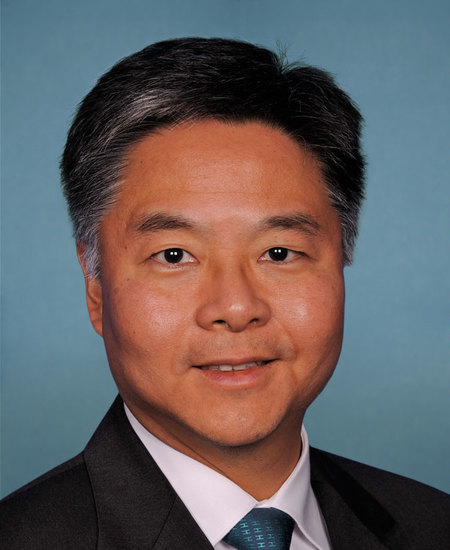
Rep. Ted Lieu
Sponsored bills
Maddy summaryHR 7634, the Plastic Pellet Free Waters Act, prohibits plastic pellets and pre-production plastic materials from being discharged into water through wastewater, spills, or runoff from specific facilities. It directly affects plastic polymer production facilities, plastic molding and forming facilities, and any point source (like packaging or transport operations) handling plastic pellets. The bill requires the EPA to issue a final rule within 60 days of enactment banning these discharges and updating all relevant wastewater, stormwater, and performance standards in permits and regulations. This creates a legal requirement for facilities to prevent plastic pellet pollution in waterways, targeting a major source of ocean plastic pollution.
Maddy summaryThis concurrent resolution (HCONRES 97) recognizes the gender wage gap, noting that women working full-time earn 84 cents for every dollar earned by men. It highlights racial disparities (e.g., Latinas earn 57 cents, Black women 69 cents) and the economic impact of the gap, including $965 billion in annual lost wages for women. As a symbolic resolution, it does not create new laws or policies but formally acknowledges the issue and reaffirms Congress’s commitment to addressing wage inequality.
Maddy summaryHR 886, the Save Our Seas 2.0 Amendments Act, updates administrative and structural provisions of the Marine Debris Foundation and its programs. It clarifies that "tribal organization" refers to entities defined under the Indian Self-Determination Act, enabling direct tribal participation in marine debris initiatives. The bill modifies board appointment rules (requiring Commerce Secretary approval for some roles), reclassifies the Foundation as a corporation, and sets a 24-month limit on using federal funds for salaries. It also expands eligible grant recipients to include Indian tribes, international NGOs, and foreign governments, while requiring the Foundation to develop tribal outreach best practices. These changes streamline operations and broaden collaboration without altering core marine debris reduction programs.
Maddy summaryThe DEFIANCE Act of 2024 creates a federal civil remedy for individuals whose intimate images are disclosed without consent or who are victims of digital forgeries (computer-generated or altered images appearing authentic). It allows victims to sue in federal court for up to $150,000 in damages, attorney fees, and court orders to stop further disclosure, provided the act occurred in interstate commerce. The law includes privacy protections like pseudonyms and sealed court filings, and sets a 10-year statute of limitations from the date of discovery or the victim’s 18th birthday. It explicitly preserves state laws that offer stronger protections for victims.
Maddy summaryThis resolution (HRES 1050) designates March 2024 as National Colorectal Cancer Awareness Month. It symbolically supports existing public awareness efforts around colorectal cancer prevention, screening, and early detection, without creating new requirements or funding. The resolution encourages the public to observe the month with educational activities, aligning with ongoing annual campaigns. It directly affects public awareness efforts but has no binding policy impact.
Maddy summaryHR 6195, the Wildland Firefighter Fair Pay Act, modifies federal pay rules for wildland firefighters and related personnel employed by the Forest Service, Department of the Interior, and National Weather Service. It establishes that premium pay earned during wildfire suppression activities (excluding prescribed fires) will be disregarded when calculating total pay for certain pay limits, preventing these employees from exceeding the Executive Schedule Level II pay cap. The bill requires the Secretaries of Agriculture, Interior, and Commerce to submit a hiring plan by March 2024 to ensure sufficient staffing without triggering pay caps. The changes take effect in January 2024 for most provisions and October 2023 for premium pay adjustments.
Maddy summaryHR 6203 extends funding for the Emergency Food Assistance Program (EFAP) through fiscal year 2028, increasing annual commodity funding to $500 million per year for 2024-2028. It raises storage and distribution funding from $100 million to $200 million annually and creates new delivery options for geographically isolated states (Hawaii, Alaska, Puerto Rico, Northern Mariana Islands, U.S. Virgin Islands, and Guam), including allowing them to order through the Department of Defense Fresh Fruit and Vegetable Program. The bill also permits these states to use up to 20% of allocated funds to directly purchase locally grown food. Finally, it allows the Secretary to consider factors like product variety and transportation distance when awarding contracts for fresh produce packages, while maintaining nutritional goals.
Maddy summaryThe Empower Act of 2024 would establish a "Freedom From Influence Fund" to finance public campaign financing for presidential candidates starting in 2028. It would increase matching payments for small contributions (up to $1,000 per person) and repeal previous expenditure limits for presidential campaigns. The fund would be financed by assessments of 4.75% on fines and penalties collected from criminal convictions and civil penalties. This would affect presidential candidates who choose to participate in the public financing system and their donors who make contributions under the new $1,000 limit.
Maddy summaryThe Uyghur Policy Act of 2023 establishes a U.S. Special Coordinator for Uyghur Issues within the State Department to coordinate policy and advocate for the protection of Uyghur cultural, religious, and linguistic identity in Xinjiang. It authorizes $250,000 annually for Uyghur human rights advocates to speak at public diplomacy events in Muslim-majority countries and mandates Uyghur language training for U.S. diplomats. The bill also directs the U.S. government to support United Nations monitoring of Xinjiang human rights issues and oppose efforts to block discussions of Xinjiang at the UN. These provisions focus on diplomatic advocacy and information-sharing, not direct sanctions or enforcement actions against China.