

Maddy summaryThis bill would provide federal grants to public housing agencies to modernize public housing through energy efficiency upgrades, infrastructure improvements, and renewable energy systems. It requires all public housing to become "zero-carbon homes" that produce enough renewable energy to meet their own consumption within 10 years. The bill includes specific requirements for workforce development, hiring from low- and very low-income communities (40% in year 1, 50% in year 2, 90% after that), and contracting with resident-owned businesses (20% in year 1, 30% in year 2, 50% after that). It also mandates resident and community engagement in planning, and requires public housing agencies to meet specific energy efficiency and water quality standards. The bill directly affects all public housing agencies managing housing for low- and very low-income residents across the United States, including tribal housing entities.
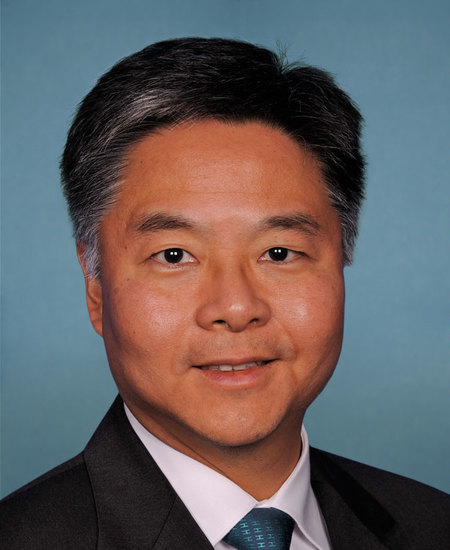
Rep. Ted Lieu
Sponsored bills
Maddy summaryHR 7770, the Rosie the Riveter Commemorative Coin Act, authorizes the U.S. Mint to produce and sell three commemorative coins honoring women who worked on the U.S. home front during World War II. It specifies $5 gold coins (max 50,000), $1 silver coins (max 400,000), and half-dollar coins (max 750,000), all to be issued between January 1, 2025, and December 31, 2025. Each coin sale includes a surcharge ($35 for gold, $10 for silver, $5 for half-dollar), with all surcharge funds directed to the Rosie the Riveter Trust for maintaining the Rosie the Riveter WWII Home Front National Historical Park and educational programs. The coins will feature designs reflecting the legacy of diverse women workers and must meet specific weight, diameter, and composition standards.
Maddy summaryHR 6727 establishes the United States Foundation for International Conservation, a nonprofit organization that will provide grants to support long-term management of protected and conserved areas in eligible countries. The Foundation requires a 2:1 cost match from other sources, demands host country and community consent through binding agreements, and prioritizes areas with high biodiversity or species of significant importance. It will be governed by a Board of Directors including government officials and private sector experts, operate for 10 years with $1 million authorized for 2024 and $100 million annually from 2025-2035, and must follow international conservation standards while prohibiting funding for countries supporting terrorism or violating human rights.
Maddy summaryThis bill establishes a federal grant program to fund projects restoring native kelp forests, directly affecting eligible entities like fishing industry members, tribes, universities, nonprofits, and state/local governments. It requires projects to address the greatest kelp declines, focus on ecosystem resilience (including natural predator-prey relationships), integrate Indigenous knowledge, and avoid commercial harvesting. The program allocates $5 million annually (2024-2028), with at least $750,000 reserved for tribal projects, and mandates that federal funds cover up to 85% of project costs (with possible waivers). Grants prioritize areas identified in tribal or government restoration plans and require monitoring plans to measure project effectiveness.
Maddy summaryHR 7746, the "Destroy Zombie Guns Act," requires businesses that destroy firearms to destroy every component of a firearm during the process, not just parts of it. This law directly affects licensed firearm destruction businesses and individuals operating as regular business to destroy firearms for profit. The bill amends federal law (18 U.S.C. § 922) to make it unlawful to fail this complete destruction, adding penalties including fines, up to 2 years in prison, and license suspension or revocation for licensed destroyers who violate the rule. The key mechanism ensures no firearm parts remain usable after destruction, targeting incomplete destruction practices.
Maddy summaryHR 7751, the Transparency in Security Clearance Denials Act, requires the Secretary of State to annually report to Congress on security clearance denials, suspensions, or revocations within the State Department's Diplomatic Security. The report must include the number of denials by position type (e.g., Foreign Service officer, civil service employee), appeal success rates, and the criteria used for decisions, with data broken down by ethnicity, national origin, race, and gender where available. This applies specifically to State Department security clearance actions, including initial applications, periodic reinvestigations, and continuous vetting. The law aims to increase transparency around clearance decisions by mandating detailed, disaggregated reporting. It does not change clearance standards or processes but requires the State Department to publicly disclose these metrics annually.
Maddy summaryThe PTO Act establishes a standard for paid annual leave, requiring most employers to provide employees with 1 hour of paid leave for every 25 hours worked, up to a maximum of 80 hours per 12-month period. It directly affects private sector employees and certain government workers, including those at the Government Accountability Office, Library of Congress, and federal agencies covered under the Congressional Accountability Act. The bill prohibits employers from interfering with employees' use of leave for any reason, requires clear notice of leave policies, and protects employees from retaliation for taking leave. It includes enforcement mechanisms through the Department of Labor, allowing employees to file complaints or lawsuits for violations of their leave rights. The Act takes effect 180 days after enactment, with specific provisions for collective bargaining agreements.
Maddy summaryHR 7747, the Federal Judiciary Stabilization Act of 2024, reclassifies existing federal district court judgeships in specific jurisdictions under a new section of law (28 U.S.C. § 133). It directly affects the courts in Hawaii, Kansas, Missouri, Alabama, Arizona, California, Florida, New Mexico, North Carolina, and Texas by updating their authorized judge counts, such as adding 4 judgeships for Hawaii and increasing California's Central District to 28. The bill modifies the official table in federal law to reflect these new numbers without creating new permanent positions. It authorizes necessary funding to implement these changes. This is a procedural adjustment to judgeship authorizations, not a policy change affecting the public.
Maddy summaryHCONRES 99 is a symbolic congressional resolution honoring Wadee Alfayoumi, a 6-year-old Palestinian-American boy murdered in a hate crime on October 14, 2023, after being stabbed 26 times by a perpetrator who made anti-Muslim and anti-Palestinian remarks. The resolution recognizes Congress's condemnation of hate crimes, Islamophobia, and anti-Palestinian discrimination, while affirming the United States' "zero tolerance" for such violence. As a procedural resolution (not a law), it does not create new policies but formally honors Wadee and his family, emphasizing the need to reject dehumanizing rhetoric targeting religious or ethnic groups.
Maddy summaryHRES 1079 is a symbolic House resolution condemning Russia's claimed suspension of the New START nuclear arms control treaty, which the U.S. considers legally invalid. It calls on Russia to immediately return to full compliance with New START, including resuming inspections and data sharing, and emphasizes the importance of arms control for global stability. The resolution urges the Biden administration to continue arms control talks with Russia and China to prevent a nuclear arms race. As a non-binding resolution, it does not change U.S. policy but expresses congressional support for maintaining the New START framework, which limits Russia's nuclear arsenal to 1,550 warheads.