

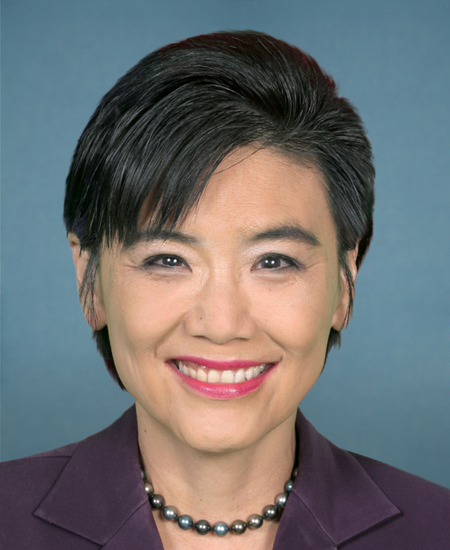
Photo of Judy Chu
D United States House · District 28 · California On the 2026 ballot

Rep. Judy Chu

Compare
Total votes
2,837
all sessions
Attendance
99%
30 missed
Higher than 89% of chamber peers
With party
98%
of cast votes
Higher than 80% of chamber peers
Bipartisan score
1%
crosses aisle rarely
Lower than 80% of chamber peers
Sponsored
2,360
bills & resolutions
Higher than 96% of chamber peers
Committees
5
assignments
2,360 bills and resolutions

Sponsored bills

Total
2,360
Primary
124
Co-sponsor
2,236
This page
2,360
matching current filters
Co-sponsor HR 8765
In committee · United States House · Co-sponsor
Disaster Relief for Farm Workers Act

Maddy summaryThis bill creates a new program to provide emergency grants to farm worker organizations during covered disasters. It directly affects migrant and seasonal farm workers who lose income or cannot work due to events like hurricanes, wildfires, pandemics, or extreme weather. The grants fund immediate relief (including direct cash or aid), building community resilience, infrastructure support, and emergency services. Funds remain available until spent, and the program requires consultation with eligible organizations, defined as farm worker groups or qualified nonprofits with relevant experience.

In committee Aug 8, 2024 1 co-sponsor
Co-sponsor HR 9304
In committee · United States House · Co-sponsor
Stomach Cancer Prevention and Early Detection Act

Maddy summaryHR 9304, the Stomach Cancer Prevention and Early Detection Act, requires the National Cancer Institute (NCI) to conduct a comprehensive review of stomach cancer incidence, risk factors, screening effectiveness, and current awareness efforts in the U.S. The review will specifically examine high-risk populations, the role of H. pylori infection, endoscopic screening methods, and public and provider education. Within 18 months of enactment, the NCI must submit a report to Congress with recommendations for defining high-risk groups, improving detection methods for precancerous conditions, establishing screening guidelines, and enhancing research and prevention efforts. This bill directly affects public health systems, healthcare providers, and individuals at higher risk for stomach cancer by aiming to inform future prevention strategies and screening protocols.

In committee Aug 6, 2024 1 co-sponsor
Co-sponsor HRES 1404
In committee · United States House · Co-sponsor
Expressing support for keeping guns out of classrooms.

Maddy summaryThis non-binding House resolution expresses the House's support for keeping guns out of schools by stating federal funds should not be used to arm school personnel or provide them firearm training. It references existing laws like the STOP School Violence Act (2018) and research showing arming staff does not improve safety, citing data on failed interventions and disproportionate impacts on students of color. The resolution affirms current policy guidance without creating new legal requirements. It serves as a formal statement of the House's position based on evidence and existing legislative frameworks.

In committee Aug 2, 2024 1 co-sponsor
Co-sponsor HR 9266
In committee · United States House · Co-sponsor
Stop Militarizing Our Streets Act of 2024

Maddy summaryThe Stop Militarizing Our Streets Act of 2024 restricts the Department of Defense from selling military-grade assault weapons or specific high-capacity ammunition (like .223 Remington and 7.62 NATO) in the commercial marketplace, and prohibits the department from procuring weapons or ammunition from dealers that sell these items commercially. The bill establishes detailed requirements for dealers who want to sell to the government, including mandatory background checks through NICS, security measures, limits on ammunition sales to individuals (500 rounds of covered ammunition or 1,000 rounds of other types in 30 days), and employee training on recognizing straw purchases and preventing illegal sales. Government-owned plants that produce firearms or ammunition for commercial sale must report annual sales data to Congress, including customer locations and revenue. The bill also authorizes the Attorney General to establish licenses for ammunition dealers and allow them to use the NICS background check system. This legislation directly affects the Department of Defense, firearms and ammunition dealers, and government-owned manufacturing facilities.

In committee Aug 2, 2024 1 co-sponsor
Co-sponsor HR 9274
In committee · United States House · Co-sponsor
SHAWL Act

Maddy summaryHR 9274, the SHAWL Act, establishes two new Smithsonian museums: the National Museum of the American Latino and the American Women’s History Museum. It authorizes both museums to be located within the National Mall’s "Reserve" area, overriding prior restrictions, and requires federal agencies managing potential sites to transfer jurisdiction to the Smithsonian after notifying congressional committees. The bill mandates that both museums accurately represent diverse cultures, histories, and viewpoints within Latino and women’s communities through exhibits and programs, requiring input from a broad range of community experts. It also requires the Smithsonian to submit biennial reports to Congress detailing compliance with these representation requirements.

In committee Aug 2, 2024 1 co-sponsor
Primary HR 9244
In committee · United States House · Lead sponsor
NO BAN Act

Maddy summaryThe NO BAN Act (HR 9244) prohibits U.S. immigration authorities from denying visas or entry based on national origin, religion, or sex. It amends immigration law to explicitly ban such discrimination in visa decisions and tightens restrictions on the president’s power to suspend entry of certain groups under Section 212(f). The bill requires specific evidence, narrow tailoring, time limits, and congressional notification for any entry restriction, while mandating public reports on visa denials and waivers. It directly affects nonimmigrant visa applicants (e.g., students, workers) and federal agencies administering immigration policy.

In committee Aug 2, 2024 0 co-sponsors
Co-sponsor HR 9253
In committee · United States House · Co-sponsor
National Gun Violence Research Act

Maddy summaryHR 9253, the National Gun Violence Research Act, repeals longstanding restrictions that blocked federal funding for gun violence research, including the 1996 Dickey Amendment. It establishes a National Gun Violence Research Program to support scientific studies on gun-related injury and death, with $200 million authorized over six years (2025-2030). The program directs agencies like the CDC, NIH, and National Institute of Justice to fund research, train researchers, develop safety standards, and share gun trace data with researchers through new protocols. This bill directly affects federal research institutions and public health agencies by enabling evidence-based study of gun violence causes and prevention strategies.

In committee Aug 2, 2024 1 co-sponsor
Co-sponsor HR 9228
In committee · United States House · Co-sponsor
BE HEARD in the Workplace Act

Maddy summary# Summary of Proposed Workplace Discrimination and Harassment Prevention Bill This comprehensive legislative proposal aims to strengthen protections against workplace discrimination and harassment through multiple interconnected provisions: 1. **Expanded Protections**: Broadens coverage to include sexual orientation, gender identity, and other protected categories in workplace discrimination laws. 2. **Nondisclosure Agreement Restrictions**: Prohibits employers from requiring nondisclosure or nondisparagement clauses that would prevent workers from reporting harassment or discrimination, with limited exceptions for settlement agreements meeting specific requirements. 3. **Arbitration Prohibition**: Bans mandatory pre-dispute arbitration agreements for work-related disputes and imposes strict requirements for post-dispute agreements. 4. **Federal Contractor Requirements**: Mandates that federal contractors disclose labor and civil rights violations from the previous three years and requires corrective actions for violations. 5. **Grant Programs**: - National grants to prevent and address workplace discrimination through education, outreach, and complaint assistance - Grants for legal assistance to low-income workers facing employment discrimination - State-level advocacy systems with funding allotments to support worker rights protection 6. **Enforcement Mechanisms**: Establishes clear enforcement procedures, with the Equal Employment Opportunity Commission (EEOC) having authority to enforce these provisions with powers similar to those under existing civil rights laws. The bill also includes definitions, implementation details, and provisions for state and federal coordination to create a comprehensive system for preventing and addressing workplace discrimination and harassment across all sectors of employment.

In committee Jul 30, 2024 1 co-sponsor
Co-sponsor HR 9217
In committee · United States House · Co-sponsor
Destination Reception Assistance Act

Maddy summaryThis bill establishes the Destination Reception Services Program to provide medium-term support to certain immigrants in the U.S., including those granted parole, placed in removal proceedings, or with pending asylum applications. It authorizes $3 billion annually (2025-2028) to fund services like housing assistance, healthcare, job training, legal aid for work authorization/asylum, childcare, and transportation through local government and nonprofit organizations. The program is managed by a federal Board and local community boards that identify high-need areas and allocate funds based on criteria like immigrant population density and service gaps. It explicitly states the program is not an "alternatives to detention" initiative and prioritizes services to help new arrivals achieve self-sufficiency.

In committee Jul 30, 2024 1 co-sponsor
Co-sponsor HRES 1386
In committee · United States House · Co-sponsor
Expressing the sense of the House of Representatives on Project 2025.

Maddy summaryHRES 1386 is a non-binding House resolution expressing the House's condemnation of Project 2025. It states that if enacted, Project 2025 would threaten healthcare access (including ending protections for pre-existing conditions and banning Medicare drug negotiations), restrict abortion and fertility services, cut education funding, raise costs for working families, and give tax breaks to wealthy corporations. The resolution specifically lists these potential impacts as reasons for the House to "condemn in the strongest terms" Project 2025. As a resolution, it does not create new law but formally expresses the House's position on this policy proposal.

In committee Jul 25, 2024 1 co-sponsor
Showing 911 to 920 of 2,360 bills
Previous 1 … 91 92 93 … 236 Next