

Maddy summaryHRES 1530 is a non-binding House resolution recognizing former President Jimmy Carter's 100th birthday. It honors his life, public service, and key achievements, including his presidency (noting the Panama Canal treaties, Camp David Accords, and founding the Departments of Education and Energy), post-presidency work with the Carter Center, and decades of humanitarian efforts. The resolution does not create new laws or affect any policies; it is purely commemorative. It formally acknowledges his contributions to Georgia, the U.S., and global peace efforts, including his 2002 Nobel Peace Prize. This symbolic gesture has no direct impact on citizens or government operations.
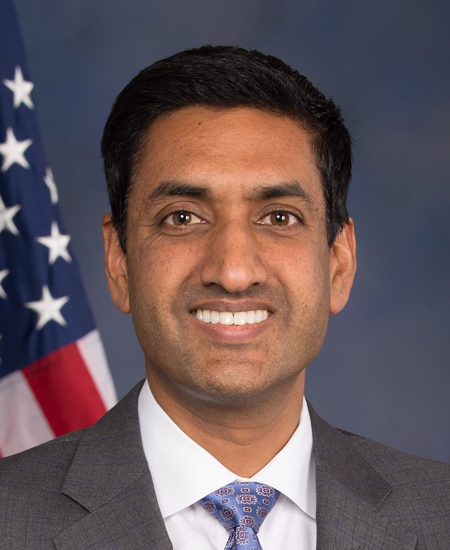
Rep. Ro Khanna
Sponsored bills
Maddy summaryThe Child Care for America Act of 2024 establishes a comprehensive program to make high-quality child care more affordable for low- and moderate-income families. It creates a grant program to reduce parent fees to $10 per day for full-time care, with the Low-Moderate Income Fee Reduction Program covering 100% of fees for families at or below 85% of State median income. The bill also establishes a $300 monthly benefit for parents caring for children under age 3 at home, requires child care providers to improve staff compensation through a "wage and benefits ladder," and provides funding for facility improvements, training, and support for family, friend, and neighbor care providers. Funded at $78 billion annually through 2034, the program targets families with incomes up to $250,000 for married couples and $125,000 for individuals.
Maddy summaryHR 9900 extends the operational timeline of the National Security Commission on Emerging Biotechnology. It modifies provisions in the 2022 National Defense Act by making expired appointments valid, changing the reporting deadline from 3 years to 3.5 years after commission formation, and setting a new final report deadline of December 31, 2026. The bill directly affects the Commission's membership structure and reporting requirements without altering its core mission. This is a procedural adjustment to maintain the Commission's continuity, not a substantive policy change.
Maddy summaryThis bill eliminates out-of-pocket costs for all FDA-approved contraceptives under TRICARE for military dependents (spouses and children) and extends full coverage to include counseling, insertion, removal, and follow-up care. It requires TRICARE Select, Prime, and pharmacy benefits to cover all contraceptive methods without cost-sharing, addressing current gaps where dependents face copays. The law also mandates family planning education for all service members and ensures sexual assault survivors can access emergency contraception without barriers at military medical facilities. This applies to all individuals with reproductive capacity, including transgender and non-binary dependents.
Maddy summaryHR 9878, the No Shame at School Act of 2024, requires schools to automatically certify students from households with unpaid meal fees for free or reduced-price meals (instead of allowing discretion), and mandates retroactive reimbursement for past unpaid meals. It directly affects school districts and students in households owing meal fees by prohibiting stigmatizing practices like special tokens, public lists of names, or withholding grades due to unpaid fees. Key provisions ban schools from physically segregating students, using debt collectors, or taking food away from students who owe fees, while requiring clear communication to households about meal applications. The bill defines "covered child" as any student enrolled in a participating school meal program whose household owes fees or is eligible for free/reduced meals.
Maddy summaryThis bill eliminates a tax credit for using carbon dioxide (CO2) in enhanced oil recovery (EOR) operations. It amends the Internal Revenue Code by removing Section 43 (the EOR credit) and modifying Section 45Q to prohibit the credit for new facilities starting construction after the law's enactment. The primary effect is ending the federal tax incentive for oil companies that inject CO2 to extract more oil from existing wells. This change directly affects oil and gas companies planning new EOR projects using CO2, as they will no longer qualify for this specific tax credit.
Maddy summaryHR 1719, the Honoring Our Fallen Heroes Act of 2023, establishes a presumption that certain cancers diagnosed in public safety officers (like police and firefighters) are work-related if linked to their duties. It defines 22 specific cancers (including lung, mesothelioma, and WTC-related cancers) as "exposure-related," allowing officers or their families to receive benefits without proving direct work connection, provided they were diagnosed within 15 years of leaving active service. The bill also creates a process for adding new cancers to the list based on scientific evidence, requiring the Bureau to review petitions and make decisions within 180 days. This applies to deaths or disabilities occurring on or after January 1, 2023, directly affecting officers who developed covered cancers during service.
Maddy summaryHRES 1499 is a symbolic resolution expressing concern about rising book bans in U.S. schools and libraries, citing PEN America data showing over 10,000 individual book bans in public schools between July 2023 and June 2024 - more than double the previous year. It highlights how bans disproportionately target books featuring LGBTQ+ themes, racial history, and marginalized voices (like *The Handmaid’s Tale*, *Maus*, and *Fry Bread*), while emphasizing students’ First Amendment rights to access diverse materials. The resolution calls on school districts and libraries to follow established best practices for handling book challenges and to protect students’ right to read widely, including works reflecting diverse perspectives. As a non-binding resolution, it does not create new law but urges local education entities to uphold free expression.
Maddy summaryThe DISPOSE Act authorizes the U.S. government to partner with Colombia, Mexico, and Peru to safely destroy chemicals used in illegal drug production. It requires the State Department, in coordination with Justice and Defense, to create a detailed implementation plan within 90 days - including timelines, budgets, and measurable goals - and provide annual progress reports to Congress on chemical destruction efforts. The initiative aims to prevent these chemicals from re-entering drug manufacturing, free storage space for future seizures, and reduce environmental harm from hazardous waste.
Maddy summaryHR 3433, the "Give Kids a Chance Act of 2024," requires pharmaceutical companies developing certain cancer drugs to conduct pediatric studies if the drugs target molecular pathways relevant to childhood cancers. It directly affects drug manufacturers submitting new applications for cancer treatments, particularly those combining previously approved adult cancer drugs or containing a single new active ingredient. The bill amends FDA regulations to mandate these pediatric investigations only when specific conditions are met, such as when a drug's molecular target is relevant to pediatric cancer growth. The FDA must issue implementing guidance within 12 months, and reports to Congress will track implementation and effectiveness starting 2 years after enactment.