

Maddy summaryHRES 1588 is a House resolution supporting Transgender Day of Remembrance (TDoR) by recognizing the epidemic of violence against transgender people and memorializing those killed between October 1, 2023, and September 30, 2024. It specifically honors 38 transgender or gender-nonconforming individuals whose lives were lost to violence during that period, highlighting that transgender women of color face disproportionate risks. The resolution acknowledges systemic issues like underreporting, barriers to healthcare, and higher rates of homelessness and suicide within the community. It calls for the U.S. government to prioritize solutions to this violence while affirming transgender people's right to dignity and safety. As a symbolic resolution, it does not create new laws or policies but formally recognizes these issues for congressional record.
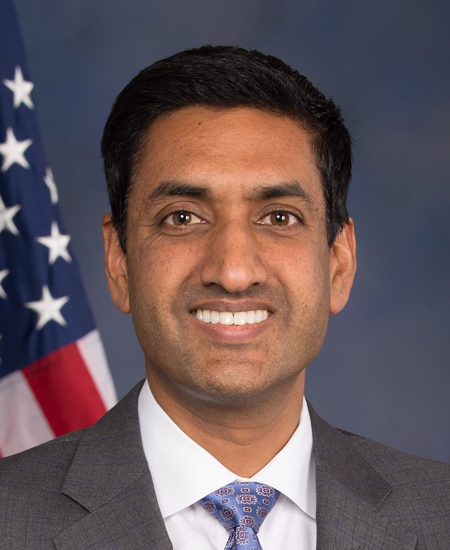
Rep. Ro Khanna
Sponsored bills
Maddy summaryThe Federal Agency Performance Act of 2024 requires federal agencies to conduct annual reviews of progress toward strategic goals, led by agency heads and Chief Operating Officers. Each review must assess performance data, identify risks to goal achievement, and propose improvement strategies - such as adjusting programs or policies - before reporting findings in annual agency performance reports. Agencies must also update the public Federal Performance Website to display quarterly progress trends and annual results for agency priority goals, including how well goals align with budget plans. The bill establishes new roles for Deputy Performance Improvement Officers (career civil servants) to support these efforts and repeals outdated pilot programs.
Maddy summaryHR 7807 creates a federal task force to address U.S. reliance on foreign sources for critical minerals essential to national security, technology, and defense. The task force, established within 90 days, will coordinate across federal agencies, state/local governments, and tribal nations to assess supply chain vulnerabilities - particularly dependence on countries like China - and recommend strategies to boost domestic mining, processing, and international partnerships. It requires regular reports to Congress, including a final report within two years, and mandates consultation with industry stakeholders and environmental experts. The bill directly affects federal departments (like Defense and Energy), state/local governments, tribal nations, and the mining industry, aiming to secure supply chains without immediate regulatory changes.
Maddy summaryThis bill authorizes a single gold medal to honor the 320th Barrage Balloon Battalion, an all-African American unit that served during the D-Day invasion in World War II. The medal commemorates their unique role as the only African American combat unit to land in Normandy, their deployment of barrage balloons to protect troops from air attacks, and their contributions to the Allied victory. The gold medal, to be struck by the Treasury and displayed at the Smithsonian Institution (including locations like the National Museum of African American History and Culture), will be made available for public display and research. This is a commemorative measure with no policy changes or direct impact on current laws or citizens.
Maddy summaryHRES 1553 is a resolution expressing the House of Representatives' sense that action is needed to address a federal tax exemption under Puerto Rico's Act 22. This provision allows wealthy Americans who do not reside in Puerto Rico to receive 100% exemptions from income and capital gains taxes in Puerto Rico while legally avoiding U.S. federal taxes. The resolution focuses on the tax loophole enabling this arrangement, which the bill claims contributes to housing displacement and price spikes on the island. It does not change tax law but urges the House to act on this issue. (Note: As a resolution, it is procedural and not a binding legislative measure.)
Maddy summaryHRES 1554 is a symbolic House resolution expressing U.S. support for recognizing and commemorating the 1984 Sikh genocide in India. It calls for official remembrance of the violence that killed over 30,000 Sikhs, destroyed communities, and involved state complicity. The resolution specifically urges the U.S. government to commemorate the genocide, demand accountability for perpetrators, and reject any denial of the event. This resolution does not create new laws or affect specific groups directly; it is a formal statement of the House's position on historical recognition.
Maddy summaryThis bill disallows tax deductions for mortgage interest and depreciation on single-family homes owned by large institutional investors (defined as entities with over $100 million in assets), and imposes a 100% excise tax on the sale or transfer of such properties. It excludes government entities, nonprofits, and federally-assisted housing (like Section 8 properties) from these rules. Revenue from the sales tax funds the Housing Trust Fund to increase affordable rental housing for low-income families. The policy directly affects major real estate firms owning single-family homes as investments, not individual homeowners or small landlords.
Maddy summaryThe VA Employee Fairness Act of 2024 modifies collective bargaining rules for employees of the Veterans Health Administration (VHA). It removes existing subsections (b), (c), and (d) from the law governing VHA employee bargaining and renumbers the remaining provision. This change streamlines the collective bargaining framework but does not alter the Secretary of Veterans Affairs' existing authorities over incentive pay and expedited hiring. The bill directly affects VHA employees by changing how their collective bargaining rights are structured under federal law. The law remains neutral, focusing solely on procedural adjustments to the existing bargaining framework.
Maddy summaryThis bill establishes minimum safety standards for railroad bridges and requires railroad carriers to provide detailed inspection reports classifying bridges as poor, fair, or good condition, including repair timelines and costs for bridges in poor condition. It mandates railroad carriers to post visible signs identifying bridge ownership and a contact number for public safety concerns, and creates a public database showing basic bridge condition information without detailed technical specifications. The bill also establishes a safety concern reporting system for the public and authorities, and requires the Department of Transportation to conduct randomized bridge inspections to verify reported conditions. Railroad carriers that fail to meet safety requirements face civil penalties, including weekly fines for continued operation of unsafe bridges.
Maddy summaryHR 8539 creates a new Office of Biotechnology Policy within the U.S. Department of Agriculture (USDA) to coordinate the agency's work on agricultural biotechnology, biomanufacturing, and related emerging technologies. The Office will develop policies covering research, regulation, labeling, commercialization, and outreach, and must coordinate with agencies like the EPA and FDA. It will directly affect USDA operations, biotechnology developers, farmers, and other stakeholders by centralizing policy coordination and requiring consultation with these groups. The bill establishes a Director who reports directly to the Secretary of Agriculture, aiming to streamline the USDA's approach to rapidly evolving biotech innovations.