

Maddy summaryHR 3546, the Prescription Drug Price Relief Act of 2025, directs the Secretary of Health and Human Services to determine if brand-name drug prices are "excessive" by comparing U.S. prices to median prices in Canada, the UK, Germany, France, and Japan, or by evaluating factors like patient population size, drug value, and R&D costs. If a price is deemed excessive, the bill automatically voids the manufacturer’s government-granted drug exclusivity (like patent protections) and allows any company to produce generic versions using the original drug data. New manufacturers must pay a reasonable royalty (capped at IRS average rates for pharma) and sell the drug at a price below the "excessive" level. The bill also requires drug manufacturers to submit detailed annual pricing reports with penalties for non-compliance and creates a public database tracking all excessive price determinations and licensing activity.
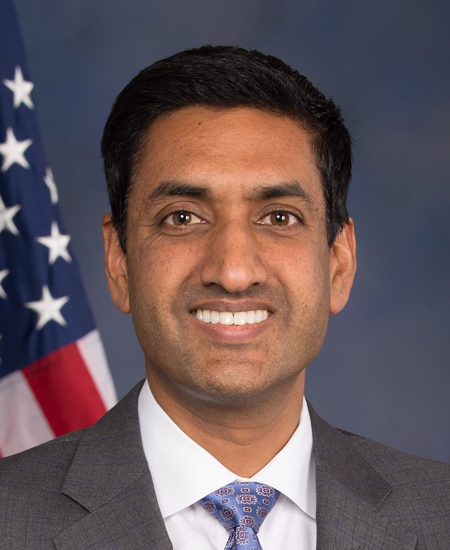
Rep. Ro Khanna
Sponsored bills
Maddy summaryThis bill would establish 18-year fixed terms for all Supreme Court justices, replacing lifetime appointments. It requires the President to nominate one justice every two years (during first and third years after presidential elections), with Senate confirmation within 90 days, and prohibits reappointments after a single term. Current justices would be phased out in order of seniority as new justices are appointed under this schedule. The bill directly affects all sitting and future Supreme Court justices by mandating term limits and a structured appointment process.
Maddy summaryHR 3554, the Close the Revolving Door Act of 2025, prohibits former Members of Congress and congressional staff from lobbying for 6 years (extending the current 1-year rule) after leaving office and bans registered lobbyists from joining Congress within 6 years of substantial lobbying contact. It requires lobbying firms employing over 3 registered lobbyists to publicly report any former lawmakers or high-level congressional staff on their payroll, and mandates a new searchable website (lobbyists.gov) for transparency. The bill directly affects former legislators, congressional staff, and lobbying firms by restricting post-government employment transitions and increasing disclosure requirements. Key provisions include a lifetime lobbying ban for Members of Congress, enhanced reporting for "substantial lobbying entities," and a $100,000 funding allocation for the new database.
Maddy summaryHR 3493, the Global Fairness in Drug Pricing Act, requires the U.S. Health and Human Services Secretary to establish price targets for pharmaceutical manufacturers, ensuring U.S. drug prices align with those in comparable developed countries. It directs the HHS Secretary to certify safe importation of drugs from low-cost countries and facilitate direct-to-consumer purchasing programs at the set prices. The bill also authorizes antitrust enforcement against drug companies for anticompetitive practices and mandates a study on whether manufacturers engage in unfair pricing that forces U.S. patients to subsidize global drug research. This legislation directly affects pharmaceutical manufacturers and American patients seeking affordable prescription drugs.
Maddy summaryHR 3501 would require Medicare providers to screen beneficiaries aged 65 and older for cognitive impairment during annual wellness visits and initial preventive physical exams, using tools approved by the National Institute on Aging. The screening must be documented in the patient’s medical record. This change applies to visits starting January 1, 2026, and aims to support early detection of conditions like Alzheimer’s through standard preventive care. The bill directly affects Medicare beneficiaries, providers, and caregivers by integrating cognitive screening into routine preventive services.
Stronger Communities through Better Transit Act This bill requires the Department of Transportation (DOT) to establish a grant program to support operating projects for public transportation and related service improvements, particularly in underserved communities and areas of persistent poverty. Specifically, the bill requires DOT to allocate funding under the program for urbanized areas, states, and Indian tribes that are recipients of funds under either the Federal Transit Administration's (FTA's) Urbanized Area Formula Funding program or Formula Grants for Rural Areas program. Eligible recipients may use funding for operating costs associated with projects that improve public transportation service for transit-dependent populations and support increased transit ridership (e.g., service expansion, information technology enhancements, and workforce development). DOT must apportion the funding so that recipients receive funds that are proportional to their share of operating costs. The bill also provides for an increased federal cost share for operating assistance for projects or programs carried out in areas of persistent poverty or underserved communities. DOT must set up a multimodal access measurement interface for public agencies to aid transit agencies in determining and reporting on access to jobs and essential services. A grant recipient must (1) report specific information to the FTA for inclusion in the National Transit Database, and (2) survey transit riders and non-riding residents regarding transit service improvements. Further, the bill expands the purposes of the public transportation programs to include supporting public transportation's role in combating climate change through growing/retaining transit ridership.
Maddy summaryThis bill clarifies that the President has no constitutional authority to withhold funds Congress has appropriated. It creates new legal mechanisms allowing private citizens and state/local governments to sue the federal government for impoundments of appropriated funds. The bill strengthens the Comptroller General's oversight role by requiring executive branch cooperation in investigations of potential violations. Federal employees who knowingly violate these provisions would face personal liability and lose immunity protections. The legislation aims to reinforce Congress's constitutional authority over the budget process.
Maddy summaryHR 3452, the "Six Assurances to Taiwan Act," formally codifies six longstanding U.S. policy commitments regarding Taiwan that were established in 1982. It reaffirms that the U.S. has never agreed to set a date for ending arms sales to Taiwan, consult with China on such sales, mediate between Taiwan and China, revise the Taiwan Relations Act, take a position on Taiwan's sovereignty, or pressure Taiwan to negotiate with China. The bill’s key mechanism requires the President to notify Congress before taking any action that could alter these assurances, giving Congress 30 days (or 60 days during a specific period) to review proposals through a joint resolution process. This applies to actions like pausing arms sales, negotiating with China on arms, or changing U.S. policy on Taiwan’s status. The bill directly affects U.S. executive branch decisions on Taiwan policy and Congressional oversight authority.
Maddy summaryThis bill establishes minimum nurse-to-patient ratios for hospital units across the country, requiring hospitals to maintain specific staffing levels (such as 1:1 in trauma units, 2:1 in critical care units, and 3:1 in emergency rooms) to improve patient safety and quality of care. Hospitals must develop transparent staffing plans that account for patient acuity, involve direct care nurses in planning, and document actual staffing levels for each shift. The bill includes strong whistleblower protections for nurses who object to unsafe staffing levels and prohibits hospitals from retaliating against nurses who report violations. It requires hospitals to comply with these standards as a condition for receiving Medicare and Medicaid payments, with enforcement through audits and civil penalties of up to $50,000 for repeated violations. The bill also includes provisions to support nurse recruitment and retention through workforce initiatives and training programs.
Maddy summaryHR 3368, the "Born in the USA Act of 2025," prohibits federal funding for Executive Order 14160 (which aimed to restrict birthright citizenship for children born in the U.S.). The bill directly affects federal agencies that might implement the executive order by blocking their use of funds for that purpose. Its key provision is a funding ban targeting the executive order and any similar future policies, without changing citizenship law. The bill does not alter birthright citizenship rights but prevents federal resources from being used to enforce the controversial executive order. It is a procedural measure focused on funding, not a substantive policy change to citizenship rules.