

Maddy summaryHR 5186 authorizes the Department of Defense to establish a program focused on strengthening the biotechnology supply chain for military use. The program would direct military laboratories to develop biotech-based materials (like bio-cement and protective coatings), reduce reliance on foreign supply chains, and partner with industry and universities to scale innovations. Key mechanisms include assessing supply chain vulnerabilities, upgrading lab infrastructure, and requiring annual reports to Congress on progress and partnerships. The program would operate for 10 years unless extended by the President for national security reasons.
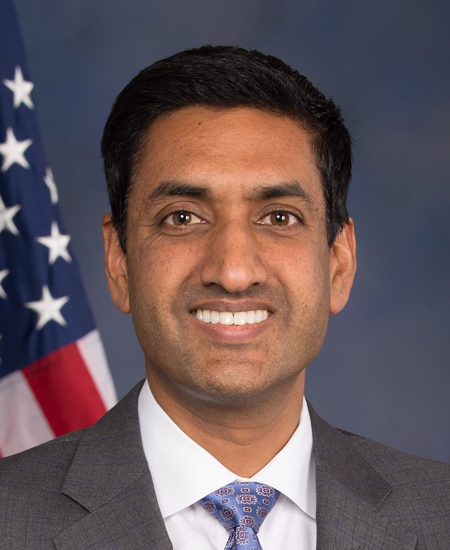
Rep. Ro Khanna
Sponsored bills
Maddy summaryHR 5190 expands a military logistics program to include commercial 3D printing facilities, allowing them to produce replacement parts rapidly near conflict zones. The bill modifies an existing Defense Department program (Section 842 of the 2024 National Defense Authorization Act) to add "commercial additive manufacturing facilities" as eligible participants for prototyping parts. This change directly affects private manufacturers with 3D printing capabilities, enabling them to support military supply chains in contested areas. The program will operate until December 31, 2030, as specified by the bill's amendment.
Maddy summaryHR 2181, the Protect Our Watchdogs Act of 2025, strengthens protections for federal Inspectors General (IGs) by requiring the President to have specific, documented reasons to remove them. The bill amends federal law to specify nine grounds for removal, including documented felony convictions, gross mismanagement, waste of funds, abuse of authority, or neglect of duty - each requiring written justification. This directly affects IGs who oversee federal agency accountability and investigations, as it prevents arbitrary removals and mandates transparency in the process. The law applies to all federal Inspectors General across agencies, ensuring their independence is maintained through clear, enforceable standards.
Maddy summaryThis bill prohibits Members of Congress, their spouses, and dependent children from owning or trading certain investments, including stocks, commodities, and derivatives (referred to as "covered investments"). It requires affected individuals to divest these investments within 90-180 days, with specific exemptions for Treasury bonds, diversified mutual funds, small business interests, and family trusts meeting strict conditions. Violations incur penalties of 10% of the investment's value plus disgorgement of profits, paid directly to the U.S. Treasury. The law applies to all covered individuals during federal service, with exceptions for investments acquired through inheritance or occupational trading (e.g., a spouse’s finance job).
Maddy summaryThe Preventing HEAT Illness and Deaths Act of 2025 establishes a National Integrated Heat Health Information System (NIHHIS) within NOAA to coordinate federal efforts on heat-related health risks. It creates an interagency committee to develop a strategic plan for improving data sharing, forecasting, and decision support tools for heat events, with a focus on communities disproportionately affected by extreme heat. The bill authorizes a Community Heat Resilience Program that provides grants to states, tribes, and local governments for projects like urban forestry, cooling centers, and heat action plans, requiring at least 40% of funds to target communities with environmental justice concerns. The legislation also mandates a study to identify gaps in heat information and response capabilities across the country. This comprehensive approach aims to reduce heat-related health impacts, particularly for vulnerable populations including older adults, outdoor workers, and communities of color.
Maddy summaryHR 5048, the "Don’t STEAL Act," amends the Fair Labor Standards Act to ensure workers receive the highest wage promised in their contracts or collective bargaining agreements, whichever exceeds federal or state minimum wage requirements. It directly affects employees engaged in commerce or working for businesses involved in commerce, requiring employers to pay at least the higher of their agreed-upon wage or the legal minimum. The bill establishes criminal penalties for willful wage theft exceeding $1,000 (up to 5 years in prison) and civil penalties for all unpaid wages, with fines funding the Department of Labor’s Wage and Hour Division enforcement efforts. These changes apply to violations occurring 90 days after enactment.
Maddy summaryThis bill (HJRES 115) terminates a presidential emergency declaration made on August 11, 2025, which claimed a "crime emergency" in Washington, D.C. It directly affects the District of Columbia by ending federal restrictions that prevented D.C. from using $1 billion in locally-raised funds for public safety, law enforcement, fire services, and schools. The resolution cites that the emergency declaration was legally flawed - section 740 of the DC Home Rule Act does not permit federalizing the Metropolitan Police Department - and notes that D.C. violent crime has reached a 30-year low. The bill formally ends the emergency under the DC Home Rule Act, restoring D.C.'s authority over its own budget and public safety resources.
Maddy summaryThe GRAS Act (HR 4958) revises food safety regulations by removing the "Generally Recognized As Safe" (GRAS) exemption from the definition of food additives under federal law. It requires food manufacturers to submit detailed safety notices to the FDA for new GRAS uses, including scientific data on carcinogenicity, reproductive toxicity, and cumulative effects, with the FDA reviewing these within 180 days. The bill mandates public comment periods for submitted notices and requires the FDA to reassess the safety of at least 10 GRAS substances every three years, including those marketed before the law's enactment. This directly affects food companies, distributors, and the FDA, adding new submission requirements, review timelines, and associated fees for GRAS-related activities.
Maddy summaryHR 4966 prohibits grocery stores from selling items at "grossly excessive prices," defined as 120% or more above the average market price over the previous six months (with exceptions for unavoidable cost increases like supply chain issues). It bans using facial recognition or personal data to set different prices for individual customers (e.g., adjusting prices based on shopping history) and requires clear signage if facial recognition is used. Stores over 10,000 square feet must replace electronic shelf labels with physical price tags. The Federal Trade Commission enforces these rules, allowing consumers to seek $3,000 per violation or actual damages, with penalties for willful violations.
Maddy summaryThe PUPP Act of 2025 creates a federal grant program to fund housing for unhoused people who have pets. It authorizes $5 million annually (2026-2030) for grants to local governments, nonprofits, or housing providers to build or retrofit properties that offer both human housing and pet-friendly accommodations. Key requirements include on-site veterinary care for pets (spaying, vaccinations, etc.), supportive services like mental health counseling for residents, and coordination with local animal care providers. This directly affects unhoused individuals with pets - often excluded from standard shelters - and the organizations managing these housing programs.