

Maddy summaryThe Justice for Black Farmers Act of 2023 addresses historical discrimination against Black farmers by the USDA through several key provisions. It establishes an Equity Commission to study discrimination and recommend solutions, creates an independent Civil Rights Oversight Board to review discrimination complaints, and provides land grants of up to 160 acres to eligible Black farmers at no cost. The bill also improves access to credit for socially disadvantaged farmers, requires the USDA to collect and publish data on racial disparities in its programs, and includes protections against discriminatory practices in the livestock industry. These measures aim to increase land ownership and economic opportunity for Black farmers while addressing systemic barriers they've faced for decades.
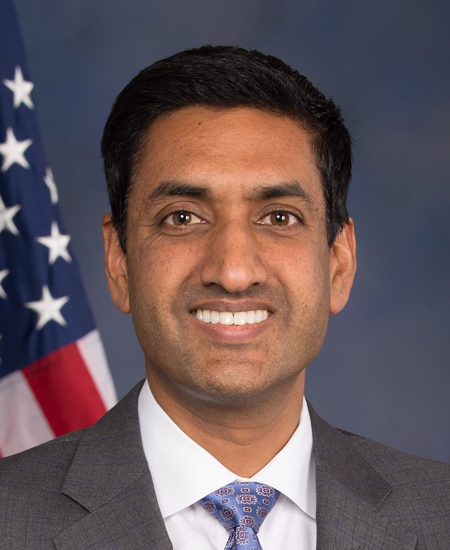
Rep. Ro Khanna
Sponsored bills
This bill authorizes the Department of Agriculture to waive the matching funds requirement for grants under the specialty crop research initiative. Currently, entities that receive grants under the initiative must provide nonfederal matching funds (including funds from an agricultural promotion, research, and information program) equal to not less than the amount of the grant.
Maddy summaryHR 1124, the Federal Death Penalty Abolition Act of 2023, would eliminate the federal death penalty by repealing provisions in over 30 sections of U.S. Code that currently allow for capital punishment in various criminal offenses. The bill would affect anyone convicted of a federal crime that currently carries the death penalty, including murder during drug trafficking, terrorism, and other violent crimes. It would remove the death penalty as a sentencing option for these offenses and require resentencing for those already under a death sentence. The bill also makes related changes to military justice procedures that currently permit capital punishment.
Maddy summaryHR 724, the Arctic Refuge Protection Act, repeals the existing oil and gas program for the Arctic National Wildlife Refuge in Alaska and designates approximately 1.56 million acres of the refuge's coastal plain as federal wilderness. This bill directly affects the Arctic Refuge by permanently prohibiting oil and gas leasing and development in that specific area. The key mechanism is adding the designated land to the National Wilderness Preservation System under the Wilderness Act, requiring it to be managed for its natural conditions. This change legally protects the area from future fossil fuel extraction activities.
Maddy summaryThis resolution exonerates 50 African-American sailors who were wrongfully convicted of mutiny by the Navy after the 1944 Port Chicago explosion, clearing their military records. It upgrades their discharges from general/summary to honorable and directs the Navy to update their files and notify surviving families. The bill specifically addresses the historical injustice of their 1944 convictions, which stemmed from racial segregation and unsafe working conditions at the segregated naval facility. It recognizes the 320 sailors (202 Black) who died in the disaster - the greatest U.S. homeland loss in WWII - and honors their service. The resolution does not alter current policy but formally corrects a 79-year-old military record.
Maddy summaryHR 1088, the Shirley Chisholm Congressional Gold Medal Act, authorizes a posthumous Congressional Gold Medal to honor Congresswoman Shirley Chisholm, the first African-American woman elected to Congress (1968) and the first Black candidate for a major party's presidential nomination (1972). The bill directs the Treasury Secretary to design and strike a gold medal featuring Chisholm's image, which will be presented by Congress and then permanently displayed at the Smithsonian Institution. Duplicate bronze medals may be sold to the public to cover production costs, with proceeds deposited into the U.S. Mint fund. This bill commemorates Chisholm's legacy and achievements without creating new laws or affecting any current policies.
Maddy summaryThe Energy Resilient Communities Act creates a federal grant program to fund clean energy microgrids that keep critical community services running during climate disasters like wildfires or floods. Eligible entities - including local governments, nonprofits, and Tribal agencies - can apply for grants covering up to 90% of costs in environmental justice communities (defined as areas with high populations of people of color, low-income residents, or Tribal communities) to build microgrids supporting hospitals, schools, or medical baseline customers (e.g., those relying on life-saving medical devices). Priority is given to projects that reduce pollution, lower energy costs, create local jobs, and use U.S.-made materials, while requiring fair wages and community-focused hiring. The program mandates annual reports to Congress tracking grant use, environmental benefits, and job creation.
Maddy summaryHR 902, "Ellie’s Law," authorizes $10 million annually from fiscal years 2024 through 2028 for the National Institute of Neurological Disorders and Stroke to conduct broader research on unruptured brain aneurysms. The funding aims to study diverse patient populations by age, sex, and race, supplementing existing research budgets without replacing them. This bill directly affects researchers and future patients by increasing federal investment in a condition impacting 6.6 million Americans, with current federal spending at only $2.08 per affected person yearly. The legislation focuses on advancing scientific understanding to improve prevention and treatment, citing the high mortality rate (50% fatal) and significant healthcare costs ($4.1 billion annually in direct costs) associated with brain aneurysm ruptures.
Maddy summaryHR 949, the Insular Area Medicaid Parity Act, removes federal funding caps on Medicaid for U.S. territories, directly affecting Puerto Rico, the U.S. Virgin Islands, Guam, the Northern Mariana Islands, and American Samoa. The bill amends the Social Security Act to eliminate the existing limit on federal Medicaid funding for these territories, allowing them to receive full federal matching funds like states. This change takes effect for fiscal year 2023, ending the previous restriction that required territories to fund a portion of their Medicaid costs themselves. The policy change ensures these territories can access the same level of federal Medicaid support as states.
Maddy summaryThe Heating and Cooling Relief Act significantly expands the Low-Income Home Energy Assistance Program (LIHEAP) to help low-income households with rising energy costs. It increases annual funding to $400 billion for fiscal years 2024-2033 (up from $2 billion), adds $1 billion yearly for cooling assistance during heat events, and expands eligibility to include households with a 3% energy burden. The bill requires states to provide protections against home energy shutoffs and late fees for program participants, and to prioritize energy-efficient, renewable energy solutions. It also creates new "just transition" grants to help communities move away from fossil fuels while reducing energy burdens for vulnerable households.