Original National Domestic Violence Awareness Month Resolution of 2021 This resolution supports the goals and ideals of National Domestic Violence Awareness Month. Further, it expresses the sense of the House of Representatives that Congress should continue to raise awareness of and support programs to end domestic violence.
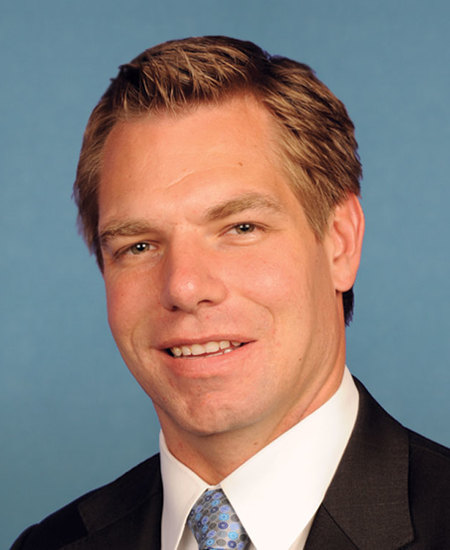
Rep. Eric Swalwell
Sponsored bills
Public Service Freedom to Negotiate Act of 20 21 This bill provides minimum collective bargaining rights and procedures for public employees and prohibits strikes by certain public safety workers. The Federal Labor Relations Authority (FLRA) shall determine for each state whether the laws of such state substantially provide for each of the minimum standard collective bargaining rights and procedures specified by this bill, including the right of public employees and supervisory employees to self-organize, form or join a labor organization, or collectively bargain. The FLRA must issue rules and take actions to establish and administer bargaining rights and procedures for those states that do not substantially provide for them. No employers, emergency services employees, or law enforcement officers may engage in a lockout, strike, or any other organized job action that is likely to result in a measurable disruption of the delivery of emergency or public safety services. Furthermore, no labor organization may be the cause of a violation of such prohibition.
State, Local, Tribal, and Territorial Fiscal Recovery, Infrastructure, and Disaster Relief Flexibility Act This bill allows states, tribes, territories, and localities to use certain COVID-19 relief funds for new categories of spending, including for natural disasters and infrastructure projects. It also makes changes to expenditure deadlines and other aspects of this funding. Specifically, recipients may use funds for emergency relief from natural disasters and associated negative economic impacts of natural disasters. In addition, recipients may use a portion of their COVID-19 relief funds for designated infrastructure projects, such as nationally significant freight and highway projects. Furthermore, the bill allows recipients to expend COVID-19 relief funds on these types of infrastructure projects until September 30, 2026. Under current law, recipients must expend the funds by December 31, 2024. Other changes in the bill include (1) modifying eligibility and allocation requirements for funding set aside for counties and Indian tribes that are near public lands, (2) allowing Indian tribes an additional year to expend their COVID-19 relief funds, and (3) establishing a process for government entities to decline COVID-19 relief funds and requiring any declined funds to be used to reduce the federal deficit.

Biological Intelligence Organization and Attribution Act This bill requires specified federal departments, including the Central Intelligence Agency, to jointly develop and submit to Congress a plan for an interagency biodefense task force to support and inform decision-making based on biological attribution (i.e., determining the source) of emerging and new diseases or other biological events. The plan must outline the duties of the task force, set out the roles of member agencies, describe the contribution of the task force to national biodefense strategies and plans, and address related matters. The bill requires the establishment of the task force not later than 90 days following the submission of the plan.
College Student Hunger Act of 20 21 This bill expands the eligibility of students at institutions of higher education to participate in the Supplemental Nutrition Assistance Program (SNAP). SNAP eligibility for students is expanded to include certain low-income students who (1) are employed a minimum of 10 hours per week (currently 20 hours) during the regular school year, (2) are eligible for a federal Pell Grant, (3) have an expected family contribution equal to zero, or (4) are independent. Additionally, the bill directs the Department of Education to provide notification to certain students regarding their eligibility for SNAP benefits, the Inspector General of the Department of Agriculture (USDA) to conduct an audit of the operations of the Food and Nutrition Service to examine the procedures and outreach practices used by the service to provide to states information about the eligibility of students at institutions of higher education for participation in the program, USDA to update its state outreach plan guidance, and USDA to implement projects to decrease student hunger at institutions of higher education and to reduce barriers to college students fully utilizing SNAP benefits at these institutions.
This resolution supports the designation of National Dyslexia Awareness Month and calls on Congress, schools, and educational agencies to recognize that dyslexia has significant educational implications that must be addressed.
Caring for Survivors Act of 2021 This bill increases the monthly rate of dependency and indemnity compensation payable to surviving spouses through the Department of Veterans Affairs. The bill also adjusts the amount payable to surviving spouses and children of veterans who were rated as totally disabled for a period of less than 10 years before their death.
This concurrent resolution supports the goals and ideals of the National Day of Silence (during which students vow to remain silent to bring attention to the harassment and discrimination faced by lesbian, gay, bisexual, transgender, queer and questioning individuals in schools).
This resolution calls for the creation of a Green New Deal with the goals of achieving greenhouse gas and toxic emissions reductions needed to stay under 1.5 degrees Celsius of warming; establishing millions of high-wage union jobs and ensuring economic security for all; investing in infrastructure and industry; securing clean air and water, climate and community resiliency, healthy food, access to nature, and a sustainable environment for all; and promoting justice and equality. The resolution calls for accomplishment of these goals through a 10-year national mobilization effort. The resolution also enumerates the goals and projects of the mobilization effort, including building smart power grids (i.e., power grids that enable customers to reduce their power use during peak demand periods); upgrading all existing buildings and constructing new buildings to achieve maximum energy and water efficiency; removing pollution and greenhouse gas emissions from the transportation and agricultural sectors; cleaning up existing hazardous waste and abandoned sites; ensuring businesspersons are free from unfair competition; and providing higher education, high-quality health care, and affordable, safe, and adequate housing to all.
Jaime's Law This bill establishes background check requirements for the sale and transfer of ammunition. Specifically, the bill prohibits a licensed importer, manufacturer, or dealer from transferring ammunition to an unlicensed individual prior to submitting a background check through the National Instant Criminal Background Check System. It also establishes penalties for violations. (Currently, background checks are required under these circumstances for the transfer of firearms, but not for ammunition.) Additionally, it prohibits an ammunition transfer between private parties (i.e., unlicensed individuals) unless a licensed importer, manufacturer, or dealer first takes possession of the ammunition to conduct a background check. However, this prohibition does not apply to certain ammunition transfers, such as a gift between spouses in good faith.