

Foreign National Firearms Background Check Enhancement Act This bill modifies the exceptions to a provision that generally prohibits a nonimmigrant visa holder from obtaining a firearm or ammunition. Current law provides certain exceptions to this prohibition against a nonimmigrant receiving a firearm or ammunition, such as for a nonimmigrant who has a U.S. hunting license. This bill narrows the exceptions by, among other changes, requiring a nonimmigrant with a hunting license to get a waiver from the Department of Justice (DOJ) before receiving a firearm. The person transferring the firearm to a nonimmigrant visa holder must verify the validity of the waiver with DOJ.
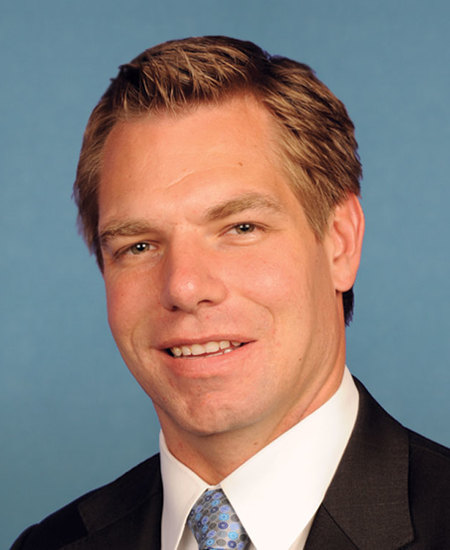
Rep. Eric Swalwell
Sponsored bills
21st Century STEM for Girls and Underrepresented Minorities Act This bill directs the Department of Education to make grants to local educational agencies to pay the costs of carrying out STEM (science, technology, engineering, and mathematics) education activities for girls and underrepresented minorities.
This resolution expresses the sense of the House of Representatives that it is the duty of the Department of Defense (DOD) to reduce the overall environmental impact of military activities and missions and to monitor and report greenhouse gas emissions from all of its operations. The resolution also suggests that DOD take other environmentally conscious actions, including committing to annual greenhouse gas emission reporting mechanisms and repurposing and managing its properties to promote carbon sequestration and biodiversity.
Help Ensure Lower Patient Copays Act or the HELP Copays Act This bill requires health insurance plans to apply certain payments made by, or on behalf of, a plan enrollee toward a plan's cost-sharing requirements. Specifically, plans must apply third-party payments, financial assistance, discounts, product vouchers, and other reductions in out-of-pocket expenses toward the requirements.
Overseas Americans Financial Access Act This bill modifies tax reporting requirements that apply to foreign financial institutions and individuals with foreign financial assets to create exceptions for the foreign accounts of certain U.S. residents or citizens living abroad.
This resolution expresses that the House of Representatives applauds the Biden administration for reaffirming the U.S. commitment to the Paris Agreement on climate change and to our collective responsibility to globally combat climate change; encourages the Biden administration to implement measures to ensure global climate change remains a top priority for this and future administrations and to cement the United States as a global leader in the fight to mitigate its most severe consequences; voices strong commitment as legislators toward achieving the climate goals of the Paris Agreement, fulfilling the forthcoming pledges from the COP26 in Glasgow, Scotland, and advancing other international efforts to keep global warming to no more than 1.5 degrees Celsius and realize global net-zero carbon emissions by 2050 using a whole-of-government approach; and recognizes the critical responsibility of the United States and other developed nations to ensure all societies have the capabilities to transition to a clean energy economy, the resources to protect against climate-induced disasters, and the necessary assistance to endure climate-related challenges to food security, regional migration, and public health.
FEMA Improvement, Reform, and Efficiency Act of 2021 or the FIRE Act This bill addresses the federal government's approach to wildfires. Specifically, the bill authorizes a public mitigation assistance applicant to relocate an eligible structure upon demonstrating that the structure is at risk from future damage and the relocation reduces the risk to the structure, is cost effective, and does not increase risk to adjacent structures. The Federal Emergency Management Agency (FEMA), in coordination with the National Weather Service, must conduct a study on Red Flag Warnings and similar weather and notification methods to implement plans and actions prior to a wildfire that can limit the impact, duration, or severity of the fire. The President must ensure that those providing counseling or case management services to victims of a major disaster are trained to address cultural competency. FEMA must (1) conduct a study and develop a plan to address providing housing assistance to survivors of major disasters or emergencies when presented with challenges such as the lack of proof of ownership, and (2) seek to contract with the National Academy of Sciences to study solutions to address the availability and affordability of insurance for wildfire perils and other related matters. The bill allows Indian tribal governments to apply for grants for equipping, upgrading, and constructing state and local emergency operations centers.
Booster Seat Safety Act This bill addresses labeling requirements and testing standards for booster seats used in motor vehicles. Specifically, the bill requires labels on booster seats to include the minimum recommended age (4 years) and weight (40 pounds) for a child to use the seat. It also requires that a label on a car seat or combination car seat list the maximum weight and height limits of the seat, as well as a recommendation to continue using the seat until the child exceeds the listed limits. Additionally, the National Highway Traffic Safety Administration (NHTSA) must either establish a minimum height recommendation for booster seats or a method for manufacturers to use to determine a minimum height recommendation. Once the minimum height or method is established, booster seat labels must also contain the minimum height recommendation. The NHTSA must also establish a standard for side-impact crash tests for booster seats and provide guidelines for creating a testing dummy that approximates a six-year old child for such crash tests. Further, the NHTSA must study systems for tethering child restraint systems in vehicles and make recommendations about using or modifying tether systems to maximize child safety.
Social Security 2100: A Sacred Trust This bill makes changes to Social Security benefits, taxes, and other aspects of the program, including by raising the primary insurance amount, increasing the maximum taxable earnings that are subject to Social Security payroll taxes, and requiring Social Security account statements to be mailed unless the individual recipient opts for electronic delivery.
Family Violence Prevention and Services Improvement Act of 20 21 This bill modifies, expands, and reauthorizes through FY2026 the Family Violence and Prevention Services program, which funds emergency shelters and supports related assistance for victims of domestic violence. Specifically, the bill requires the Department of Health and Human Services (HHS) to award grants and enter cooperative agreements with state and tribal domestic violence coalitions, and community-based organizations, to support prevention services. Depending on the type of organization, grant recipients must use funding to (1) provide technical assistance; (2) promote evidence-informed prevention strategies; (3) implement coordinated, community responses to reduce risk factors for family violence; and (4) develop prevention partnership strategies. Further, HHS must award specified grants to organizations that provide population-specific services in underserved communities and to community-based organizations that provide culturally specific domestic violence services to racial and ethnic minority groups. The bill also establishes a grants program for tribal domestic violence coalitions to support the provision of local, tribal, family domestic or dating violence services and requires HHS to award a grant for the administration of a hotline dedicated to serving Indians affected by domestic violence. In addition, the bill modifies certain program-wide definitions; changes the requirements for specified grant applications, eligibility criteria, and use of funds; and makes other technical revisions.