

Keep Americans Safe Act This bill establishes a new criminal offense for the import, sale, manufacture, transfer, or possession of a large capacity ammunition feeding device (LCAFD). The bill does not prohibit certain conduct with respect to an LCAFD, including the following: importation, sale, manufacture, transfer, or possession related to certain law enforcement efforts, or authorized tests or experiments; importation, sale, transfer, or possession related to securing nuclear materials; and possession by a retired law enforcement officer. The bill permits continued possession of, but prohibits sale or transfer of, a grandfathered LCAFD. Newly manufactured LCAFDs must display serial number identification and the date of manufacture. Additionally, the bill allows a state or local government to use Edward Byrne Memorial Justice Assistance Grant Program funds to compensate individuals who surrender an LCAFD under a buy-back program.
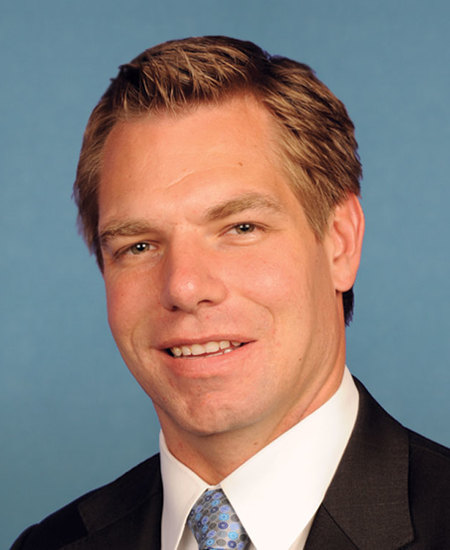
Rep. Eric Swalwell
Sponsored bills
Law Enforcement Protection Act of 2021 This bill includes armor-piercing, concealable weapons in the definition of firearm under the National Firearms Act.
Stop Hate Crimes Act of 2021 This bill lowers the statutory burden of proof for showing intent with respect to a federal hate crime offense. Current law makes it unlawful to willfully cause bodily injury, or attempt to do so using a dangerous weapon, because of the actual or perceived protected characteristic (e.g., race) of a person. In 2014, the U.S. Court of Appeals for the Sixth Circuit held that the because of standard requires proof that a person's actual or perceived protected characteristic was the sole motivating factor in the offense. This bill replaces the because of standard with a new standard. Specifically, willfully causing bodily injury, or attempting to do so using a dangerous weapon, is a hate crime offense if a person's actual or perceived protected characteristic was a contributory motivating factor in the offense.
Camp Lejeune Justice Act of 2021 This bill allows certain individuals to sue and recover damages for harm from exposure to contaminated water at Camp Lejeune in North Carolina between August 1, 1953, and December 31, 1987. This action is available only to individuals who were exposed to contaminated water for at least 30 days. The bill prohibits the U.S. government from asserting specified immunity from litigation in response to such a lawsuit. The bill also prohibits an individual who brings such an action from bringing a separate tort action against the United States based on the same harm.
Healthcare Workforce Resilience Act This bill makes previously unused immigrant visas available to nurses and physicians who petition for such a visa before the date that is 90 days after the end of the declared national emergency relating to the COVID-19 (i.e., coronavirus disease 2019) outbreak. The number of visas available shall be the total number of unused employment-based immigrant visas from FY1992-FY2020, up to 40,000. Of such visas, 25,000 shall be reserved for nurses and 15,000 for physicians. Certain family members may accompany the principal beneficiary of a visa provided under this bill, and visas for such family members shall (1) be made available from the unused visas from FY1992-FY2020, and (2) not be counted against the 40,000 cap. Visas provided under this bill shall be exempt from per-country limitations.
Dignity for Detained Immigrants Act of 2021 This bill directs the Department of Homeland Security (DHS) to establish standards for facilities holding aliens in its custody, phases out using non-DHS facilities for such purposes, and contains other related provisions. The standards shall comply with the American Bar Association's Civil Immigration Detention Standards. The DHS Office of Inspector General (OIG) shall conduct periodic unannounced inspections of each facility and shall take various actions against noncompliant facilities, including imposing fines, cancelling contracts, and closing facilities. DHS shall report to Congress any death of an alien in its custody within 24 hours and conduct an investigation within 30 days that identifies policy changes that could reduce the likelihood of such a death. DHS is prohibited from entering into contracts for third parties to operate detention facilities or alternatives to detention programs and shall terminate existing contracts within three years of the bill's enactment. The bill establishes that OIG facility inspection reports and contracts for an outside entity to operate a detention facility are records available to the public under the Freedom of Information Act. DHS shall maintain certain information relating to detained aliens, including the alien's location and whether the alien was separated from family. The bill provides for various requirements and procedures related to detaining aliens, including (1) prohibiting DHS from detaining children, (2) imposing a presumption that an alien should be released, and (3) establishing that aliens in custody shall be subject to the least restrictive conditions. The bill also abolishes mandatory detention for asylum seekers.
Equal Access to Abortion Coverage in Health Insurance Act of 2021 or the EACH Act of 2021 This bill requires federal health care programs to provide coverage for abortion services and requires federal facilities to provide access to those services. The bill also permits qualified health plans to use funds attributable to premium tax credits and reduced cost sharing assistance to pay for abortion services.
This concurrent resolution objects to the slowdown in mail delivery instituted by the Postmaster General and urges that the decisions to slow down mail and increase postage rates be halted immediately pending further investigation and full substantiation by the Postmaster General to Congress.
Maddy summaryHR 5537, the Toxic-Free Beauty Act of 2021, bans specific chemicals in cosmetics under federal law. It prohibits the use of substances like certain PFAS (water-repellent chemicals), phthalates (e.g., dibutyl phthalate), formaldehyde, mercury, and specific parabens in cosmetic products. The ban directly affects cosmetic manufacturers, requiring them to reformulate products, and benefits consumers by removing these chemicals from beauty items. The law takes effect on January 1, 2025, with the ban applying to products bearing or containing the listed substances.
Preventing Youth Substance Abuse Act of 2021 This bill authorizes for FY2022-FY2026 the Opioid Affected Youth Initiative, which is administered by the Office of Juvenile Justice and Delinquency Prevention.