

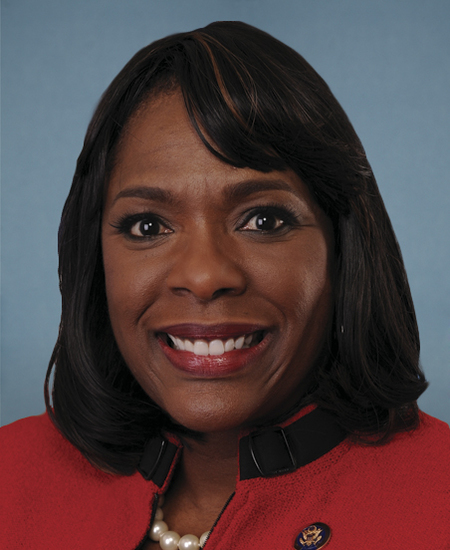
Photo of Terri A. Sewell
D United States House · District 7 · Alabama On the 2026 ballot

Rep. Terri A. Sewell

Compare
Total votes
2,837
all sessions
Attendance
96%
107 missed
Near the chamber average
With party
98%
of cast votes
Near the chamber average
Bipartisan score
1%
crosses aisle rarely
Near the chamber average
Sponsored
1,741
bills & resolutions
Higher than 88% of chamber peers
Committees
7
assignments
1,741 bills and resolutions

Sponsored bills

Total
1,741
Primary
64
Co-sponsor
1,677
This page
1,741
matching current filters
Co-sponsor HR 1155
Passed · United States House · Co-sponsor
Recovery of Stolen Checks Act

Maddy summaryThe Recovery of Stolen Checks Act (HR 1155) allows taxpayers who have lost or had a paper tax refund check stolen to choose receiving a replacement refund via direct deposit instead of a paper check. Taxpayers must make this election within six months of the law's enactment, and the Treasury Department will establish the required procedures. The bill amends the Internal Revenue Code to require the Secretary of the Treasury to create regulations for this process, directly affecting individuals eligible for a replacement paper check due to loss or theft. This change simplifies the replacement method without altering eligibility for refunds.

Passed Apr 1, 2025 1 co-sponsor
Co-sponsor HRES 269
In committee · United States House · Co-sponsor
Reaffirming the commitment of the Federal Government to historically Black colleges and universities and honoring their enduring legacy and contributions.

Maddy summaryThis resolution (HRES 269) is a symbolic statement honoring historically Black colleges and universities (HBCUs) and reaffirming the federal government's existing commitment to them. It does not create new laws or funding but formally recognizes HBCUs' role in educating nearly 300,000 students annually, producing 50% of Black teachers and 80% of Black judges, and contributing $16.5 billion to the economy. The resolution requests that federal agencies receive copies to align with ongoing support for HBCUs, though it does not alter any existing policies or resources. It directly affects HBCUs by affirming their national significance and the government’s longstanding partnership with them.

In committee Mar 31, 2025 1 co-sponsor
Co-sponsor HRES 280
In committee · United States House · Co-sponsor
Supporting the goals and ideals of National Women's History Month.

Maddy summaryHRES 280 is a non-binding House resolution supporting National Women’s History Month in March 2025. It formally recognizes the month-long observance and honors individuals and organizations that have advanced women’s history education and the women’s suffrage movement. The resolution does not create new laws, funding, or obligations - it is a symbolic statement of support. It directly affects no specific group but aims to raise public awareness of women’s historical contributions. The resolution aligns with longstanding congressional practice of recognizing national observances.

In committee Mar 31, 2025 1 co-sponsor
Co-sponsor HR 2509
In committee · United States House · Co-sponsor
COMPLETE Care Act

Maddy summaryHR 2509, the COMPLETE Care Act, creates Medicare payment incentives for primary care providers who integrate specific behavioral health services into their practice. It directly affects Medicare providers offering services identified by HCPCS codes 99484, 99492, 99493, 99494, G2214, and G0323 (covering models like Collaborative Care and Primary Care Behavioral Health) during 2027-2029. The bill increases Medicare payments for these services to 125-175% of standard rates (phasing down from 175% in 2027 to 125% in 2029) and waives budget neutrality rules to fund these higher payments. Additionally, it requires the HHS Secretary to provide technical assistance to primary care practices adopting these models by 2026, with dedicated funding for 2025-2029.

In committee Mar 31, 2025 1 co-sponsor
Co-sponsor HR 1782
In committee · United States House · Co-sponsor
SHOPP Act of 2025

Maddy summaryThe SHOPP Act of 2025 amends the Gus Schumacher Nutrition Incentive Program to expand eligible food items for SNAP participants. It adds legumes (like beans and peas) to the list of qualifying foods and allows fresh frozen fruits and vegetables to count toward year-round incentives. This directly affects SNAP recipients shopping at participating farmers markets or retailers, making it easier to access more types of produce. The bill updates existing program language to replace "fruits and vegetables" with "fruits, vegetables, and legumes" and "fresh fruits and vegetables" with "fresh or fresh frozen fruits, vegetables, and legumes." These changes aim to increase access to a wider variety of nutritious foods through existing incentive programs.

In committee Mar 28, 2025 1 co-sponsor
Co-sponsor HR 1271
In committee · United States House · Co-sponsor
To provide additional funding for scholarships for students at 1890 institutions, and for other purposes.

Maddy summaryHR 1271 increases funding for scholarships at 1890 institutions - historically Black colleges and universities established under the Second Morrill Act - by adding mandatory annual support. It amends existing law to explicitly include bachelor's and graduate programs in scholarship eligibility and requires $15 million annually from the Commodity Credit Corporation starting in fiscal year 2025, to remain available until spent. This funding directly supports students at these institutions by expanding access to financial aid for higher education. The bill updates previous funding language to ensure ongoing support beyond 2023.

In committee Mar 28, 2025 1 co-sponsor
Co-sponsor HR 2464
In committee · United States House · Co-sponsor
Repealing Outdated and Unilateral Tariff Authorities Act

Maddy summaryThis bill repeals Section 338 of the Tariff Act of 1930 (19 U.S.C. 1338), which granted the President unilateral authority to impose tariffs without Congressional approval. It directly affects the President's ability to use this specific provision for tariff actions. The key mechanism is the removal of this legal authority from U.S. trade law. The bill makes no other changes to tariff policy or procedures.

In committee Mar 27, 2025 1 co-sponsor
Co-sponsor HR 2440
In committee · United States House · Co-sponsor
SIFIA Act

Maddy summaryThe SIFIA Act creates tax credit bonds to finance school infrastructure projects, allowing investors to claim a 25% annual tax credit based on the bond's face value. It requires projects to be net-zero energy buildings and mandates completion within six years, with school districts partnering with private developers meeting strict experience and reporting criteria. The bill allocates $10 billion total for these bonds ($2.5 billion annually), including $1 billion reserved for rural school projects. It also includes rules for bond redemption if funds aren't spent on time and sets limits on how much a single school district can borrow.

In committee Mar 27, 2025 1 co-sponsor
Co-sponsor HR 2421
In committee · United States House · Co-sponsor
Protecting Taxpayer Resources Act

Maddy summaryHR 2421, the Protecting Taxpayer Resources Act, prevents the Department of Homeland Security from assigning certain homeland security duties to Internal Revenue Service (IRS) employees without specific conditions. It requires the Treasury Inspector General for Tax Administration to determine first that IRS staff have been trained for the new duties, and second that assigning these duties won't disrupt core IRS functions like helping taxpayers understand tax rules or enforcing tax laws fairly. The determination must be published in the Federal Register to take effect. This bill directly affects IRS personnel and DHS operations by establishing clear procedural safeguards before transferring responsibilities between the agencies.

In committee Mar 27, 2025 1 co-sponsor
Co-sponsor HR 2410
In committee · United States House · Co-sponsor
Revitalizing Downtowns and Main Streets Act

Maddy summaryHR 2410 creates a 20% federal tax credit for developers converting older non-residential buildings (at least 20 years old) into affordable housing. The credit applies to qualified conversion costs, requiring that 20% of units be rent-restricted for residents earning 80% or less of the area median income for 30 years. It establishes a $12 billion national credit limit, with $3 billion reserved for conversions in economically distressed areas, and mandates state-level allocation plans prioritizing projects near transit and employment. The bill directly affects developers seeking tax incentives for downtown revitalization, not tenants or local governments.

In committee Mar 27, 2025 1 co-sponsor
Showing 441 to 450 of 1,741 bills
Previous 1 … 44 45 46 … 175 Next