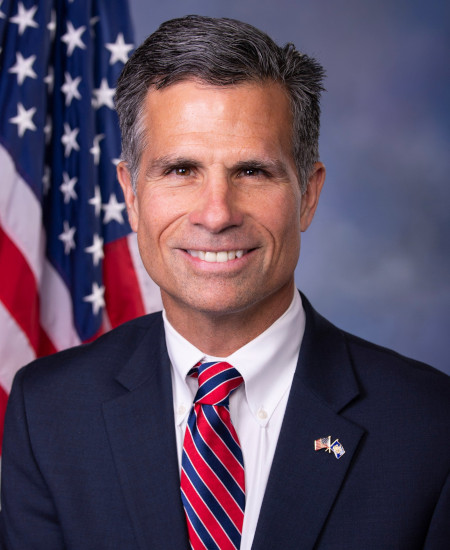
Photo of Daniel Meuser
R United States House · District 9 · Pennsylvania On the 2026 ballot

Rep. Daniel Meuser

Compare
Total votes
2,837
all sessions
Attendance
97%
95 missed
Lower than 82% of chamber peers
With party
96%
of cast votes
Near the chamber average
Bipartisan score
2%
crosses aisle rarely
Near the chamber average
Sponsored
1,144
bills & resolutions
Near the chamber average
Committees
6
assignments
1,144 bills and resolutions

Sponsored bills

Total
1,144
Primary
62
Co-sponsor
1,082
This page
1,144
matching current filters
Co-sponsor HR 7550
In committee · Ohio House · Co-sponsor
Permanent Tax Relief for Seniors Act

Maddy summaryHR 7550, the Permanent Tax Relief for Seniors Act, makes a specific tax deduction for seniors permanent. It removes an expiration date that previously limited the deduction to taxable years before 2029, extending it indefinitely. This change directly affects seniors aged 65 or older who claim the standard deduction under the Internal Revenue Code. The key mechanism is amending the tax code to eliminate the sunset provision, ensuring the deduction applies to all future taxable years beginning after December 31, 2026. The policy change provides ongoing tax relief for eligible seniors without altering other tax provisions.

In committee Feb 12, 2026 1 co-sponsor
Primary HR 7548
In committee · Ohio House · Lead sponsor
SCAM Act

Maddy summaryThe SCAM Act requires online platforms that display paid advertisements (like social media sites) to verify advertiser identities, implement scam detection systems, and remove fraudulent ads within 24 hours of confirmation. It directly affects platforms that accept payment for ads, targeting scams such as fake giveaways, romance scams, and AI impersonations that cost consumers $195 billion in 2024 (per FTC data). Key mechanisms include mandatory identity checks for advertisers, active monitoring systems, and a 72-hour investigation window for reported scams. The law aims to reduce fraud by shifting responsibility to platforms, with enforcement by the FTC and state attorneys general.

In committee Feb 12, 2026 0 co-sponsors
Co-sponsor HR 5616
Passed · Ohio House · Co-sponsor
$2.50 for America’s 250th Act

Maddy summaryThis bill authorizes the U.S. Mint to produce two types of commemorative $2.50 coins for the 250th anniversary of the Declaration of Independence: a circulating coin for everyday use and a numismatic (collector) coin. Both would feature designs based on the 1926 Sesquicentennial coin - showing allegorical liberty holding the Declaration on one side and Independence Hall on the other - with "1776-2026" inscriptions. The bill requires the Mint to issue these coins by July 4, 2026, if technically and economically feasible, but does not mandate their production or affect any specific groups beyond the public who may purchase them.

Passed Feb 12, 2026 1 co-sponsor
Co-sponsor HR 3682
Passed · Ohio House · Co-sponsor
Financial Stability Oversight Council Improvement Act of 2025

Maddy summaryThis bill amends the process for the Financial Stability Oversight Council (FSOC) when considering actions against U.S. nonbank financial companies. It requires the FSOC to first determine that alternative solutions - such as new regulatory standards, agency actions, or a company's written plan - are not possible or insufficient to protect financial stability before voting on a formal determination. The change directly affects the FSOC and large nonbank financial companies that could face regulatory scrutiny. The key provision adds a new step to ensure the Council explores other options before taking significant action. (Procedural bill; summary limited to 3 sentences as specified.)

Passed Feb 11, 2026 1 co-sponsor
Co-sponsor HR 3390
Passed · Ohio House · Co-sponsor
Bringing the Discount Window into the 21st Century Act

Maddy summaryHR 3390, the "Bringing the Discount Window into the 21st Century Act," requires the Federal Reserve Board to review and potentially modernize its discount window operations - the facility banks use to borrow during liquidity crises. Within 240 days, the Fed must assess the window's effectiveness, technology, cybersecurity, communications, oversight, and operating hours, including public input. The Fed must then develop a remediation plan with specific actions, timelines, and measures to maintain improvements, and submit a report to Congress within one year. Annual follow-up reports on progress will also be required. This bill directly affects the Federal Reserve’s operations and the banks relying on the discount window during financial stress.

Passed Feb 11, 2026 1 co-sponsor
Co-sponsor HR 5221
In committee · Ohio House · Co-sponsor
PART Act

Maddy summaryThe PART Act requires new vehicles to have catalytic converters marked with a unique identification number that links directly to the vehicle's identification number, stored in a law enforcement-accessible database. It establishes a $7 million grant program to help repair shops, dealers, law enforcement, and fleet owners purchase equipment for marking converters with visible, durable identifiers (using die or pin stamping and high-visibility paint). The bill also mandates that businesses buying catalytic converters keep detailed seller records (including vehicle information) for two years and use traceable payments, banning cash or cryptocurrency transactions. Additionally, it creates new federal criminal penalties for stealing or trafficking in catalytic converters, with potential sentences of up to five years in prison.

In committee Feb 10, 2026 1 co-sponsor
Co-sponsor HR 7352
In committee · Ohio House · Co-sponsor
PASTEUR Act of 2026

Maddy summaryThe PASTEUR Act of 2026 creates a new government contracting program to incentivize development of new antimicrobial drugs for treating drug-resistant infections. The Health and Human Services Secretary would award contracts to pharmaceutical sponsors meeting specific criteria on clinical benefits, innovation, and public health impact, with annual payments ranging from $75 million to $300 million (adjusted for inflation). Contract requirements include ensuring drug availability, tracking resistance data, promoting appropriate use, and maintaining supply chains. The bill also establishes antimicrobial stewardship programs for hospitals and outpatient facilities and improves surveillance of antimicrobial use and resistance. This legislation aims to address antibiotic resistance by creating financial incentives for new treatments and improving how antimicrobials are used and monitored.

In committee Feb 4, 2026 1 co-sponsor
Co-sponsor HR 3699
In committee · Ohio House · Co-sponsor
Energy Choice Act

Maddy summaryThis bill prevents state or local governments from banning or restricting energy connections (like installation, modification, or access) based on the type or source of energy, such as electricity, natural gas, or renewable fuels. It directly affects consumers choosing energy providers and energy companies seeking to offer services. The key provision prohibits local laws, regulations, or policies that limit energy services sold in interstate commerce, covering all energy types listed in the bill’s definitions. It does not create new programs but limits regulatory authority at the state or local level. The law aims to ensure open access to diverse energy sources without source-based restrictions.

In committee Feb 4, 2026 1 co-sponsor
Co-sponsor HR 7296
In committee · Ohio House · Co-sponsor
SAVE America Act

Safeguard American Voter Eligibility Act or the SAVE America Act This bill requires individuals to provide documentary proof of U.S. citizenship when registering to vote, and requires photo identification to vote, in federal elections. Specifically, the bill prohibits states from accepting and processing an application to register to vote in a federal election unless the applicant presents documentary proof of U.S. citizenship. The bill specifies what documents are considered acceptable proof of U.S. citizenship, such as identification that complies with the REAL ID Act of 2005 that indicates U.S. citizenship. Further, the bill (1) prohibits states from registering an individual to vote in a federal election unless, at the time the individual applies to register to vote, the individual provides documentary proof of U.S. citizenship; and (2) requires states to establish an alternative process to demonstrate U.S. citizenship. Each state must take affirmative steps on an ongoing basis to ensure that only U.S. citizens are registered to vote, which shall include establishing a program to identify individuals who are not U.S. citizens using information supplied by certain sources. Additionally, states must remove noncitizens from their official lists of eligible voters. The bill (1) provides for a private right of action for certain violations, and (2) establishes criminal penalties for certain offenses. Individuals voting in federal elections must present an eligible photo identification document. An individual who votes by absentee ballot must submit a copy of their identification document with both the request for, and the submission of, the absentee ballot.


In committee Jan 30, 2026 1 co-sponsor
Showing 91 to 100 of 1,144 bills
Previous 1 9 10 11 115 Next