

Ocean Shipping Reform Act of 2021 This bill revises provisions related to ocean shipping policies and is designed to support the growth and development of U.S. exports and promote reciprocal trade in the common carriage of goods by water in the foreign commerce of the United States. Among other provisions, the bill sets forth requirements for operating a shipping exchange involving ocean transportation in the foreign commerce of the United States; requires ocean common carriers to report to the Federal Maritime Commission (FMC) each calendar quarter on total import and export tonnage and the total loaded and empty 20-foot equivalent units per vessel that makes port in the United States; requires the FMC to publish and annually update all its findings of false certifications by ocean common carriers or marine terminal operators and all penalties assessed against such carriers or operators; revises annual reporting requirements for the FMC on foreign laws and practices to include practices by ocean common carriers; prohibits ocean common carriers and marine terminal operators from retaliating or discriminating against shippers because such shippers have patronized another carrier, or filed a complaint; directs the FMC to establish rules prohibiting ocean common carriers and marine terminal operators from adopting and applying unjust and unreasonable demurrage and detention fees; authorizes the FMC to initiate investigations of an ocean common carrier's fees or charges and apply enforcement measures, as appropriate; directs the Department of Transportation to seek to enter into an agreement with the National Academy of Sciences to study the U.S. supply chain industry, including data constraints that impede the flow of maritime cargo and add to supply chain inefficiencies; and provides authority for the FMC to issue an emergency order requiring ocean common carriers or marine terminal operators to share directly with relevant shippers, rail carriers, or motor carriers information relating to cargo throughput and availability.
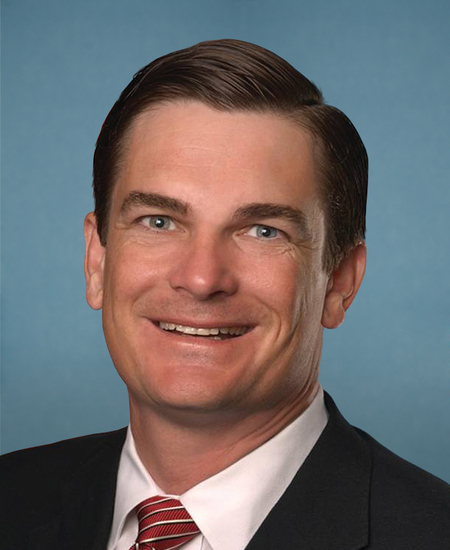
Rep. Austin Scott
Sponsored bills
Critical Infrastructure Manufacturing Feasibility Act This bill requires the Department of Commerce to study and report on products that are in high demand across the critical infrastructure sectors. Critical infrastructure sectors are those whose assets, systems, and networks are vital to national security, the economy, public health or safety, or any combination of those matters. The study must (1) identify the products in high demand across those sectors that are being imported due to manufacturing, material, or supply chain constraints; and (2) analyze the costs, benefits, and feasibility of manufacturing those products in the United States.
Maddy summaryHRES 822 is a ceremonial resolution passed by the U.S. House of Representatives to honor the late Senator Max Cleland (D-GA), who died on November 9, 2021. It recognizes his military service as a Vietnam War veteran (losing both legs and an arm in combat), his 50+ years of public service - including roles as Georgia Secretary of State, U.S. Senator, and Administrator of the Veterans Administration - and his advocacy for veterans. The resolution formally expresses the House's respect for his legacy and directs the Clerk to transmit a copy to Cleland’s family and the Senate. As a commemorative resolution, it has no policy impact or direct effect on any individuals or laws.
This resolution commemorates the 125th anniversary of the National Grain and Feed Association. It also recognizes the National Grain and Feed Association for 125 years of promoting the noble purpose of its members in transforming the American farmer's bounty into safe, nutritious, sustainable, and affordable human and animal food.
Fairness for Federal Contractors Act of 2021 This bill prohibits executive agencies from requiring contractors to receive a COVID-19 vaccination. The bill also requires the Government Accountability Office to study the degree to which Executive Order 14042 (Ensuring Adequate COVID Safety Protocols for Federal Contractors) caused disruptions to federal contracts, supply chains, and transportation systems.
This joint resolution nullifies a Department of Labor emergency temporary standard for preventing the transmission of COVID-19 in employment settings. Under the standard issued on November 5, 2021, employers with 100 or more employees must require their onsite employees to either be fully vaccinated against COVID-19 or undergo weekly COVID-19 testing.
Forage Fish Conservation Act of 2021 This bill addresses the management and conservation of forage fish. The Department of Commerce must issue a definition for the term forage fish . It must consider certain factors in defining such term, including whether a species covered by the definition (1) is at a low trophic level; (2) is generally small to intermediate-sized; (3) occurs in schools or other dense aggregations; (4) contributes significantly to the diets of other fish, marine mammals, or birds; and (5) serves as a conduit for energy transfer to species at a higher trophic level. Commerce must also establish guidelines to assist regional fishery management councils in (1) developing a list of unmanaged forage fish areas and prohibiting the development of any new forage fish fisheries until the potential impacts of such fisheries have been assessed; and (2)setting annual catch limits for forage fish fisheries that assess, specify, and reduce such limits by the diet needs of other fish species and marine wildlife. The bill adds shad (American shad and hickory shad)and river herring (blueback herring and alewife)to the list of managed stocks for the New England and Mid-Atlantic Fishery Management Council.
This bill designates the community-based outpatient clinic of the Department of Veterans Affairs in Columbus, Georgia, as the Robert S. Poydasheff VA Clinic.
This concurrent resolution declares that Congress should not impose any new performance fee, tax, royalty, or other charge relating to the public performance of sound recordings on a local radio station for broadcasting sound recordings over the air, or on any business for such public performance of sound recordings.
Maddy summaryHRES 386 is a symbolic resolution introduced in the U.S. House of Representatives that expresses support for recognizing "National Police Week" each year. The resolution acknowledges law enforcement officers' sacrifices, particularly during the pandemic, and encourages the public to honor their service. As a non-binding statement, this resolution does not create new law or change policy but serves as a formal expression of support for law enforcement officers across the United States.