

Honoring Our Promises through Expedition for Afghan SIVs Act of 2021 or the HOPE for Afghan SIVs Act of 2021 This bill authorizes the Department of State and the Department of Homeland Security (DHS) to postpone the medical exam requirement for qualifying citizens or nationals of Afghanistan seeking entry into the United States as special immigrants. Specifically, this bill applies to an existing program that provides special immigrant status to an individual (or the spouse or child of such an individual) who (1) faithfully performed sensitive and trusted duties for the U.S. government or the International Security Assistance Force in Afghanistan on or after October 7, 2001, and (2) has experienced or is experiencing an ongoing serious threat due to the performance of those duties. Under this bill, the State Department and DHS may jointly issue a blanket waiver of any requirement for such individuals to undergo a medical exam before admission into the United States. DHS shall ensure, to the greatest extent practicable, that individuals admitted under such a waiver undergo medical exams no later than 30 days after admission into the United States. Such an individual shall be admitted as a conditional permanent resident. DHS shall remove the conditions once the individual receives and passes a medical examination.
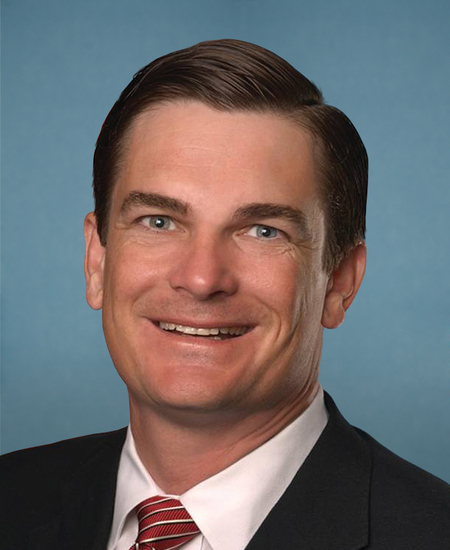
Rep. Austin Scott
Sponsored bills
David Dorn Back the Blue Act This bill directs the Department of Justice (DOJ) to provide programs to support the hiring and retention of law enforcement personnel and to increase their salaries. Further, DOJ may make grants to state and local law enforcement agencies for this purpose.
Chinese Communist Party (CCP) Politburo Accountability Act This bill authorizes the President to impose visa- and property-blocking sanctions on certain senior officials of the Chinese Communist Party (CCP) and addresses related issues. The President may impose sanctions on senior CCP officials who have engaged in or provided support for (1) any malign disinformation campaign or political warfare operation against the United States; (2) the theft of intellectual property belonging to a U.S. individual or entity; (3) actions undermining Taiwan's sovereignty; or (4) restrictions against the practice of religion in China, including the forced closure of any place of worship. The President must impose sanctions on four named senior CCP officials. The Department of State must report to Congress on whether any CCP Politburo members meet the criteria for sanctions under various authorities. (The Politburo and the Politburo Standing Committee are China's highest decision-making bodies.)
Maddy summaryHRES 779 is a symbolic resolution introduced in the U.S. House of Representatives on November 5, 2021. It expresses Congress’s disapproval of the Occupational Safety and Health Administration’s (OSHA) emergency temporary standard (ETS) requiring employers with over 100 workers to mandate COVID-19 vaccinations or weekly testing/mask-wearing. The resolution argues OSHA overstepped its authority by treating COVID-19 as a workplace-specific risk, despite Congress having delegated vaccine-related authority to other agencies like the FDA and CDC. As a non-binding resolution, it does not change any laws or enforceable requirements - it only states congressional opinion on the ETS.
Truckers Responding At National Shipping Ports Overcoming Retail Turmoil Act or the TRANSPORT Act This bill requires the Department of Transportation (DOT) to award grants to motor carriers and motor private carriers for transporting goods from ports during declared national emergencies or when DOT determines a port is at least 50% congested. DOT may use unobligated funds available under specified COVID-19 relief laws for the grants.
This resolution congratulates the Atlanta Braves on winning the 2021 Major League Baseball World Series and honors the life and legacy of Henry Louis Aaron.
Maddy summaryHRES 754 is a non-binding resolution expressing the House of Representatives' opposition to proposed "punitive natural gas taxes" on U.S. businesses, families, and workers. It cites claims that such taxes would raise average energy bills by 17%, reduce GDP by $9 billion, and eliminate 90,000 jobs, while disproportionately harming low-income households. The resolution argues that opposing these taxes supports U.S. energy security, national security, and continued leadership in reducing emissions through domestic natural gas production. As a procedural resolution, it does not create law but formally states the House's position against this policy approach.
This bill prohibits the use of federal funds to require a member of the Armed Forces to receive a COVID-19 vaccination. The bill also prohibits adverse action (e.g., punishment) being taken against a member of the Armed Forces because the member refuses to receive a COVID-19 vaccination.
Risk Management for Derivatives Clearing Organizations Act This bill allows derivatives clearing organizations and clearing agencies to maintain accounts at a Federal Reserve Bank.
Treatment Restoration for Emergency Antibody Therapeutics Act or the TREAT Act This bill prohibits the Department of Health and Human Services (HHS) from implementing any policy that restricts health care facilities from ordering and receiving COVID-19 monoclonal antibody therapies directly from manufacturers and distributors. In addition, the bill expressly nullifies a policy announced on September 13, 2021, under which HHS allocated supplies of these therapies through state or territorial governments.