Stop Funding Our Adversaries Act of 2022 This bill prohibits federal agencies from conducting or supporting, either directly or indirectly, research that will be conducted by China's government, the Chinese Communist Party, or any agent, instrumentality, or entity belonging to or controlled by either entity.
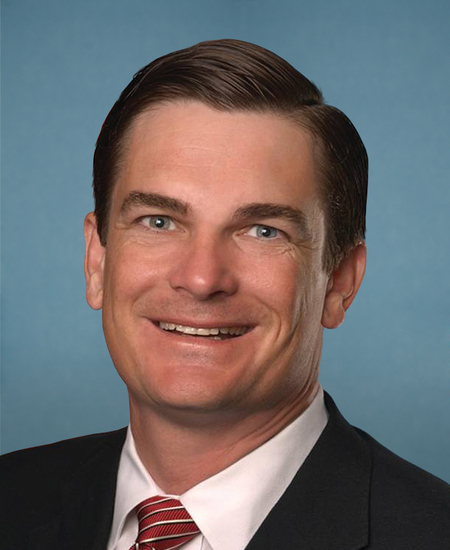
Rep. Austin Scott
Sponsored bills
This bill designates the National Museum of the Mighty Eighth Air Force located at 175 Bourne Avenue, Pooler, Georgia (or any successor location), as the official National Museum of the Mighty Eighth Air Force of the United States.
Blockchain Solutions for Small Businesses Act This bill requires the Small Business Administration to study the current and potential uses of blockchain technology (i.e., the technology that supports digital currencies such as Bitcoin) in making loans to qualified small businesses.
Teamwork for Employees and Managers Act of 2022 This bill authorizes employers and employees to establish voluntary employee involvement organizations to address matters of mutual interest within the workplace (e.g., productivity, compensation, benefits, recruitment, and retention). Employee involvement organizations are not considered labor organizations under federal labor laws, and they do not constitute an unfair labor practice by an employer provided the employees are not already represented by a labor organization.
This resolution congratulates the University of Georgia Bulldogs for an exemplary season and winning the 2022 National Collegiate Athletic Association College Football Playoff National Championship game.
Max Cleland VA Medical Center Act This bill designates the Department of Veterans Affairs medical center in Atlanta, Georgia, as the Joseph Maxwell Cleland Atlanta Department of Veterans Affairs Medical Center or the Joseph Maxwell Cleland Atlanta VA Medical Center.
Accelerating Access to Critical Therapies for ALS Act This bill establishes grant programs to address neurodegenerative diseases, such as amyotrophic lateral sclerosis (also known as ALS or Lou Gehrig's disease), and contains other related provisions. The Department of Health and Human Services (HHS) shall award grants to eligible entities for scientific research utilizing data from expanded access to investigational ALS treatments for individuals who are not otherwise eligible for clinical trials. The Food and Drug Administration (FDA) shall award grants to public and private entities to cover the costs of research and development of drugs that diagnose or treat ALS and other rare neurodegenerative diseases. HHS shall also establish the Public-Private Partnership for Neurodegenerative Diseases between the National Institutes of Health, the FDA, and at least one eligible entity (generally, an institution of higher education or a nonprofit organization). The partnership shall support the development and regulatory review of drugs that address ALS and other rare neurodegenerative diseases. The FDA shall publish on its website a five-year action plan for fostering the development of drugs that improve or extend the lives of people living with rare neurodegenerative diseases. The Government Accountability Office must report to Congress about the grants provided under this bill, including an analysis of the impact of such grants on research and development of treatments for ALS.
This bill posthumously provides for the award of a Congressional Gold Medal in commemoration of the 13 service members who died on August 26, 2021, while stationed at Hamid Karzai International Airport in Afghanistan.
This resolution recognizes the importance of Christmas symbols and traditions. The resolution (1) disapproves of attempts to ban references to Christmas, and (2) supports the use of these symbols and traditions by those who celebrate Christmas.
Chronic Wasting Disease Research and Management Act This bill directs the Department of Agriculture (USDA) to address chronic wasting disease afflicting deer, elk, and moose populations. Specifically, the bill directs USDA to establish a program to research and manage the disease. Under the program, USDA must offer to enter into agreements with state or tribal wildlife agencies and departments of agriculture, institutions of higher education, and research centers to support research on the transmission of, resistance to, and diagnosis of the disease. In addition, USDA must offer to enter into agreements with such agencies and departments to support state and tribal efforts to develop and implement management strategies that address the disease. USDA must also develop and maintain materials to inform the public on chronic wasting disease and techniques to help prevent the spread of the disease. In addition, USDA must solicit public feedback on potential updates and improvements to standards of the chronic wasting disease herd certification program.