

Maddy summarySB 717 (North Carolina) increases penalties for assault by strangulation by creating three new felony classifications based on injury severity. It establishes a Class F felony for strangulation causing serious bodily injury (defined as risk of death, disfigurement, permanent impairment, or prolonged hospitalization), a Class H G felony for strangulation causing physical injury, and a Class H felony for strangulation without specified injury. The law directly affects individuals convicted of strangulation assaults in North Carolina, defining "strangulation" as pressure on the throat/neck or obstruction of nose/mouth. The bill takes effect June 1, 2025, applying to offenses committed on or after that date.
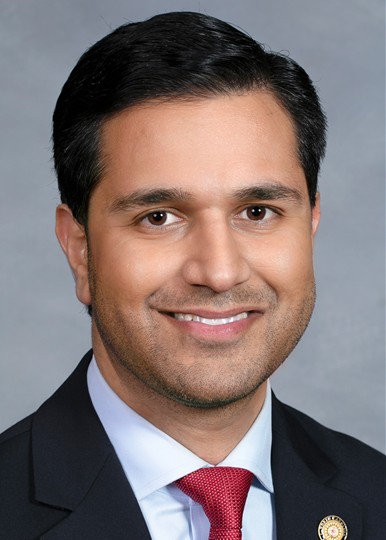
Sen. Mujtaba Mohammed
Sponsored bills
Maddy summarySB 740 appropriates $250,000 from North Carolina's General Fund as a one-time grant to the Council for Children's Rights, Inc. for its operating expenses during the 2025-2026 fiscal year. The bill directs the Office of State Budget and Management to provide this funding, which directly supports the organization's day-to-day operations. It becomes effective July 1, 2025, and does not change existing laws or create new programs - only allocates specific funding for an established nonprofit.
Maddy summarySB 741 appropriates $5 million from North Carolina's General Fund to the Charlotte Mecklenburg Library Foundation (a nonprofit) for constructing a new main library. The funds are designated for the 2025-2026 fiscal year and become effective July 1, 2025, directly supporting the library's physical expansion project.
Maddy summarySB 752 allows North Carolina schools to use epinephrine nasal spray in addition to auto-injectors for treating severe allergic reactions (anaphylaxis). The bill requires schools to stock at least two emergency epinephrine products (including nasal spray) in secure but accessible locations, train staff to recognize symptoms and administer treatment, and develop emergency action plans. It applies to all public, charter, and regional schools, directly affecting students with severe allergies and school staff trained to respond to emergencies. The policy change takes effect for the 2025-2026 school year.
Maddy summarySB 742 appropriates $500,000 from the General Fund to provide a directed grant to The C.W. Williams Community Health Center, Inc., a nonprofit organization in Mecklenburg County. The funds are intended to support the completion of its full-service community health center facility during the 2025-2026 fiscal year. This bill directly affects the C.W. Williams Community Health Center by providing targeted financial assistance for infrastructure completion. The grant is non-recurring and becomes effective July 1, 2025. The bill does not establish new policies or broadly impact other entities or services.
Maddy summarySB 736 creates a new Housing Innovation Office within North Carolina's Housing Finance Agency, funded by a permanent increase in the real estate transfer tax. The bill raises the tax rate on property sales over $500,000 from $1 per $500 to $1 per $400, directing the additional revenue ($5 million annually for 2025-2027) to this office. The office will use these funds for research, technical assistance, grants, and loans to support affordable housing construction, maintenance, and innovative building solutions. This directly affects homebuyers/sellers (through the tax increase) and aims to address the state's housing affordability crisis by expanding funding for housing projects.
Maddy summarySB 745 allows North Carolina child care centers operating under voluntary enhanced requirements to increase maximum group sizes for infants (0-12 months) from 10 to 12 children and for toddlers (12-24 months) from 12 to 15 children, while maintaining stricter staff-to-child ratios (e.g., 1:4 for infants). It also aligns nap time supervision rules for one-year-olds with existing rules for two-year-olds, requiring visible supervision by a staff member present in the room. The bill directly affects licensed child care centers seeking flexibility under voluntary enhanced licensing standards. These changes aim to provide capacity options without reducing staff ratios, effective upon enactment.
Maddy summarySB 743 appropriates $20.44 million in state funds to the Town of Davidson for emergency services, effective July 1, 2025. The bill directs the funds specifically for: constructing a new fire station ($17 million), purchasing an emergency vehicle ($3 million), buying police safety equipment ($100,000), and replacing breathing apparatus ($340,000). These allocations are intended to directly support Davidson's fire department, police department, and community safety infrastructure. The funding comes from the state's General Fund as a one-time grant, not recurring annual support.
Maddy summarySB 746 establishes a 11-member Study Committee on Automation and the Workforce to examine how automation impacts North Carolina's labor market, with specific focus on low-income and minority workers. The committee will review effects of AI, robotics, self-service technologies, and software on jobs, analyze education gaps and systemic barriers, and recommend strategies to support affected workers through retraining and new economic opportunities. It must submit its first report to the Governor by the 2027 General Assembly, including specific policy proposals for mitigating negative impacts. This bill creates a study mechanism, not new laws or programs, to inform future state action.
Maddy summarySB 692 reduces the copayment rate for subsidized child care in North Carolina from 10% to 5% of a family's gross income. This directly affects low-income families who qualify for state-subsidized child care services. The bill amends existing law to lower the percentage parents pay for care, while maintaining the same blended and part-time care calculations (83% and 75% of full-time copayments, respectively). The change takes effect on July 1, 2025.