

Maddy summaryThis bill proposes constitutional amendments to require each North Carolina senator to represent two counties (instead of one) and to fix the state at exactly 100 counties. It also updates rules for incorporating new cities or towns, preventing new municipalities within specific distances of existing cities based on their population size (e.g., within 1 mile of a city with 5,000+ residents). The changes would require voter approval in the November 2026 election. If approved, the new rules would take effect after certification by the State Board of Elections.
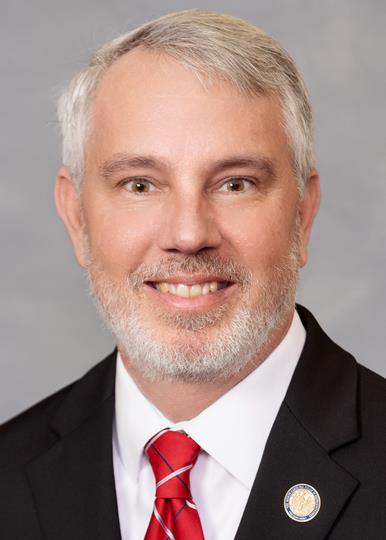
Rep. Blair Eddins
Sponsored bills
Maddy summaryHB 130 establishes a $475 million program to provide financial assistance to North Carolina farmers who suffered crop losses from natural disasters in 2024. It directly affects farmers in counties designated by the USDA as disaster areas, requiring verified losses of eligible agricultural commodities (like crops, livestock, or specialty plants) planted but not harvested by January 1, 2024. The program uses county and state yield/price averages to calculate payments, mandates submission of USDA Form 578 or equivalent documentation within 30 days, and allocates funds from state reserves (Stabilization, IT, and Economic Development) to cover verified losses. Farmers must provide documentation for verification, and the Department of Agriculture may audit claims to ensure proper use of funds, with refunds required for inaccurate information.
Maddy summaryHB 31 would amend North Carolina's State Human Resources Act to make every statewide general election day a paid holiday for state employees. This change would add election days to the current list of paid holidays (which includes Martin Luther King Jr.'s Birthday and Veterans Day), while maintaining the limit of 13 paid holidays per year. The bill directly affects state workers, ensuring they receive paid time off on election days without reducing the total number of paid holidays. It does not change election dates or voting procedures, only the employment benefits for state employees on those days. The legislation is currently pending in committee review.
Maddy summaryHB 155 allows Wilkes County Schools and Alexander County Schools to adopt an earlier school start date (no earlier than August 19) for the 2025-2026 school year, instead of the standard August 26 date, if they meet specific "good cause" criteria. The bill requires these districts to document having experienced at least eight emergency school closures (due to weather, power failures, etc.) across four of the last ten years. This waiver applies only to these two counties and ensures they can maintain required instructional days while adjusting their calendars. The law takes effect when enacted, applying to the 2025-2026 school year.
Maddy summaryHB 72 prohibits North Carolina's Attorney General from participating in any court case (as a party, amicus, or otherwise) that argues a presidential executive order should be invalidated. The law directly affects the Attorney General's office, restricting their ability to challenge federal executive actions in state or federal courts. Key provisions state the Attorney General cannot advance arguments leading to the invalidation of any presidential executive order, applying to all pending or future litigation. This is a procedural limitation on state legal actions, not a change to federal executive power. The bill becomes effective upon enactment for cases filed after that date.
Maddy summaryHB 86, titled "Citizens' Expungement Clarification of 2025," prohibits non-citizens and non-legal residents of the U.S. from clearing criminal convictions or charges from their records through expungement in North Carolina. The bill requires courts to verify a petitioner’s U.S. residency or citizenship status at least 30 days before granting expungement, including potential queries to U.S. Immigration and Customs Enforcement (ICE). It exempts individuals who lawfully entered the U.S. and have filed or are awaiting an immigrant petition with U.S. immigration authorities. The law takes effect October 1, 2025, applying to all expungement petitions filed after that date.
Maddy summaryHB 39 excludes motor vehicles owned by veterans with a 100% disability rating certified by the U.S. Department of Veterans Affairs from North Carolina property tax. It amends state tax law to add these vehicles as a designated exempt class under G.S. 105-275. The exclusion applies to vehicles registered on or after January 1, 2026. This policy directly affects eligible disabled veterans who own motor vehicles, reducing their property tax burden. The bill does not change eligibility criteria or tax rates for other vehicle classes.
Maddy summaryHB 36 requires North Carolina's Department of Veterans and Military Affairs to improve maintenance at all four state veterans cemeteries, directly affecting veterans' families and cemetery operations. The bill mandates addressing specific issues like headstone installation delays, equipment damage to graves, drainage problems, debris, and poor grounds appearance, while allowing military groups to volunteer for upkeep. It also directs the department to review and adjust funeral service policies, including chapel-only options, service duration, attendee limits, and grave visitation rules during services. The department must submit a report on these changes to legislative committees by October 1, 2025.
Maddy summaryHB 12 would require North Carolina and all its local governments to observe Eastern Standard Time year-round, eliminating the biannual clock changes for daylight saving time. This bill directly affects state agencies, local municipalities, and residents by keeping the state on standard time permanently, as permitted under federal law (the Uniform Time Act of 1966). The key provision amends state law to mandate year-round standard time, aligning with a federal provision that allows states to forgo daylight saving time. The bill would take effect on March 8, 2026, if enacted. This is a procedural change to time observance, not a new policy affecting services or regulations.