

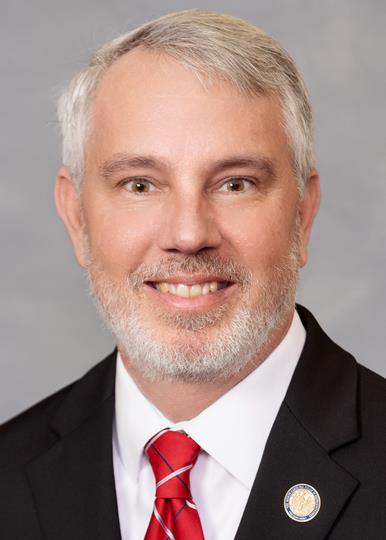
Photo of Blair Eddins
R North Carolina House · District 94 On the 2026 ballot

Rep. Blair Eddins

Compare
Total votes
497
all sessions
Attendance
100%
of floor votes
Higher than 91% of chamber peers
With party
99%
of cast votes
Near the chamber average
Bipartisan score
0%
crosses aisle rarely
Near the chamber average
Sponsored
109
bills & resolutions
Near the chamber average
Committees
8
assignments
109 bills and resolutions

Sponsored bills

Total
109
Primary
6
Co-sponsor
103
This page
109
matching current filters
Co-sponsor HB 62
died · North Carolina House · Co-sponsor
Farmers Protection Act.

Maddy summaryHB 62, the Farmers Protection Act, prohibits banks from denying or canceling financial services to farmers based on their greenhouse gas emissions, fertilizer use, or machinery type. It creates a rebuttable presumption that banks violating this rule are acting on ESG (environmental, social, governance) commitments, requiring banks to prove decisions were financially motivated. Banks must annually attest to compliance under penalty of perjury, and violations may result in civil penalties up to $10,000 per incident. The law directly affects farmers, banks, credit unions, and state financial associations by restricting discriminatory lending practices tied to environmental factors.

died Mar 17, 2025 1 co-sponsor
Primary HB 98
died · North Carolina House · Lead sponsor
Patriotism Expression Act.

Maddy summaryHB 98, titled the "Patriotism Expression Act" (though misleadingly named), primarily modifies North Carolina's fireworks laws to permit the sale, possession, and use of specific consumer fireworks. It allows consumer fireworks (like sparklers, party poppers, and small novelty devices meeting safety standards under G.S. 58-82A-80) for public use, while maintaining an 18+ age restriction for purchase. The bill specifies that these fireworks must comply with defined safety limits (e.g., no more than 16 milligrams in party poppers, 75 grams per tube for sparklers) and prohibits indoor displays. It directly affects consumers, retailers, and fire safety enforcement, but does not change prohibitions on most fireworks or explosives.

died Mar 17, 2025 0 co-sponsors
Co-sponsor HB 380
In committee · North Carolina House · Co-sponsor
Conscientious Objections to Vaccine Mandates.

Maddy summaryHB 380 would allow North Carolina students to opt out of school vaccination requirements by submitting a written statement citing personal beliefs (a "conscientious objection"), rather than requiring proof of religious affiliation. It amends immunization reporting rules to include "conscientious objection" as a formal exemption category alongside medical and religious exemptions for public schools and colleges. Parents or guardians would need to provide this written statement instead of religious documentation to exempt their child from vaccination mandates. The policy change applies to public schools and colleges starting in the 2026-2027 school year.

In committee Mar 13, 2025 1 co-sponsor
Co-sponsor HB 276
In committee · North Carolina House · Co-sponsor
Align Benefits for Firefighters with Cancer.

Maddy summaryHB 276 expands the definition of "killed in the line of duty" for firefighters to include deaths caused by specific cancers that previously qualified them for benefits under North Carolina's Firefighters' Cancer Insurance Program. The bill adds seven specific cancers (like mesothelioma and testicular cancer) to the list and includes any cancer diagnosis that already provided benefits under the existing program. It also formally links the Firefighters' Health Benefits Pilot Program to the Cancer Insurance Program, ensuring consistent coverage, and appropriates $2 million annually for related death benefits starting July 1, 2025. This change directly affects firefighters diagnosed with covered cancers and their families, who will now qualify for death benefits under the Public Safety Employees' Death Benefits Act.

In committee Mar 12, 2025 1 co-sponsor
Co-sponsor HB 362
In committee · North Carolina House · Co-sponsor
Clean Skies Geoengineering Ban.

Maddy summaryHB 362 prohibits the intentional release of substances or technologies within North Carolina aimed at altering weather, temperature, or sunlight - including stratospheric aerosol injection (SAI), cloud seeding, and electromagnetic emissions. It defines "atmospheric modification" broadly to cover activities affecting climate, agriculture, health, or security, while explicitly excluding licensed pesticide applications by aircraft. The law makes it illegal to intentionally inject or disperse materials for such purposes and directs the Environmental Management Commission to create implementing rules. This bill directly affects entities or individuals conducting weather-altering experiments or technologies within the state. The measure is currently in committee referral after passing its first reading in the North Carolina House.

In committee Mar 12, 2025 1 co-sponsor
Co-sponsor HB 11
died · North Carolina House · Co-sponsor
No Tax on Tips, Overtime, Bonus Pay.

Maddy summaryHB 11 would allow North Carolina taxpayers to deduct overtime pay, up to $2,500 in bonus pay (defined as cash awards for workplace dedication), and reported tips from their taxable income. It applies to individuals and married couples filing jointly, with each spouse eligible for separate deductions. The bill specifically defines "bonus pay" to exclude tips and requires taxpayers to provide documentation to claim the deduction. This policy change would take effect for tax returns filed in 2025.

died Mar 11, 2025 1 co-sponsor
Co-sponsor HB 296
In committee · North Carolina House · Co-sponsor
Corn Farmer Recovery Act - Phase I.

Maddy summaryHB 296 establishes a $89.5 million program to provide financial assistance to North Carolina corn farmers who suffered crop losses due to 2024 disasters like drought and hurricanes in USDA-designated disaster counties. Farmers must verify losses using USDA forms or equivalent documentation within 45 days, with payments calculated using county yield averages and state price data. Funds can only be used for agricultural recovery expenses like replanting or equipment repair, and recipients must provide proof of eligible spending. The program builds on existing state disaster funds and requires strict documentation to prevent misuse, with potential audits and repayment for inaccurate claims.

In committee Mar 6, 2025 1 co-sponsor
Co-sponsor HB 299
In committee · North Carolina House · Co-sponsor
Increase Disabled Veteran Property Tax Benefit.

Maddy summaryHB 299 increases the property tax exemption for disabled veterans in North Carolina from $45,000 to $54,000 of a home's appraised value. It directly affects qualifying disabled veterans who own and occupy their primary residence, allowing them to exclude a larger portion of their home's value from property taxes. The bill amends Section 105-277.1C of state law to reflect this higher exclusion limit, while maintaining that recipients cannot claim other property tax relief. This change takes effect for property taxes due on or after July 1, 2025.

In committee Mar 6, 2025 1 co-sponsor
Co-sponsor HB 273
In committee · North Carolina House · Co-sponsor
Create/Fund Brushy Mountains State Natural Area.

Maddy summaryHB 273 creates the Brushy Mountains State Natural Area (BMSNA) in Alexander, Caldwell, and Wilkes counties, adding it to North Carolina's state parks system. The bill appropriates $500,000 total ($250,000 one-time and $250,000 annual) from the General Fund for initial land acquisition, site development, and operating costs at BMSNA, using existing funding sources like the Land and Water Conservation Fund. This directly affects residents and visitors in those three counties by establishing a new protected natural area. The funding becomes effective July 1, 2025, for the 2025-2026 fiscal year.

In committee Mar 5, 2025 1 co-sponsor
Co-sponsor HB 142
In committee · North Carolina House · Co-sponsor
Implement Zero-Based Budgeting.

Maddy summaryHB 142 requires North Carolina state agencies to adopt zero-based budgeting for the 2031-2033 fiscal biennium, starting with a phased implementation beginning July 1, 2027. This means agencies must justify every funding request from scratch each budget cycle - starting with a $0 baseline - rather than carrying over previous appropriations. Agencies must submit detailed justifications for each budget item, including explanations of their functions, performance data, and goals. The bill directly affects all state agencies in the executive branch, requiring them to re-evaluate all programs and costs annually. The full zero-based budget will apply to the entire state budget starting in 2031-2033.

In committee Mar 4, 2025 1 co-sponsor
Showing 91 to 100 of 109 bills