

Maddy summaryHB 69, the Military and Veterans Educational Promise Act, provides two key benefits for military-affiliated individuals and veterans at North Carolina's University of North Carolina (UNC) schools. First, it requires UNC institutions to allow eligible military members (including reservists) and their spouses to defer admission for up to five years (for active duty) or two years (for reserve service) upon enrollment notice. Second, it establishes in-state tuition rates for honorably discharged veterans who served at least 90 days in the military, graduated from a North Carolina high school after 2004, had a North Carolina duty station, or received a Purple Heart. The bill applies to all UNC institutions beginning in the 2025-2026 academic year.
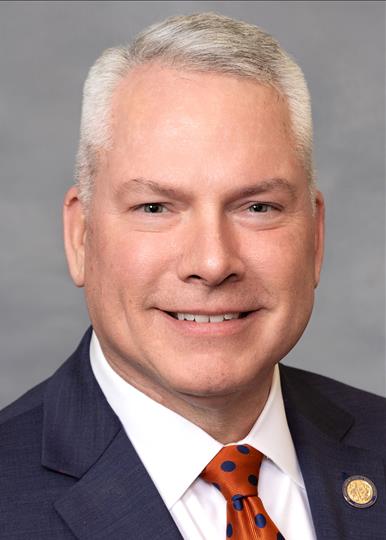
Rep. Grant Campbell
Sponsored bills
Maddy summaryHouse Bill 272, known as "The Sergeant Mickey Hutchens Act," allows certain law enforcement, probation/parole, and correctional officers in North Carolina to purchase additional retirement service credit. Officers who hold an advanced law enforcement or corrections certificate and have at least five years of membership service can buy up to four years of creditable service. This purchase applies to members of the Teachers' and State Employees' Retirement System or the Local Governmental Employees' Retirement System. To do so, they must pay a lump sum covering the full cost of the increased retirement system liability and an administrative fee, with the option for their employer to contribute to this cost.
Maddy summaryHouse Bill 670 establishes the Career and College Pathways Innovation Challenge Grant Program, providing competitive grants to North Carolina community colleges. These grants support local and regional partnerships that aim to increase postsecondary enrollment and completion for students and adults, align educational offerings with workforce needs, and reduce educational opportunity gaps. The State Board of Community Colleges administers the program, awarding funds for initiatives like work-based learning and financial support beyond tuition. For the 2025-2026 and 2026-2027 fiscal years, $2 million is specifically allocated to community colleges in counties affected by Hurricane Helene. The bill appropriates $5 million in recurring funds for the program, effective July 1, 2025.
Maddy summaryHB 695 amends the allocation of 911 funds to support the state's VIPER public safety radio network. This bill requires the 911 Board to allocate a minimum of 20% of total 911 service charges to the State Highway Patrol. These funds are designated for the support and maintenance of the VIPER system, specifically for its role in 911 services, ensuring interoperability among 911 systems, and facilitating first responder dispatch. This change aims to enhance emergency communications and dispatch capabilities throughout the state and becomes effective July 1, 2025.
Maddy summaryThis bill revives and expands a program that allows eligible retired educators to return to work in high-need schools. It defines "high-need retired teachers" as beneficiaries of the Teachers' and State Employees' Retirement System who meet specific retirement and service criteria, and are reemployed by local boards of education. A key provision ensures that earnings from this reemployment do not count against post-retirement earnings limits, allowing these teachers to receive both their full retirement allowance and a salary. The Department of Public Instruction is tasked with certifying these teachers, and local boards must report their employment status to the Retirement System.
Maddy summaryHouse Bill 820 requires health benefit plans in North Carolina to provide coverage for early refills of prescription eye drops. This means insurers cannot deny a refill for a 30-day supply if at least 21 days have passed since the last fill, or if the patient has used 70% of the medication according to their healthcare provider's instructions. The bill also specifies that the requested refill must not exceed the total number of refills indicated on the original prescription. These requirements apply to all health benefit plans, including the State Health Plan, with an effective date of October 1, 2025, or the subsequent plan year.
Maddy summaryHB 114 (Employment Preference for Military Personnel) updates North Carolina's state employment policy to expand eligibility for hiring preference. It removes the requirement that military service must have occurred during a "period of war" and now includes active-duty service members, National Guard and Reserve members, and their spouses/dependents in the preference program. The bill ensures state departments, agencies, and institutions must grant hiring preference to qualifying individuals (including active-duty personnel during service) for all employment events like initial hires, promotions, and transfers. This change directly affects military service members, their families, and North Carolina state employers by broadening who qualifies for employment preference without wartime service restrictions.
Maddy summaryHB 671 establishes a four-year pilot program (2025-2026 through 2028-2029) that provides grants to North Carolina public high schools (grades 9-12) to form or support competitive speech and debate teams. Schools can receive up to $10,000 per team annually, covering coach stipends (capped at $2,500 for lead coaches and $1,500 for assistants) and competition expenses like travel and league fees. Participating schools must join the Tarheel Forensic League and National Speech and Debate Association, and the program allows students from schools without teams to join the nearest team (with students covering their own transportation). Funded by $500,000 yearly from the General Fund, the Department of Public Instruction will administer the program and report annually on grant usage and student academic outcomes.
Maddy summaryHB 893 limits how much North Carolina's Chiropractic Board can charge chiropractors for disciplinary actions, capping costs at $1,000 for settled cases and $3,000 for cases with a full hearing. It requires the Board to provide itemized cost breakdowns and refund any overcharges. The bill also mandates that the Board keep detailed, accurate meeting minutes, including summaries of public comments and vote records. These changes directly affect chiropractors facing disciplinary proceedings under the Board's jurisdiction.
Maddy summaryHB 1001 requires nursing programs approved by the North Carolina Board of Nursing to annually report specific data about graduates of their sexual assault nurse examiner (SANE) training programs. These programs must submit on October 1 each year the total number of graduates, each graduate's county of employment, and their planned or current workplace location. The bill directly affects approved nursing education programs, not patients or healthcare providers. This data collection begins on August 1, 2025, to help the Board track SANE workforce distribution. The North Carolina Board of Nursing may create rules to implement these reporting requirements.