

Maddy summaryHB 572 authorizes the Department of Military and Veterans Affairs to establish a statewide pilot program providing Electroencephalogram combined Transcranial Magnetic Stimulation (eTMS) treatment. This program is for veterans, first responders, and their immediate family members experiencing conditions such as substance use disorders, mental illness, sleep disorders, traumatic brain injuries, and PTSD. The Department will select a provider to create a network for in-person and off-site care, aiming for statewide access. Participants in the program will also receive neurophysiological monitoring, counseling, wellness programming, and access to a peer-to-peer support network. The selected provider must collect and report treatment outcomes and expenditures to the Department and legislative committees by September 15, 2026.
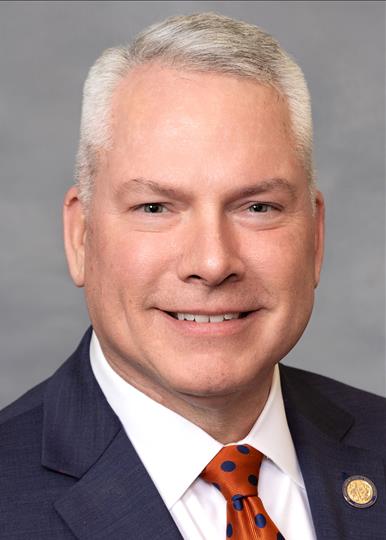
Rep. Grant Campbell
Sponsored bills
Maddy summaryHB 772, titled the North Carolina Student Lifeline Act, requires public schools and community colleges in North Carolina to provide students with the Suicide and Crisis Lifeline phone number. It mandates that institutions display the phrase "To reach the Suicide and Crisis Lifeline, call 988 or text HOME to 741741." in several locations. These locations include new student identification cards issued to students in grades six through 12, the school website, and the home screen of any electronic device issued to students. The information must also appear on school agendas or calendars, documents used during suicide awareness activities, and registration documents. Additionally, schools are required to annually verify the accuracy of the Lifeline contact information.
Maddy summaryHB 567, titled "Ensure Access to Biomarker Testing," mandates that North Carolina health benefit plans provide coverage for biomarker testing for the diagnosis, treatment, and monitoring of various diseases or conditions. This coverage is required when the testing is supported by medical and scientific evidence, such as FDA approval or nationally recognized clinical guidelines. The bill also prohibits insurers from denying coverage, raising premiums, or charging higher rates based on an individual's biomarker information. Additionally, it establishes a 24-hour timeline for insurers to complete utilization reviews for urgent healthcare services, aiming to improve access to diagnostic testing and care for North Carolinians.
Maddy summaryHouse Bill 741 authorizes the North Carolina Division of Motor Vehicles to issue "Military Veteran" special registration plates with a personalized background. The bill modifies the plate's design to specify that the name and insignia of the veteran's branch of service will appear on the left side. This change directly affects U.S. Military Veterans in North Carolina who are eligible for this special license plate. These personalized veteran plates will also be exempt from minimum application requirements typically needed for other special plates.
Maddy summaryHouse Bill 516, the "Motorcycle Road Guard Safety Act," creates a system allowing certified individuals to direct traffic for motorcycle groups. To become a motorcycle road guard, a person must be at least 18 years old, possess a valid driver's license, and successfully complete a certification course developed by the Division of Motor Vehicles. Certified road guards must meet specific safety standards and are required to notify and obtain consent from the chief of police in each city where they plan to direct traffic. The Division of Motor Vehicles will adopt rules to implement these new provisions.
Maddy summaryHB 92, titled the "NC Digital Assets Investments Act," authorizes the North Carolina State Treasurer to invest various state funds in qualifying digital assets. This includes funds from the General Fund, Highway Fund, and numerous retirement and special funds. The bill specifies that eligible digital assets must be exchange-traded products with an average market capitalization of at least $750 billion over the preceding 12 months. Additionally, investments in digital assets cannot exceed 10% of a fund's balance, and the State Treasurer must use a defined "secure custody solution" if managing these assets internally.
Maddy summaryHB 156 sets minimum standards for stop loss, catastrophic, and reinsurance coverage provided to small employers in North Carolina. It directly affects small employers (defined as those with fewer than 12 eligible employees) and insurers selling these specific insurance products. The bill requires insurers to maintain a minimum annual attachment point of $20,000 per individual (adjusted annually using the Consumer Price Index) and a minimum aggregate attachment point of either 120% of expected claims or $20,000 per year. These standards apply to all new, renewed, or amended insurance contracts issued on or after October 1, 2025.
Maddy summaryHB 512 creates an exemption to the practice of veterinary medicine for emergency medical services (EMS) personnel. This allows EMS personnel, excluding dispatchers, to provide emergency medical transport and services to injured K-9 police animals or certified search and rescue dogs at an emergency scene. The bill also grants limited immunity from prosecution for EMS personnel who act in good faith when providing such care. However, this immunity does not extend to gross negligence, wanton conduct, or intentional wrongdoing.
Maddy summaryHouse Bill 146 amends North Carolina's driver's license renewal process. It allows active duty members of the U.S. Armed Forces, or reserve components serving on active duty and stationed outside North Carolina, to renew their driver's licenses remotely multiple times in a row. Currently, a remote renewal requires the previous renewal to have been done in person, but this bill removes that restriction for eligible military personnel. This change aims to make it easier for these individuals to maintain their licenses while serving away from the state. The act becomes effective October 1, 2025, applying to licenses renewed on or after that date.
Maddy summaryHB 254 designates the fourth Thursday of March each year as Tuskegee Airmen Commemoration Day in North Carolina. This officially recognizes and honors the legacy of the African-American pilots, navigators, bombardiers, instructors, and support staff who trained at Tuskegee Institute from 1941 to 1949.