

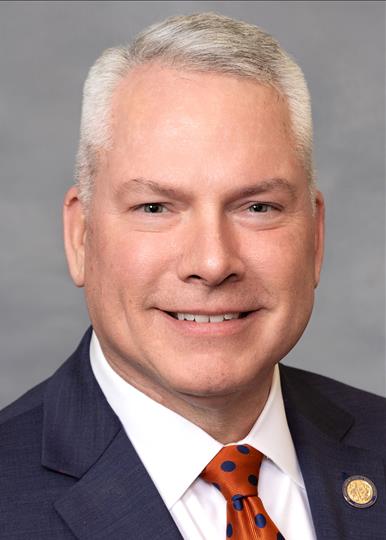
Photo of Grant Campbell
R North Carolina House · District 83 On the 2026 ballot

Rep. Grant Campbell

Compare
Total votes
481
all sessions
Attendance
91%
43 missed
Near the chamber average
With party
99%
of cast votes
Near the chamber average
Bipartisan score
0%
crosses aisle rarely
Near the chamber average
Sponsored
162
bills & resolutions
Near the chamber average
Committees
10
assignments
162 bills and resolutions

Sponsored bills

Total
162
Primary
43
Co-sponsor
119
This page
162
matching current filters
Co-sponsor HB 1124
died · North Carolina House · Co-sponsor
Interstate Compact for School Psychologists.

Maddy summaryThis bill establishes an Interstate Compact for School Psychologists in North Carolina, allowing licensed professionals to practice in other participating states without facing repetitive licensing requirements. The legislation creates a commission to oversee the agreement and defines specific rules for mobility, including provisions for military families and standards for professional conduct. Additionally, the bill allocates funds to support a virtual training program for school psychologists. By streamlining the licensure process, the measure aims to increase the availability of qualified mental health services in schools across member states.

died Jun 2, 2026 1 co-sponsor
Co-sponsor HB 1089
Signed into law · North Carolina House · Co-sponsor
Constitutional Amendment Property Tax Levy Limit.

Maddy summaryThis bill proposes a constitutional amendment that would require the North Carolina legislature to establish a statewide limit on how much local property tax levies can increase each year. The measure also mandates that any local government wanting to raise property taxes beyond this limit must first obtain approval from a majority of voters in that specific area. Because this change alters the state constitution, it will not take effect immediately but will instead be placed on the November 3, 2026, ballot for voters to decide whether to adopt. If approved by the public, the amendment would legally bind the General Assembly to create the specific tax increase caps mentioned in the text.

Signed into law May 21, 2026 1 co-sponsor
Co-sponsor HB 1110
In committee · North Carolina House · Co-sponsor
Early Intervention School Attendance Pilot.

Maddy summaryThis bill establishes a two-year pilot program in North Carolina to test data-driven systems aimed at reducing chronic absenteeism, which currently affects one in four public school students. The Department of Public Instruction will select a single public school unit serving up to 15,000 diverse students to implement a vendor-provided platform that offers real-time monitoring, automated family communication, and targeted intervention strategies. Appropriated funds totaling $75,000 will cover technology costs, staff training, and program evaluation, with the pilot running from the 2026-2027 fiscal year through the 2027-2028 fiscal year. By the end of the program, the department must report findings on attendance improvements and operational efficiencies to determine if the initiative should be expanded statewide.

In committee May 19, 2026 1 co-sponsor
Co-sponsor HB 1019
Passed · North Carolina House · Co-sponsor
Mike Clampitt 1st Responder Tax Fairness Act.

Maddy summaryThis bill, known as the Mike Clampitt 1st Responder Tax Fairness Act, aims to expand tax exemptions for volunteer fire departments and rescue squads in North Carolina. Specifically, it allows these independent groups, which have two or fewer paid employees and are already exempt from state income tax, to avoid paying a highway use tax on specific emergency vehicles like fire trucks, forest firefighting units, and other emergency service vehicles. The change applies to vehicles when a certificate of title is issued on or after July 1, 2026, ensuring these organizations can acquire necessary equipment without incurring this particular tax. By broadening the existing exemption, the legislation directly benefits volunteer responders who operate outside of local government units.

Passed May 18, 2026 1 co-sponsor
Co-sponsor HB 1154
In committee · North Carolina House · Co-sponsor
Expand the FarmSHARE Food Hub Program.

Maddy summaryThis bill allocates $6 million in state funds to expand two food assistance programs in North Carolina for the 2026-2027 fiscal year. The first $4 million supports FarmSHARE, which provides grants to buy locally grown food and distribute it for free to food-insecure individuals and households. The second $2 million funds the Double Up Food Bucks Program, allowing people receiving nutrition assistance to use their benefits to purchase fresh fruits and vegetables at farmers markets and other local retailers. Both programs require the state department to submit annual reports detailing participation numbers, distribution metrics, and financial data to legislative oversight committees. The legislation takes effect on July 1, 2026.

In committee May 13, 2026 1 co-sponsor
Co-sponsor HB 1193
In committee · North Carolina House · Co-sponsor
Rep. Mike Clampitt Bone Marrow Donation Act.

Maddy summaryHB 1193, known as the Mike Clampitt Bone Marrow Donation Act, designates November as Marrow Donation Awareness Month in North Carolina. The bill requires the Department of Health and Human Services and the Department of Motor Vehicles to promote bone marrow donation by posting public service announcements online and displaying them at driver license offices. Additionally, the legislation appropriates $100,000 to fund a state-wide public awareness campaign for this initiative, with the law taking effect on July 1, 2026.

In committee May 12, 2026 1 co-sponsor
Primary HB 1074
In committee · North Carolina House · Lead sponsor
Prescription Drug Expenses Tax Deduction.

Maddy summaryThis North Carolina bill allows taxpayers to deduct up to $5,000 of unreimbursed costs for prescribed medications and pharmacy fees from their state income tax. The deduction applies to expenses not covered by tax-advantaged accounts like Flexible Spending or Health Savings Accounts and prevents double-dipping if a federal deduction is already claimed for the same year. Effective for tax years starting on or after January 1, 2026, the measure directly affects individuals paying out-of-pocket for prescription drugs who itemize their state taxes.

In committee May 12, 2026 0 co-sponsors
Co-sponsor HB 1090
In committee · North Carolina House · Co-sponsor
Revitalizing, Uplifting Regions and Access Local (RURAL) Care Act.

Maddy summaryThis bill creates a new Rural Healthcare Infrastructure Fund in North Carolina to help build, repair, and modernize healthcare facilities in rural areas. The fund will provide money through grants and low-interest loans to support construction and renovation projects, while also replacing an older stabilization program. A state council must first develop and get approval for a detailed plan outlining how the fund will be managed and who can apply before any money is awarded. The bill also updates the duties of the state health council and requires annual reports on how the fund is being used.

In committee May 12, 2026 1 co-sponsor
Co-sponsor HB 1198
In committee · North Carolina House · Co-sponsor
Sexual Assault Nurse Examiners Nurses Data/Registration Information Requirements.

Maddy summaryThis North Carolina bill requires training programs for sexual assault nurse examiners to submit annual reports to the state Board of Nursing regarding graduate employment details. It also mandates that active nursing licensees register with the Board to provide and update their training credentials and practice locations. The legislation creates a database for this information and allocates $50,000 to help the Board implement these reporting requirements. These changes take effect in 2026 and apply to active nurses and their training programs within the state.

In committee May 5, 2026 1 co-sponsor
Co-sponsor HB 1156
In committee · North Carolina House · Co-sponsor
Wastewater Design Flow Modifications.

Maddy summaryThis bill allows wastewater treatment system operators in North Carolina to calculate sewage flow rates for new homes at a lower standard of 55 gallons per day per bedroom, provided the state environmental department approves the change based on local usage data. Under the new rules, operators must still ensure that reducing the flow rate does not harm public health or the environment, while systems without allocated capacity for future connections must continue using the standard rate of 75 gallons per day per bedroom. To support these changes, the state will allocate $10,000 to the Department of Environmental Quality in the 2026-2027 fiscal year to review and evaluate the proposed lower flow rates. The legislation is set to take effect on July 1, 2026.

In committee May 4, 2026 1 co-sponsor
Showing 21 to 30 of 162 bills
Previous 1 … 2 3 4 … 17 Next